

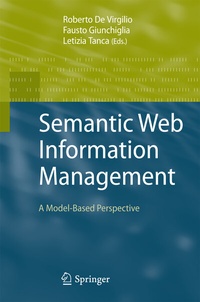
Semantic Web Information Management
Description

Databases have been designed to store large volumes of data and to provide efficient query interfaces. Semantic Web formats are geared towards capturing domain knowledge, interlinking annotations, and offering a high-level, machine-processable view of information. However, the gigantic amount of such useful information makes efficient management of it increasingly difficult, undermining the possibility of transforming it into useful knowledge.
The research presented by De Virgilio, Giunchiglia and Tanca tries to bridge the two worlds in order to leverage the efficiency and scalability of database-oriented technologies to support an ontological high-level view of data and metadata. The contributions present and analyze techniques for semantic information management, by taking advantage of the synergies between the logical basis of the Semantic Web and the logical foundations of data management. The book's leitmotif is to propose models and methods especially tailored to represent and manage data that is appropriately structured for easier machine processing on the Web.
After two introductory chapters on data management and the Semantic Web in general, the remaining contributions are grouped into five parts on Semantic Web Data Storage, Reasoning in the Semantic Web, Semantic Web Data Querying, Semantic Web Applications, and Engineering Semantic Web Systems. The handbook-like presentation makes this volume an important reference on current work and a source of inspiration for future development, targeting academic and industrial researchers as well as graduate students in Semantic Web technologies or database design.
Reviews / Votes
From the reviews:
"The book . explores the topics of storage, reasoning, and querying, as well as applications and engineering methods for semantic web systems. . The book is useful for newcomers to the field, as well as for experienced researchers, who want to review or explore recent approaches. The bibliography will serve as a source for relevant works to deepen the investigations. . Overall, the book is an excellent resource for researchers and practitioners, which presents and analyses the challenges and recent techniques on semantic information management." (Alejandra Gonzalez-Beltran, Informer, January, 2012)More details
Other editions
Additional editions
Persons
Roberto De Virgilio is with Università di Roma Tre as PostDoc fellow under the supervision of Riccardo Torlone. The last years his research focuses on Semantic Web information management at different levels of abstraction.
Fausto Giunchiglia is professor of computer science at the University of Trento, Department of Information and Communication Technology, ECCAI Fellow. His research has covered many different areas: knowledge representation, context and reasoning with context, knowledge management and peer-to-peer knowledge, semantic web, formal methods, theorem proving, and model checking.
Letizia Tanca is a full professor with Politecnico di Milano. Her research interests range over all database theory, especially on deductive, active and object oriented databases, graph-based languages for databases, and the semantics of advanced database and information systems, representation and querying of semistructured information. Her most recent research interests concern context-aware database design, data integration, schema evolution, mobile databases and very small databases for mobile devices.
