

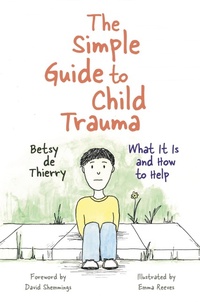
The Simple Guide to Child Trauma
What It Is and How to Help
Published on 21. September 2016
80 pages
978-1-78450-401-4 (ISBN)
Description

? What is trauma?
? How does it affect children?
? How can adults help?
Providing straightforward answers to these complex questions, The Simple Guide to Child Trauma is the perfect starting point for any adult caring for or working with a child who has experienced trauma. It will help them to understand more about a child's emotional and behavioural responses following trauma and provides welcome strategies to aid recovery. Reassuring advice will also rejuvenate adults' abilities to face the challenges of supporting children.
? How does it affect children?
? How can adults help?
Providing straightforward answers to these complex questions, The Simple Guide to Child Trauma is the perfect starting point for any adult caring for or working with a child who has experienced trauma. It will help them to understand more about a child's emotional and behavioural responses following trauma and provides welcome strategies to aid recovery. Reassuring advice will also rejuvenate adults' abilities to face the challenges of supporting children.
Reviews / Votes
In this accessible, enlightening little book, Betsy de Thierry recognises both the need to advocate for young people who have experienced trauma and to resource the adults in homes and schools who care for them. Emphasising the need for compassionate, relational responses to these often misunderstood young people, Betsy offers an array of practical strategies and insights to enable those responses, whilst conveying her core subject with confidence and clarity. An important, generous and timely publication. -- Louise Michelle Bomber, Strategic Attachment Lead Teacher & Therapist As a parent myself I have found this book to be such a useful tool. To have a basic understanding of how the brain works has given me greater confidence as a parent in handling my children calmly and remaining empathetic even when I don't always understand the reasons behind their behaviour. I value the comprehensible and practical tips that are listed in this book of how you can develop the connection and healing relationship with the child in your care. It's beautifully written with such profound insight that is essential for any caring person working with children. -- Dannii Gray, Parent This book is easy to read using plain, clear language - free of jargon. It has really helpful suggestions that could be used in both professional and home settings. -- Liz Hall, Parent and Police Child Protection Investigator and Trainer Simplifying and condensing the complex world of childhood trauma into tangible, easy to grasp terms, de Thierry shows her mastery of the field in this handy guide. Her conversational style translates the neuroscience of trauma into supportive, concrete steps that any helping adult can apply to the children in his or her life. Empathy for the reader and patience for these vulnerable youth are ever-present as de Thierry herself models the restorative power of relationships. Such a hopeful and comforting read! -- Kendra Morris-Jacobson, Oregon Post Adoption Resource Center (ORPARC) What this 'simple guide' does elegantly and quickly is bring a large amount of research - from psychology, social work, neuroscience, biochemistry and genetics - directly to the busy but interested professionals, parents and carers working in this field. It translates complex ideas into 'practice-rich' language for adults who need to understand the inner worlds of children, rather than simply explore their 'wishes and feelings'. -- From the foreword by Professor David Shemmings OBEMore details
Edition
Digital original
Language
English
Place of publication
London
United Kingdom
Target group
College/higher education
Professional and scholarly
Edition type
Digital original
Illustrations
7 b&w illustrations
ISBN-13
978-1-78450-401-4 (9781784504014)
Copyright in bibliographic data and cover images is held by Nielsen Book Services Limited or by the publishers or by their respective licensors: all rights reserved.
Schweitzer Classification
Other editions
Additional editions
Book
09/2016
Jessica Kingsley Publishers
€16.50
Shipment within 15-20 days
Persons
Betsy de Thierry is a practising psychotherapist and with over 30 years of experience and knowledge within the field of Complex Trauma & navigating Trauma Recovery. She is the founder of Trauma Recovery Global, which provides training and consultancy and partnerships with select organisations and practitioners to licence her Trauma Recovery Focused Model (TRFM) in 34 nations. She is also the founder of the Trauma Recovery Centre (TRC), a charity specialising in recovery from complex trauma and the founder of CTRN (Childhood Trauma Recovery Network UK). Betsy is also a qualified primary school teacher and is a mum of four brilliant sons. David Shemmings is Professor of Social Work in the School of Social Policy, Sociology and Social Research at the University of Kent. He undertook his PhD in attachment theory, and has spent most of his working life in the field of child protection. David was awarded an OBE in the Queen's Birthday Honours list in June 2014 for 'Services to Child Protection'.
Content
- Intro
- The Simple Guide to Child Trauma - What It Is and How to Help by Betsy de Theirry
- Foreword
- Introduction
- 1. Understanding Trauma
- Stress, crisis and trauma
- What is trauma?
- Children soak up what's around them
- What kind of things can cause trauma to affect children?
- Children find words really tough to use
- What can you do when children have become traumatised?
- 2. The Impact of Trauma
- How does trauma affect behaviour, relationships, learning, thinking, feeling and doing?
- What fires together, wires together
- The recovery process
- What you could do
- 3. Helping a Child Become Calm
- How to help a child self-regulate
- Our own strong feelings
- 4. Frustrating Behaviours from Traumatised Children
- Attention-seeking
- Anger
- Being 'zoned out'
- Hyperactive
- Controlling
- 5. Key Approaches to Help Children Recover
- Empathy
- Kindness
- Patience
- Thinking the best/not taking it personally
- Being kind to yourself
- Having some special time with a child one to one
- Getting help when you can
- Thoughts and tips from other people
- 6. Important Things to Consider when Trying to Facilitate Recovery
- Resilience
- Attachment
- Saying sorry
- Their behaviour
- 7. Getting Your Head around the Different Therapies on Offer
- Conclusion
- References
- Recommended Further Reading
- Helpful Organisations and Resources to Support You as You Support a Traumatised Child or Young Person
- Index
