

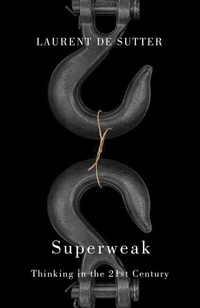
Superweak
Description

Today, however, the critical project shows signs of exhaustion. We are beginning to realize that being right is useless, now that everyone can lay claim to the same power as we can. The democratization of reason, proceeding alongside the development of critique through modernity, has produced a stalemate: for every judgment that we pronounce, there is another opposing one - with grounds as solid as our own, and the same right to assert itself. Rather than elevating us above the world, critique has mired us in an impasse of claim and counter-claim.
The age of critique is now over, argues Laurent de Sutter, and in its place we need to develop a postcritical form of thinking, one he calls "superweak," a form of thinking based not on establishing grounds, pronouncing judgment, and determining duty, but on welcoming possibility, exploring what the world has to offer, and cultivating a vertiginous appreciation for moving within a world less grounded and less bounded by the terms of critical reason.
More details
Other editions
Persons
Content
Introduction
Kratè
1. A brief encounter at Ichij -ji
2. The posture of Musashi
3. A surplus of strength
4. Critique and modernity
5. Reason: being right
6. Virality of critique
7. Five weaknesses
8. We are the detritus
9. Kant fatigue
10. Beyond
Book I
Phusis
11. What is critique?
12. Subjects with an attitude
13. Being, at the limit
14. Modes of life
15. For an ethics of the dandy
16. Incorporating the aesthetic
17. Giudizio and gusto
18. Logic of incarnation
19. The ordeal of judgment
20. Of defiance
21. The time of reflection
22. Two forms of reason
23. Haptics of merit
24. Mirror, mirror, on the wall
25. Epistémè aisthètikè
26. What matters
27. To judge well
28. The form of the limits
29. First antinomy of critique
30. The imperative of reason
31. How to overcome philosophy
32. History of intussusception
33. Hand to hand, body to body
34. Distrust...
35. The life and death of superheroes
36. Every human being is an artist
37. Punk philosophy
38. Beyond place
39. The precarious of all lands
40. Kryptonite hypothesis
41. Censure, my fine care
42. Tetsugaku and bimyôgaku
43. What is kokoro?
44. Critique against critique
45. Too disgusted
46. Portrait of No-Face
47. Chez Panisse
48. Coprology of critique
49. Dancing in your head
50. Proposals for a poetics of excarnation
Book II
Archè
51. Architectonics of thought
52. A question of principles
53. The right to power
54. What comes from below
55. Cosmic anarchy
56. Surveilling the world
57. Now, dig!
58. One must make distinctions
59. Back to the basement one started from
60. For a decomposed architecture
61. A world of constraints
62. Of deconstruction
63. The shithouse stage of design
64. Functionalism of critique
65. To be and to be duty-bound
66. Phantoms against phantoms
67. Kindly pay in advance
68. Freemasonry & Co.
69. Spirit, are you there?
70. Just anything
71. Who's to blame
72. Ever more
73. Green cabbage and cabbage green, or, Six of one, half dozen of the other
74. Second antinomy of critique
75. Ergründen and Abgründen
76. Running out of steam
77. Ground zero
78. Factishes of all lands...
79. This is inadmissible
80. Elements of anarchic cosmology
81. To infinitize again
82. Adieu to philosophy
83. The weather takes a turn for the worse
84. Delete as appropriate
85. Method of the madness
86. Quite presumed
87. The Blade
88. Each time unique, the beginning of the world
89. Less than nothing, more than everything
90. Maximalist manifesto
Book III
Nomos
91. I think, therefore I judge
92. From dikazein to krinein
93. Putting order into effect
94. The institution of crisis
95. Politics of philosophy
96. Servants of the nomos
97. To death!
98. Cui bono
99. Inquisition everywhere, justice nowhere
100. On the guarantee
101. Green cabbage and cabbage green, or, Six of one, half dozen of the other (2)
102. Critique of prejudicial reason
103. The Treaty of Osnabrück
104. The origins of geometry
105. Force of rule
106. At the limit
107. Kant surveyor
108. Necessity of the Bestimmung
109. Third antinomy of critique
110. What is necessary is necessary
111. Lethal Weapon
112. Dikaian krisis krinate
113. Listen to the logos
114. Cosmic shortcut
115. Behind the truth
116. The engineering of Creation
117. Onward and upward!
118. After the law
119. One does not know what one can do
120. Ever new
121. Introduction to jurifuturism
122. Protasis and apodosis
123. Post-truth
124. To work!
125. Everything you always wanted to know about modernity, but were afraid to ask
126. How does one evolve in chaos?
127. Kekkai
128. On the other side
129. Cosmopoetics and transnodality
130. Postface to transgression
Book IV
Gramma
131. Alas!
132. Ludology of reality
133. Ow, ow, ow!
134. The madman and the poet
135. From the book to the Book
136. Controversy surrounding faith
137. There is only the outside of text
138. Including the unknowable
139. What one cannot talk about, one talks about all the same
140. The method of detection
141. All culpable
142. Redemption!
143. For an ugly realism
144. Thanatography
145. The shittiness of things
146. Semiology of irenicism
147. All language is fascist
148. There is no outside of text
149. Fourth antinomy of critique
150. To abjure language
151. Cherchez la fiction! Seek the fiction!
152. Silence, it's talking
153. Weird realism 2.0
154. It's implausible!
155. From top to bottom
156. Uncertainties and inconsistencies
157. A little further to the east
158. Water Margin
159. A history without end
160. Comic of lucidity
161. Anti-vitalism
162. Toward objectality
163. An encounter
164. To become poem
165. Of life in the fore-worlds
166. Still and always
167. In praise of space opera
168. More than anything
169. Assholes & Co.
170. Infrastructuralism redux
Book V
Epistémè
171. Politics of the boudoir
172. Libido sciendi
173. The art of striptease
174. Mehr Licht!
175. Program for a policing of the hole
176. You won't fool me there
177. Porn rationalism
178. On cretinism as a postulate
179. Algorithmic anthropology
180. The solitude of reason
181. Cherchez la forme! Seek the form!
182. The product of a minus and a minus is a plus
183. What is an argument?
184. Theory of the therefore
185. Introduction to the catu ko i
186. How it works
187. Dialetheic manifesto
188. Fifth antinomy of critique
189. The non-duped err
190. Postcritique 1.0
191. Prolegomena to general semantics
192. For a quantum thought
193. Beyond reality
194. What the gods do
195. May be
196. Brrrr!
197. Menace contra menace
198. Mobilis in mobile
199. Questions of scale
200. Anything goes
201. To stir shit up
202. Il pensiero debole, or, weak thought
203. Return to...
204. In praise of departure
205. What if... ?
206. It's too easy
207. The coming infrastructuralism
208. Another chaos is possible
209. Who cares
210. Royal flush
Epilogue
Sophia
211. A wooden sword
212. Once critique, always critique
213. In the zone
214. Everything happens
215. Toward a new obscurantism
216. Take a chance, give it a try
217. So that was it!
218. Acceleration!
219. To be done with the assholes
220....
Acknowledgments
Notes
INTRODUCTION
Kratè
§1
A brief encounter at Ichijo-ji
"I only have one thing to teach you, and it is this: you are too strong. Do you understand me, Musashi? The way of the sword is the way of man. Being strong doesn't last forever. You are too strong. Truly, you are too strong." Miyamoto Musashi turned pale. Each of the words the monk threw in his face struck him like the blows without count that he had rained down upon others - but he did not understand why they should affect him so. All his life, he had trained to master the art of the sword so that he could defeat and triumph over any who dared face him in combat. He succeeded and became the greatest swordsman in Japan. Yet the taunts of the monk rekindled the doubt that he had smothered one day long ago. He had thought that the way of the katana required him to master every gesture, every breath; he had become the very sword he used to cut down his adversaries. Even as it meted out death, the sword brought life to the one who seized upon its energies and its curves, its plenitude and its void, its beginning and its end - or so Musashi had thought. But with a few words, the monk had reduced this self-certainty to nothing; the unyielding strength the young ronin had learned to cultivate was transformed into a wince - worse: it assumed the face of the very impasse that the discipline of the sword should allow one to avoid. Musashi trained to become Japan's most powerful samurai - but in achieving this, he had lost all access to the way of life to which he aspired. In becoming too strong, he had lost life as such. All this time, he had failed to grasp the most elementary lesson: that life is not a question of strength - indeed: that it is the contrary of all strength. In life, one never wins; in life, triumph is a vanity - as is the greatness one hopes to derive from it.
§2
The Musashi posture
When Yoshikawa Eiji wrote his epic romance of Musashi's life1 and decided to include the encounter with the monk Nikkan, it was as a sort of moral fable. To the furious arrogance of the ronin, he wanted to oppose the ironic wisdom of a Buddhist monk, to suggest that wisdom, if it exists at all, must pass through an examination from the outside, an exterior to our obsessions. But it was a fable whose scope went far beyond a simple lesson in balance and modesty: it implied a general relation with the world. Underscoring the vanity of strength, suggesting that life is in the first instance a defeat, sneering at the possibility of greatness - collectively, these indicate a posture, a physical and mental position. One might say there is a "Musashi posture" proper to all individuals standing up and facing the world as if they expect it to justify itself to them - even if it ends up crushing them just like anyone else. This posture was not exclusive to Japan at the start of the twentieth century, to its aggressive desire for death, or to the spirituality it sought in its syncretism of Shinto, Buddhism, and philosophical thought. It was a posture that could be found wherever issues of truth, beauty, or action were interpreted in the manner of a physics equation, in which it is only the forces that are present that count. Between the Japan of the Showa era (when Yoshiwara wrote) and that of the Edo period (when Musashi lived), a temporal arc embracing all of modernity could be traced. To this temporal arc, one might add a geographical one, starting from Japan and encompassing the entire globe: an arc which would define a zone of the arrogance of strength and the forgetfulness of life. This double arc, it must be said, was, and still is, the one within which we think.
§3
A surplus of strength
The age in which we live - however we understand this "we" - bears witness to the triumph of the Musashi posture. Wherever an equanimity, intelligence, or reconciliation with a world larger than us prevails, the same obsession with strength is in evidence. This obsession, however, does not direct itself upon the means through which humanity might crush or destroy; it is not an obsession with the violence or pollution that has marked almost the entirety of its history. Rather, it is the obsession with the possibility of detaching oneself - an obsession with creating a space situated somehow above the mediocrity of our fellow human beings, their morbid impulses, and their senseless actions. The strength of one who wins every time is a strength whose prime characteristic is that it encounters no real resistance: it is a literally inexorable strength - a surplus of strength. We have, in fact, become superstrong. There can be nothing placed before our eyes or submitted to our curiosity that is not subject to an examination in which we alone are judge, jury, and executioner, and with no possibility of appeal. Nothing can resist us: the greatest work of art, the most heroic action, the noblest enterprise, the most impeccable figure - their superlativeness pertains only so long as we grant that it be so. Each of us, everywhere in the world, whatever our wealth or poverty, our culture or our ignorance, our effective power or lack of the same - we are stronger than all. Superstrength is the contemporary condition of human being - a condition of thought, a way of looking and reflecting, a system of evaluation. Above all, it is a space: a sort of mental gymnasium where, like Musashi, we move our warrior body with the same pitilessness as the ronin felt for his adversaries.
§4
Critique and modernity
One might well ask if there was something new in the human obsession with strength - even dating it back to the dawn of modern times. It is a notable fact, however, that the era in which Musashi fought duel upon duel was also the era in which, on the other side of the globe, a philosophical project was launched which took strength as its explicit object. This was the project of critique, a project of great prestige and certainly among the greatest theoretical successes of modernity. There is even something of a synonym there: modernity could only ever be a critical modernity. From its birth at the end of the sixteenth century, the critical project spread first in literate circles, then in popular ones, until it constituted the fundamental basis of everything that matters to contemporary society: education, the press, politics, the arts, and so on. From theater to design, from political theory to rhetoric, from literature to the social sciences, the critical project constitutes the default system for all thought processes enjoying any degree of respectability. Historians, for their part, have shown the importance of the role it played in their original conception, their development, and their evolution - how it was decisive in opening up an exit ramp from the age of religious, political, and scientific dogma.2 Absent the possibility of critical thought, we would forever be delivered over, bound and tied, to the power of authorities who, in the name of God, the Law, or the True, claim the capacity to distinguish the thinkable from the unthinkable, the possible from the impossible, the sayable from the unsayable. If modernity can be defined as the journey we have undertaken in our move away from dogmatics, then critique must be accorded its due praise. This merit, however, scarcely conceals a difficulty, a problem, a whispering unsettlement - one that ever more insistently arises from the overthrow of dogmatism and the restitution, to each person, of the authority to think. Authority - in other words, strength.
§5
Reason: being right
Critique is the materiel of superstrength. The absolute omnipresence of critique compels this assessment in all domains of the thinkable - therefore also of the sayable, and therefore also of the possible. It is thanks to critique that our gaze, our palate, our hearing, our sense of touch, indeed the whole panoply of our senses, encounter the phenomena within their scope as inferiors - as migrants, as it were, subject to our validation. Faced with a world of things and sensations, it is we who have the power to decide what is worthy and what is not, what is acceptable and what is not, what is beautiful or what is not - even if we qualify our judgment as pertaining "for me." In actuality, it is never merely "for me" that we judge. If we judge, it is for the very fact of judging - it is because our regime of thought is now entirely structured by the logic of judgment.3 If critique is the materiel of superstrength, this is because we no longer possess any other; its omnipresence, within the space of the thinkable, has crushed all possibility of assuming any posture other than that of Musashi. In rejecting the authority of dogmas, the moderns have wholly submitted themselves to an anti-dogma, as one would speak of an antipope: the anti-dogma of reason - the ordering of thought in accordance with the possibility of being right. By defending a new conception of reason, critique has resulted above all in defending the capacity of reason to triumph over everything that is not reason - or, to be more precise, to triumph over everything that fails to conform to the functional specifications that support...
