

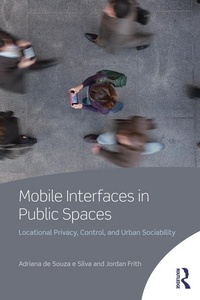
Mobile Interfaces in Public Spaces
Locational Privacy, Control, and Urban Sociability
1st Edition
Published on 23. April 2012
224 pages
978-1-136-34257-8 (ISBN)
Description

Mobile phones are no longer what they used to be. Not only can users connect to the Internet anywhere and anytime, they can also use their devices to map their precise geographic coordinates - and access location-specific information like restaurant reviews, historical information, and locations of other people nearby. The proliferation of location-aware mobile technologies calls for a new understanding of how we define public spaces, how we deal with locational privacy, and how networks of power are developed today.
In Mobile Interfaces in Public Spaces, Adriana de Souza E. Silva and Jordan Frith examine these social and spatial changes by framing the development of location-aware technology within the context of other mobile and portable technologies such as the book, the Walkman, the iPod, and the mobile phone. These technologies work as interfaces to public spaces - that is, as symbolic systems that not only filter information but also reshape communication relationships and the environment in which social interaction takes place. Yet rather than detaching people from their surroundings, the authors suggest that location-aware technologies may ultimately strengthen our connections to locations.
In Mobile Interfaces in Public Spaces, Adriana de Souza E. Silva and Jordan Frith examine these social and spatial changes by framing the development of location-aware technology within the context of other mobile and portable technologies such as the book, the Walkman, the iPod, and the mobile phone. These technologies work as interfaces to public spaces - that is, as symbolic systems that not only filter information but also reshape communication relationships and the environment in which social interaction takes place. Yet rather than detaching people from their surroundings, the authors suggest that location-aware technologies may ultimately strengthen our connections to locations.
Reviews / Votes
"Mobile Interfaces in Public Spaces presents an insightful analysis of how mobility affects behavior in public settings, and how public settings affect communication behavior. The authors cast their net broadly, encompassing a range of significant issues including voice and sound, privacy and publicity, and norms and policies." -James E. Katz, Professor of Communication and Director of the Center for Mobile Communication Studies, Rutgers University'An incredibly clear and useful guide to how mobile technologies are re-shaping our connections to locations and to other people. In considering devices that range from the paperback book to the portable music player to the smartphone as different kinds of "interfaces" with public space, the authors offer great insight into how we filter, control, and manage our relations with spaces and social situations that blur the boundaries between private and public. This is a much-needed contribution to the literature on the new location-based technologies that will become increasingly significant in the coming decade. Consider it an operating manual for the future.' - Mimi Sheller, Professor of Sociology and Director of the Mobilities Research and Policy Center at Drexel University
'Mobile Interfaces in Public Spaces is an historically situated and nuanced account of the role interfaces - from books and Walkmans to iPods and mobile phones - play in our relationships to self, others and everyday urban life. Connecting contemporary practice with classic social theory, this evocative and engaging book is a much needed contribution to this cutting edge field of research.' - Heather A. Horst, RMIT University, Australia
'Highly recommended...In this thought-provoking volume, Silva and Frith consider the impact of location-aware mobile technologies on the human sense of identity, privacy, and control in public spaces. The authors effectively address this emerging area of scholarship, providing insight and discussing relevant theory...Extensively sourced and well written, this engaging title, part of the "Routledge Research in Cultural and Media Studies" series, is a welcome addition to the scholarship in this area.' - CHOICE magazine, D. D. Tritt, University of South Carolina Aiken, USA
More details
Language
English
Place of publication
London
United Kingdom
Publishing group
Taylor & Francis Ltd
Target group
College/higher education
Illustrations
18 s/w Photographien bzw. Rasterbilder
18 Halftones, black and white
File size
2,29 MB
ISBN-13
978-1-136-34257-8 (9781136342578)
Copyright in bibliographic data and cover images is held by Nielsen Book Services Limited or by the publishers or by their respective licensors: all rights reserved.
Schweitzer Classification
Other editions
Additional editions
Adriana De Souza E. Silva
Mobile Interfaces in Public Spaces
Locational Privacy, Control, and Urban Sociability
Book
05/2014
Routledge
€208.48
Shipment within 10-20 days
Adriana de Souza e Silva | Jordan Frith
Mobile Interfaces in Public Spaces
Locational Privacy, Control, and Urban Sociability
Book
03/2012
1st Edition
Routledge
€241.70
Shipment within 15-20 days
Adriana de Souza e Silva | Jordan Frith
Mobile Interfaces in Public Spaces
Locational Privacy, Control, and Urban Sociability
Book
03/2012
1st Edition
Routledge
€73.30
Shipment within 15-20 days
Persons
Adriana de Souza e Silva is Associate Professor in the Department of Communication at North Carolina State University. Her research focuses on how mobile and locative interfaces shape interactions with public spaces and create new forms of sociability. She is the co-editor of Digital Cityscapes: Merging Digital and Urban Playspaces, and co-author of Net-Locality: Why Location Matters in a Networked World,
Jordan Frith is a doctoral candidate in North Carolina State University's Communication, Rhetoric and Digital Media program. His main research interests are locative media and space, particularly how locative media may influence interactions in urban spaces. He has recently been published in the journals Mobilities and Communication, Culture, and Critique.
Jordan Frith is a doctoral candidate in North Carolina State University's Communication, Rhetoric and Digital Media program. His main research interests are locative media and space, particularly how locative media may influence interactions in urban spaces. He has recently been published in the journals Mobilities and Communication, Culture, and Critique.
Content
Introduction Part 1: Mobile Media History 1. Personalization 2. Privacy Part 2: Location-Awareness in Public Spaces 3. Mobile Phones 4. Location-Aware Media 5. Control and Personalization 6. Privacy and Surveillance 7. Conclusion
