

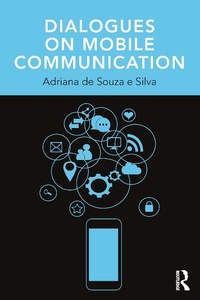
Dialogues on Mobile Communication
Published on 4. October 2016
244 pages
978-1-315-53459-6 (ISBN)
Description

In this book, top scholars in the field of mobile communication discuss the major issues related to the use of mobile phones in today's society, such as the tension between private and public, youth mobile culture, creative appropriations of mobile devices, and mobile methods. Each chapter unfolds as an open dialogue between scholars and graduate students of communication. They contain an introduction by a student, followed by a short lecture and a question and answer section with the students, and a closing statement by a student that responds to the scholar's argument. The book is a valuable resource not only for individuals interested in mobile communication, but also students and teachers willing to use the affordances of mobile media to expand the physical boundaries of classrooms and promote collaborative learning practices.
Reviews / Votes
This collection provides a very welcome and timely perspective on the thriving and fast developing field of mobile communication. Based on lectures by key figures in the field and ensuing discussions with researchers and students, the book preserves in an original manner, their dialogic format of production, and highlights different active directions of current research rarely brought together as a coherent whole. This far ranging and highly accessible book will provide a powerful resource for anyone interested in mobile studies - Christian Licoppe, Professor, Sociology of Information and Communication Technologies, Telecom ParistechThis volume treks across many research traditions and continents to deliver state-of-the-art insights on mobile communication studies. It also bridges the gap between research and pedagogy by putting leading figures in direct conversation with graduate students pushing on the frontiers of this expanding field. - Scott W. Campbell, Constance F. & Arnold C. Pohs Professor of Telecommunication, Department of Communication Studies, University of Michigan
More details
Series
Language
English
Place of publication
London
United Kingdom
Publishing group
Taylor & Francis Ltd
Target group
College/higher education
Product notice
Reflowable
Illustrations
8 Line drawings, black and white; 23 Halftones, black and white; 31 Illustrations, black and white
File size
4,00 MB
ISBN-13
978-1-315-53459-6 (9781315534596)
Copyright in bibliographic data and cover images is held by Nielsen Book Services Limited or by the publishers or by their respective licensors: all rights reserved.
Schweitzer Classification
Other editions
Additional editions
Adriana de Souza e Silva
Dialogues on Mobile Communication
Book
10/2016
1st Edition
Routledge
€243.40
Shipment within 10-20 days
Adriana de Souza e Silva
Dialogues on Mobile Communication
Book
10/2016
1st Edition
Routledge
€72.80
Shipment within 10-20 days
Person
Adriana de Souza e Silva is Associate Professor at the Department of Communication at North Carolina State University (NCSU), director of the Communication, Rhetoric and Digital Media (CRDM) PhD program at NCSU, and affiliated faculty at the Digital Games Research Center at NCSU. Dr. de Souza e Silva's research focuses on how mobile and locative interfaces shape people's interactions with public spaces and create new forms of sociability. She teaches classes on mobile technologies, location-based games and internet studies. Dr. de Souza e Silva is the co-editor (with Daniel M. Sutko) of Digital Cityscapes-Merging digital and urban playspaces (Peter Lang, 2009), and (with Mimi Sheller) of Mobility and locative media: Mobile communication in hybrid spaces (Routledge, 2014). She is the co-author (with Eric Gordon) of Net-Locality: Why location matters in a networked world (Blackwell, 2011), and (with Jordan Frith) of Mobile interfaces in public spaces: Control, privacy, and urban sociability (Routledge, 2012). She holds a Ph.D. in Communication and Culture from the Federal University of Rio de Janeiro, Brazil.
Content
Introduction: What is Mobile Communication? And how do we talk about it? (Adriana de Souza e Silva)
1. History, (Eric Abrahamson)
Introduction and Conclusion, (Larissa Carneiro)
2. Mobile Communication, (Rich Ling)
Introduction and Conclusion, (Eli Typhina)
3. Mobilities, (Mimi Sheller)
Introduction and Conclusion, (Hector Rendon)
4. Ubiquitous Computing, (Paul Dourish)
Introduction and Conclusion, (Cristiane S. Damasceno)
5. Mobile Internet, (Gerard Goggin)
Introduction and Conclusion, (Fernanda Duarte)
6. Design, (Ole Jensen)
Introduction and Conclusion, (Keon Pettiway)
7. Mobile Social Networks, (Lee Humphreys)
Introduction and Conclusion: Sarah Evans
8. Locative Media, (Jason Farman)
Introduction and Conclusion, (Jordan Frith)
9. Civic Engagement, (Eric Gordon)
Introduction and Conclusion, (Chelsea K. Hamptom)
10. Youth Culture, (Gitte Stald)
Introduction and Conclusion, (Pinar Ceyhan)
11. Global South, (Jonathan Donner)
Conclusion, (Katreena Alder)
1. History, (Eric Abrahamson)
Introduction and Conclusion, (Larissa Carneiro)
2. Mobile Communication, (Rich Ling)
Introduction and Conclusion, (Eli Typhina)
3. Mobilities, (Mimi Sheller)
Introduction and Conclusion, (Hector Rendon)
4. Ubiquitous Computing, (Paul Dourish)
Introduction and Conclusion, (Cristiane S. Damasceno)
5. Mobile Internet, (Gerard Goggin)
Introduction and Conclusion, (Fernanda Duarte)
6. Design, (Ole Jensen)
Introduction and Conclusion, (Keon Pettiway)
7. Mobile Social Networks, (Lee Humphreys)
Introduction and Conclusion: Sarah Evans
8. Locative Media, (Jason Farman)
Introduction and Conclusion, (Jordan Frith)
9. Civic Engagement, (Eric Gordon)
Introduction and Conclusion, (Chelsea K. Hamptom)
10. Youth Culture, (Gitte Stald)
Introduction and Conclusion, (Pinar Ceyhan)
11. Global South, (Jonathan Donner)
Conclusion, (Katreena Alder)
