

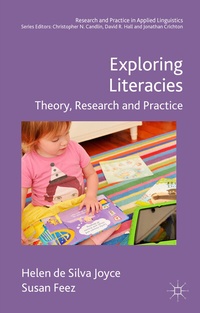
Exploring Literacies
Theory, Research and Practice
Published on 26. January 2016
XXI, 420 pages
978-1-137-31903-6 (ISBN)
Description

This book is a guide to current research and debate in the field of literacies practice and education. It provides both an historical and lifespan view of the field as well as an overview of research methodologies with first-hand examples from a range of researchers involved in literacy research.
More details
Series
Edition
1st ed. 2016
Language
English
Place of publication
London
United Kingdom
Publishing group
Palgrave Macmillan UK
Target group
Professional and scholarly
Product notice
Reflowable
Illustrations
XXI, 420 p.
File size
2,89 MB
ISBN-13
978-1-137-31903-6 (9781137319036)
DOI
10.1057/9781137319036
Schweitzer Classification
Other editions
Additional editions
Book
10/2015
Palgrave Macmillan
€106.99
Shipment within 15-20 days
Persons
Helen de Silva Joyce is Adjunct Lecturer at the School of Education, University of New England, Australia, and was previously Director of Community and Migrant in the NSW Department of Education and Training for over ten years. Her expertise is in the area of language research and education. She is the author and editor of many language education resources for all sectors of education, including four recent books on visual literacy and multimodality.
Susan Feez is Senior Lecturer at the School of Education, University of New England, Australia. After many years working as a classroom teacher, Susan now teaches and researches in the field of English, languages and literacies education, and in Montessori education. In collaboration with colleagues she also develops resources for classroom teachers.
Susan Feez is Senior Lecturer at the School of Education, University of New England, Australia. After many years working as a classroom teacher, Susan now teaches and researches in the field of English, languages and literacies education, and in Montessori education. In collaboration with colleagues she also develops resources for classroom teachers.
Content
- Cover
- Contents
- List of Figures and Tables
- Preface and Acknowledgements
- General Editors' Preface
- Part I: Literacies Education: The Landscapes of Literacy Studies
- Introduction
- 1 Literacy: A Field of Evolving Terms, Definitions and Educational Approaches
- Defining literacy
- Failing to become literate
- Educating for literacy
- Literacy as learned practice
- Literacy as coding and skills practice
- Literacy as individual practice
- Literacy as sociocultural practice
- Reconciling approaches to literacy education
- Numeracy education
- Conclusion
- 2 Studies of Literacy over Time and across Disciplines
- Literacy across time and space
- Literacy across academic disciplines
- Researching academic literacies
- Technicality
- Abstraction
- Evaluation
- Genre
- Multimodal literacy
- The nature of specialisation
- Critical literacies
- Conclusion
- Part II: Lifespan Literacies
- Introduction
- 3 Literacy from Home to School
- Lessons from the past
- Conceptual frameworks for research
- A century of theoretical perspectives
- The behaviourist view
- Cognitive views
- The nativist view
- Interactionist views
- Biological views
- Conceptualising initial literacy instruction
- Intensive phonics instruction
- Whole language
- Towards balanced and responsive approaches to initial literacy instruction
- Socially informed initial literacy education: integrating skills, knowledge and pedagogy
- Ethnographic views
- A sociocognitive lens
- The social semiotic tradition
- Social semiotic research frameworks: discourse analysis and ontogenetic trajectories
- Conclusion
- 4 Literacy at School
- Frameworks for integrating literacy elements: the what of literacies education
- From inventories to binaries
- From binaries to integrated relational frameworks: an educational linguistics
- The four resources model
- Types of literate practice
- Teaching about texts in context
- Teaching knowledge about grammar
- Teaching knowledge about spelling
- Teaching knowledge about visual grammar
- Literacy and the school curriculum: increasing specialisation
- The crucial shift in the middle years
- Literacy across the secondary school years
- Literacy outside school
- Comprehensive literacy teaching frameworks: the how of literacy teaching
- The macro and micro levels
- Genre-based pedagogy
- Expanding literacy teaching repertoires
- Conclusion
- 5 Literacy in Adult Life: Community, Further Education and Work
- Measuring adult literacy levels
- Literacy domains, practices and events
- Literacy domains
- Literacy practices and events
- Numeracy as social practice
- Literacies in the community
- Literacy and disadvantage
- Literacy and the experience of migrants and refugees
- Literacy for specific purposes
- Literacies in further education
- Literacies in the workplace
- Literacy as lifelong learning in a plurilingual world
- Conclusion
- Part III: Literacy Research: A Continuing Project
- Introduction
- 6 Researching Literacy: A Methodological Map
- Types of research
- Research methods
- Action research
- Case studies
- Design-based research
- Discourse analysis
- Analysis of classroom discourse
- Analysis of written texts
- Multimodal text analysis
- Ethnographic research
- Verbal protocols
- Meta-analysis
- Conclusion
- 7 Researcher Voices
- James Gee: a literacy research journey
- Literacy in primary school contexts
- Maria Estela Brisk: 'Genres in writing' - a collaborative research project
- Mary Schleppegrell and Annemarie Palincsar: the iterative development of modules to support teachers' engagement in exploring language and meaning in text with English-language learners
- Geoff Williams and Ruth French: teaching and learning grammatics
- Literacy in middle school contexts
- Len Unsworth and Angela Thomas: teaching effective 3D authoring in the middle school years - multimedia grammatical design and multimedia authoring pedagogy
- Jenny Hammond: the needs of English as an additional language (EAL) students in Australian schools
- Anne-Vera Meidell Sigsgaard: classroom interactions in a Danish history classroom
- Barbara Comber, Peter Freebody, Helen Nixon, Victoria Carrington and Anne-Marie Morgan: new literacy demands in the middle years - learning from design experiments
- Literacy in secondary school contexts
- Debra Myhill: grammar for writing
- Literacy across school contexts
- James Martin: language and social power - Write It Right Disadvantaged Schools Projects
- Frances Christie and Beverly Derewianka: literacy development across the years of schooling
- Claire Acevedo, Caroline Coffin, Carlos Gouveia, Ann-Christin Lövstedt and Rachel Whittaker: Teacher Learning for European Literacy Education (TeL4ELE) 2011-2013 Project
- Literacy development
- Brian Byrne: behaviour-genetic studies of literacy development
- Literacy and numeracy in adult learning contexts
- Anne Burns: action research
- Dave Tout: adult numeracy teaching - making meaning in mathematics
- Stephen Black and Jo Balatti: adult literacy and social capital
- Brian Paltridge, Sue Starfield and Louise Ravelli: doctoral writing in visual and performing arts
- Susan Hood: multiple modes and modalities of communication
- Literacy in social contexts
- Jennifer Blunden: word work - linguistic perspectives on meaning, accessibility and knowledge-building in museum exhibitions
- Helen Whitty: researching museums and their relationships to families and literacy
- Nancy Jackson: reading work - literacies in the new workplace
- Literacy research: the onwards journey
- What to research
- Notes
- References
- Index
