

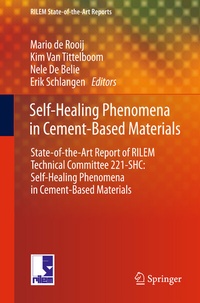
Self-Healing Phenomena in Cement-Based Materials
Description

Self-healing materials are man-made materials which have the built-in capability to repair damage. Failure in materials is often caused by the occurrence of small microcracks throughout the material. In self-healing materials phenomena are triggered to counteract these microcracks. These processes are ideally triggered by the occurrence of damage itself.
Thus far, the self-healing capacity of cement-based materials has been considered as something "extra". This could be called passive self-healing, since it was not a designed feature of the material, but an inherent property of it. Centuries-old buildings have been said to have survived these centuries because of the inherent self-healing capacity of the binders used for cementing building blocks together.
In this State-of-the-Art Report a closer look is taken at self-healing phenomena in cement-based materials. It is shown what options are available to design for this effect rather than have it occur as a "coincidental extra".
More details
Other editions
Additional editions
Content
1 Introduction: 1.1 Self-healing phenomena.- 1.2 Why self-healing in cement-based materials.- 1.3 Definitions in an emerging field.- 1.4 Outline of the report.- 1.5 Link to other RILEM TC's.- 1.6 References.- 2 Experimental techniques used to verify healing: 2.1 Introduction.- 2.2 Techniques used to examine crack healing.- 2.3 Techniques used to verify recovery against environmental actions.- 2.4 Techniques used to verify recovery against mechanical actions.- 2.5 References.- 3 Recovery against environmental action: 3.1 Autogenic self-healing.- 3.2 Autonomic self-healing.- 3.3 References.- 4 Recovery against mechanical actions: 4.1 Autogenic self-healing.- 4.2 Autonomic self-healing.- 4.3 References.- 5 Modelling of self-healing cementitious materials: 5.1 Introduction.- 5.2 Lattice modelling for concrete with tubular encapsulation.- 5.3 Simulation of autogenic self-healing for concrete at early age.- 5.4 Simulation of self-healing capacity of hybrid fibre material.- 5.5 Analyticalmodels for cracks hitting encapsulated materials.- 5.6 Self-healing by on-going hydration.- 5.7 References.- 6 Other materials, applications and future developments: 6.1 Introduction.- 6.2 Self-healing in other materials.- 6.3 Applications.- 6.4 Future developments and outlook.- 6.5 References.
