

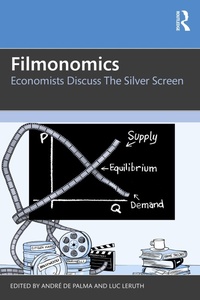
Filmonomics
Economists Discuss the Silver Screen
Published on 8. April 2025
278 pages
978-1-040-34064-6 (ISBN)
Description

What could movies as diverse as The Last Samurai, Cleo from 5 to 7, or Dr. Strangelove have in common? Filmonomics has a simple yet intriguing answer: economics as the main driving force of the plot or as the main motivation of the characters' actions.
This book analyses how movie makers use economic and financial motives in their plots or to build their characters. Have they done it in line with economic theory? Or are they proposing a new angle, a new perspective, that economists should take note of? The authors here do not discuss wages in the film industry or the economics of movies. What interests them is the economic motivations underpinning the behaviour of fictional characters in their favourite films. They argue that credible movie characters can behave in irrational ways, and movie makers occasionally introduce new ideas that economists should take note of.
A unique contribution, this book will be of interest to readers eager to discover what economists have to say about films and film directors. It will be indispensable for students and researchers of economics, media studies, film studies, and cultural studies.
This book analyses how movie makers use economic and financial motives in their plots or to build their characters. Have they done it in line with economic theory? Or are they proposing a new angle, a new perspective, that economists should take note of? The authors here do not discuss wages in the film industry or the economics of movies. What interests them is the economic motivations underpinning the behaviour of fictional characters in their favourite films. They argue that credible movie characters can behave in irrational ways, and movie makers occasionally introduce new ideas that economists should take note of.
A unique contribution, this book will be of interest to readers eager to discover what economists have to say about films and film directors. It will be indispensable for students and researchers of economics, media studies, film studies, and cultural studies.
Reviews / Votes
"Much research analyzes the economics of films and of the movie industry. By comparison, little exists about economics (and related social sciences) in films - how the characters make choices, how they interact, and the happy or tragic outcomes of their actions. This book fills that vacuum. Read it, then view (or re-view) the films discussed here, and you will acquire an amazing new and rich way of watching films and thinking about them."Avinash Dixit
, Sherrerd University Professor Emeritus, Princeton University
"Very well documented, this work will delight a wide audience intrigued by the economic themes conveyed by the films. I thank the authors for devoting an entire chapter to our Farinelli under the particular gaze of the economy of the castrati. Extremely interesting!"
Gerard Corbiau
, Film Director (Farinelli)
"Filmonomics is not only a fun book to read for movie lovers and social scientists. By highlighting the broad economic aspects present in famous movies, the authors make us rethink their content and learn some economics along the way."
Gerard Roland,
E. Morris Cox Distinguished Professor of Economics and Professor of Political Science, University of California, Berkeley
"Economics explains (almost) everything. And everything is in films. This is a wonderfully eclectic set of short essays by a wide swathe of authors from different backgrounds. It is a joy to open up and engage the deeper thoughts that lie behind iconic, and some less known, and some rather obscure movies."
Simon P. Anderson,
Commonwealth Professor of Economics, University of Virginia
'Rarely have characters on screen been viewed from the lens of Homo Economicus. Andre de Palma and Luc Leruth in association with a few of the finest economists of our times revisit a selection of legendary characters on screen, and without compromising academic rigour, lucidly and fascinatingly explain their economic behaviour and concerns. A milestone work that not only enriches literature on cinema but will also aid screenplay writers.'
Danish Hussain, Actor, poet, storyteller, and theatre director "Much research analyzes the economics of films and of the movie industry. By comparison, little exists about economics (and related social sciences) in films - how the characters make choices, how they interact, and the happy or tragic outcomes of their actions. This book fills that vacuum. Read it, then view (or re-view) the films discussed here, and you will acquire an amazing new and rich way of watching films and thinking about them."
Avinash Dixit, Sherrerd University Professor Emeritus, Princeton University
"Very well documented, this work will delight a wide audience intrigued by the economic themes conveyed by the films. I thank the authors for devoting an entire chapter to our "Farinelli", under the particular gaze of the economy of the castratii. Extremely interesting!"
Gerard Corbiau, Film Director (Farinelli)
"Filmonomics is not only a fun book to read for movie lovers and social scientists. By highlighting the broad economic aspects present in famous movies, the authors make us rethink their content and learn some economics along the way."
Gerard Roland, E. Morris Cox Distinguished Professor of Economics and Professor of Political science, University of California Berkeley.
"Economics explains (almost) everything. And everything is in films. This is a wonderfully eclectic set of short essays by a wide swathe of authors from different backgrounds. It is a joy to open up and engage the deeper thoughts that lie behind iconic, and some less known, and some rather obscure movies."
Simon P. Anderson, Commonwealth Professor of Economics, University of Virginia
'Rarely have characters on screen been viewed from the lens of Homo Economicus. Andre de Palma and Luc Leruth in association with a few of the finest economists of our times revisit a selection of legendary characters on screen, and without compromising academic rigour, lucidly and fascinatingly explain their economic behaviour and concerns. A milestone work that not only enriches literature on cinema but will also aid screenplay writers.'
Danish Hussain, Actor, poet, storyteller, and theatre director
More details
Language
English
Place of publication
London
United Kingdom
Publishing group
Taylor & Francis Ltd
Target group
College/higher education
Professional and scholarly
Illustrations
1 Tables, black and white; 5 Line drawings, black and white; 5 Illustrations, black and white
File size
3,22 MB
ISBN-13
978-1-040-34064-6 (9781040340646)
Copyright in bibliographic data and cover images is held by Nielsen Book Services Limited or by the publishers or by their respective licensors: all rights reserved.
Schweitzer Classification
Other editions
Additional editions
Book
04/2025
1st Edition
Routledge India
€207.90
Shipment within 10-20 days
Book
04/2025
1st Edition
Routledge India
€63.90
Shipment within 15-20 days

Filmonomics
Economists Discuss the Silver Screen
Book
04/2025
Routledge
Unfortunately, price unknown
Available (delivery time upon request)
Persons
Andre de Palma holds a PhD in Physics (supervised by Nobel Laureate I. Prigogine) from the Free University of Brussels and a PhD in Economics from the University of Burgundy. He has taught in the following institutions: Queen's University, Canada; Northwestern University, USA; University of Geneva, Switzerland; and Ecole Normale Superieure (ENS) Paris Saclay, France. He is an honorary member of the Institut Universitaire de France and the Association francaise d'economie des transports. He is a founding member of the international association of Transport Economics. He is now Emeritus Chair Professor at CY Cergy-Paris University and a visiting researcher at Strasbourg and Laval, Canada Universities, and an instructor at Ecole Polytechnique Federale de Lausanne (EPFL), Switzerland. He specializes in transportation economics, behavioural economics, industrial organization, and risk. He has also published outside the field of economics, including 'L'addiction rationnelle dans une nouvelle de Stefan Zweig' and 'Ode a l'erreur,' in 2021 (Quand la litterature nous est contee, La lettre volee, Edition de l'Universite Libre de Bruxelles).
Luc Leruth is an associate researcher at the University of Clermont-Auvergne, France. He has an M.Sc. in Mathematics and an M.A. and a PhD in Economics. A former International Monetary Fund (IMF) staff member, he has led missions in numerous countries, was the head of the Fiscal Transparency Unit, secretary of the G10, and director of three Regional Technical Assistance Centers. He has also pursued an academic career, holding teaching positions at the Free University Brussels, the University of Liege, and the University of Essex. He was a member of Center for Operations Research and Econometrics (CORE) and has published numerous papers in peer-reviewed journals. He has also pursued a literary career. His first novel, La 4eme Note, was published in August 2001, translated into Portuguese and Russian. It was the best-selling first novel at Gallimard for 2001 and a finalist of the Prince of Monaco "Best Young Author" biennial Award. His second novel, La Machine Magique, was also published in the Collection Blanche, Gallimard (2004). In collaboration with Jean Dreze, he is the author of Rumble in a Village (2020). His first play Le Daguerreotypiste malgre lui was published in 2022.
Luc Leruth is an associate researcher at the University of Clermont-Auvergne, France. He has an M.Sc. in Mathematics and an M.A. and a PhD in Economics. A former International Monetary Fund (IMF) staff member, he has led missions in numerous countries, was the head of the Fiscal Transparency Unit, secretary of the G10, and director of three Regional Technical Assistance Centers. He has also pursued an academic career, holding teaching positions at the Free University Brussels, the University of Liege, and the University of Essex. He was a member of Center for Operations Research and Econometrics (CORE) and has published numerous papers in peer-reviewed journals. He has also pursued a literary career. His first novel, La 4eme Note, was published in August 2001, translated into Portuguese and Russian. It was the best-selling first novel at Gallimard for 2001 and a finalist of the Prince of Monaco "Best Young Author" biennial Award. His second novel, La Machine Magique, was also published in the Collection Blanche, Gallimard (2004). In collaboration with Jean Dreze, he is the author of Rumble in a Village (2020). His first play Le Daguerreotypiste malgre lui was published in 2022.
Content
Section 1: Money and happiness 1. Citizen Kane and the morality of tycoons 2. Wall Street versus Des Hommes et des Dieux: On greed and social responsibility 3. Farinelli and the reasons for the rise and fall of castrati 4. Crazy Rich Asians: A Singapore NEG story? Section 2: Intergenerational transfers and family affairs 5. Trading places and equality of opportunity 6. Narayama, a spaceship Section 3: Women in society 7. Cleo from 5 to 7: A feminine Homo Economicus? 8. Mirch Masala and Manthan: the power of women's collective action in challenging (orthodox economic theory and) local authority 9. Difret and the way to challenge male authority Section 4: Adapting to social changes 10. The Last Samurai and the struggle for the heart of a discipline 11. The individual, the state, and economics in Indian films: A fifty-year transition 12. Protecting society in A Clockwork Orange 13. The Purple Rose of Cairo and the foundations of rationality Section 5: Individualism, cooperation, and other behavioral patterns 14. The strange games of Dr. Strangelove 15. Transport and economic development in Once upon a Time in the West 16. The philosophy behind The Fountainhead 17. Stopping a bank run in It's a Wonderful Life 18. The Hateful Eight: Bounty hunting, spatial competition, and persuasion Section 6: Winner of the Filmonomics Young Author Award 19. Garm Hava: The Economics of discrimination and other grim tales 20. Coda - Algorithmic Cinema
