

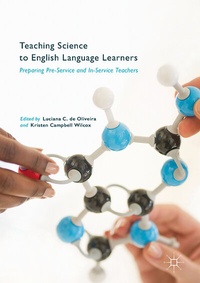
Teaching Science to English Language Learners
Description

This edited collection explores how science can be taught to English language learners (ELLs) in 21st century classrooms. The authors focus on the ways in which pre-service and in-service science teachers have developed-or may develop-instructional effectiveness for working with ELLs in the secondary classroom. Chapter topics are grounded in both research and practice, addressing a range of timely topics including the current state of ELL education in the secondary science classroom, approaches to leveraging the talents and strengths of bilingual students in heterogeneous classrooms, best practices in teaching science to multilingual students, and ways to infuse the secondary science teacher preparation curriculum with ELL pedagogy. This book will appeal to an audience beyond secondary content area teachers and teacher educators to all teachers of ELLs, teacher educators and researchers of language acquisition more broadly.
More details
Other editions
Additional editions
Persons
Luciana C. de Oliveira is Chair and Associate Professor in the Department of Teaching and Learning in the School of Education and Human Development at the University of Miami, Florida, USA. Her research focuses on issues related to teaching English language learners (ELLs) at the K-12 level, including the role of language in learning the content areas and teacher education, advocacy and social justice.
Kristen Campbell Wilcox is Assistant Professor in the Educational Theory and Practice Department of the University at Albany, SUNY, USA. A former ESL and EFL teacher in Puerto Rico and Brazil, her areas of research interest have focused on the intersections of language, culture, and achievement among diverse youth.
Content
- Chapter 1. Curriculum in Motion for English Language Learners in Science: Teachers Supporting Newcomer Unaccompanied Youth; Lourdes Cardozo-Gaibisso, Martha Allexsaht-Snider, and Cory Buxton.- Chapter 2. Bridging Language and Content for English Language Learners in the Science Classroom; Samina Hadi-Tabassum and Emily Reardon.- Chapter 3. Preparing Science Teachers for Project-Based, Integrated, Collaborative Instruction; Carrie L. McDermott and Andrea Honigsfeld.- Chapter 4. Maximizing Science Teachers' Pedagogical Potential for Teaching Science Literacy to English Language Learners; Clara Lee Brown and Mehmet Aydeniz.- Chapter 5. Supporting English Language Learners in Secondary Science Through Culturally Responsive Teaching; Gretchen Oliver.- Chapter 6. Writing Their Way into Science: Middle School English Language Learners as Next Generation Scientists; Judy Sharkey and Tina Proulx.- Chapter 7. Helping English Language Learners Access the Language and Content of Science through the Integration of Culturally and Linguistically Valid Assessment Practices; Sultan Turkan and Alexis Lopez.- Chapter 8. Practical Language Learning Strategies that Increase Science Learning and Engagement; Ana Lado and Adrienne Wright.- Chapter 9. Scaffolding Science Vocabulary for Middle School Newcomer English Language Learners; Yuliya Ardasheva.
