

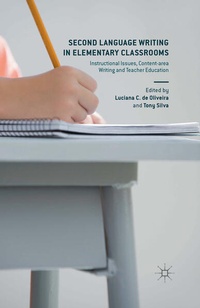
Second Language Writing in Elementary Classrooms
Description

Second Language Writing in Elementary Classrooms focuses on L2 writing in elementary classrooms. It features chapters that highlight research in elementary classrooms focused on the writing development of multilingual children, and research in teacher education to prepare elementary teachers to teach L2 writing and address L2 writers' needs.
Reviews / Votes
"Writing is one of the most understudied and most important abilities that children need to develop in schools. For children who are learning English in school contexts, learning to write and write well is absolutely essential for successful schooling. This book is written for teacher and teacher educator audiences, and it is loaded with great ideas, strategies, and approaches to writing practices that work with English learners. de Oliveira and Silva present a set of research-based chapters that provide evidence for effective writing practices in academic contexts in which English learners are mixed with students whose home language is English. In my opinion, this collection of chapters is the most up-to-date scholarship on second language writing in the elementary school. This is a must read for teachers and teacher educators who want to improve their practices." (Christian Faltis, Professor of Education, University of California, Davis, USA)
"Dramatic changes in school demographics indicate that, in less than a decade, one in four children entering Kindergarten will speak a language other than English at home. This change in the student population coupled with new sets of standards highlight the need to focus on how emergent bilinguals learn how to write in English and in their first language. This collection of rich chapters showcases how educators can teach writing in meaningful, effective, culturally affirming ways. The book also highlights voids and offers solutions in at least two areas: 1) the insufficient and sporadic writing opportunities for emergent bilinguals, and 2) the lack of systematic research about how second language learners learn how to write. This is a must read for K-6 pre-service and in-service teachers and teacher educators." (Gisela Ernst-Slavit, Professor, Washington State University, Vancouver, Canada)
"With the increasing number of English learners (ELs) in today's classrooms, the majority of whom are at the elementary level, all teachers need to draw from an expansive repertoire of research-based strategies to effectively build upon their ELs' strengths and also meet their unique needs. With this book, de Oliveira and Silva voice the urgent need for educators to recognize that they must focus on teaching writing to ELs in order for their students to succeed. The authors in this edited volume use engaging means to shine a light on relevant research on elementary ELs' writing, an area of ELs' language development that has the tendency to develop last and prevent ELs from advancing. I highly recommend this book for those who wish to explore issues and solutions to develop elementary ELs' writing skills." (Diane Staehr Fenner, NCATE/CAEP Program Coordinator, TESOL International Association)
More details
Other editions
Additional editions
Persons
Luciana C. de Oliveira is Associate Professor in the Department of Teaching and Learning in the School of Education and Human Development at the University of Miami, Florida. Her research focuses on issues related to teaching English language learners (ELLs) at the K-12 level.
Tony Silva is Professor in the Department of English at Purdue University, where he directs the Graduate Program in Second Language Studies/ESL. His research focuses on second language writing theory, research, and practice.
Content
PART I: INSTRUCTIONAL ISSUES
2. E-Journaling in Response to Digital Texts; Sally Brown
3. The Benefits of Co-Teaching in the ESL Elementary Classroom; Carrie Neely
4. Instructional Interactions Around Writing: A Study of Elementary Bilingual Students Writing in a Second Language; Joanna W. Wong
PART II: CONTENT-AREA WRITING
5. Teaching Writing through Genres and Language; Tracy Hodgson-Drysdale
6. Bilingual Fourth Graders Develop a Central Character for Their Narratives; Maria Estela Brisk, Deborah Nelson and Cheryl O'Connor
7. Disciplinary Language Development in Writing: Science Reports and Common Core State Standards; Dong-shin Shin
8. Supporting L2 Elementary Science Writing with SFL in an Age of School Reform; Kathryn Accurso, Meg Gebhard, Cecily Selden
PART III: TEACHER EDUCATION
9. Bridging the In and Out-of-School Writing Practices of ELLs Through Postmethod Pedagogy: OneElementary Teacher's Journey; Sarah Henderson Lee
10. Pre-service Teacher Preparation for L2 Writing: Perspectives of In-Service Elementary ESL Teachers; Ditlev Larsen
