

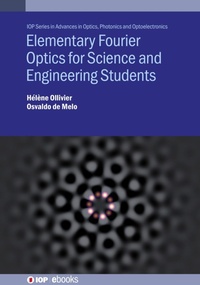
Elementary Fourier Optics for Science and Engineering Students
Description

Elementary Fourier Optics for Science and Engineering Students introduces the principles of Fourier optics, emphasizing their foundational role in modern optical systems. Designed for undergraduates and early graduates in Physics, Mathematics, or Engineering, this book describes how wave propagation, diffraction, and linear systems theory unite under the Fourier framework to explain phenomena like image formation, holography, and optical signal processing. Important concepts as convolution, cross-correlation, transfer function and their relationship with image resolution are also included.
To make the book truly standalone, it includes, at the beginning, a dedicated math chapter which reviews essential concepts to contextualize the math and a foundational optics chapter covering prerequisites like wave theory, geometric optics, and diffraction basis, helping students fill gaps in their background. Moreover, the book includes a specialized Fourier analysis chapter which explains 1D Fourier Transform concepts in depth and builds intuition before moving to 2D concepts.
The book also includes advanced topics as holography principles, discrete Fourier transform implementations including Fast Fourier Transform, and Fourier spectroscopy techniques. Between the key features of the books are a progressive learning path, visual explanations, use of a specialized program for graphic Fourier Transform implementation, chapter abstracts, solved and non-solved exercises, and a list of relevant bibliography.
More details
Other editions
Additional editions
Persons
Hélène Ollivier simultaneously obtained her engineer diploma from Institut d'Optique Graduate School (Palaiseau, France), completed her master¿s degree in Lasers, Optics and Matter, and graduated from Ecole Normale Supérieure de Paris-Saclay as a normalien student in 2017. She completed her doctoral research in quantum photonics and cavity quantum electrodynamics in the Optics and Semiconductors nanoStructures Group under the supervision of Professor Pascale Senellart, a CNRS research director at the Center for Nanosciences and Nanotechnologies (C2N). She has authored three first-author publications, one in ACS Photonics and two in Physical Review Letters and co-authored five additional papers published in other top journals such as Nature Photonics, Nature Communications, and Optica. As a laureate of the 2016 physics aggregation, a highly competitive examination for the Education Nationale in France, she is deeply involved in physics education. She has held a permanent position as Associate Professor at the Foton Institute (University of Rennes) since September 2024. She currently teaches subjects related to photonics at ENSSAT (École Nationale Supérieure des Sciences Appliquées et de Technologie) in Lannion and conducts research on room-temperature single-photon sources based on rare-earth-ion-doped optical fibers.
Osvaldo de Melo is a distinguished physicist and educator specializing in semiconductor materials, thin-film growth, and nanotechnology. He earned his Ph.D. in Physical Sciences from the University of Havana in 1992, focusing on ternary single crystal solutions of II-VI telluride compounds. A dedicated educator with over 40 years of experience, he served as Full Professor of Physics at the University of Havana (1993-2021), Dean of the Faculty of Physics (2001-2006), and visiting scholar at prestigious institutions including the Autonomous University of Madrid, the Instituto Politécnico Nacional (Mexico), and the Universidade Federal de Minas Gerais (Brazil). His research, documented in more than 100 peer-reviewed scientific publications, spans materials preparation, nanostructured semiconductors, and 2D layered systems including molybdenum oxides and Bi2Te3. With an h-index of 19 (Google Scholar) and more than 1,375 citations, his scientific contributions have earned numerous honors including Cuba's National Physics Prize (2016) and multiple awards from the Cuban Academy of Sciences for breakthroughs across various areas of Physics and Materials Science. Currently affiliated with both the Escuela Superior de Física y Matemáticas and the Escuela Superior de Ingeniería Mecánica y Eléctrica at Mexico's Instituto Politécnico Nacional (IPN), he investigates transition-metal oxides and dichalcogenides for next-generation electronic devices.
Content
Preface
Acknowledgments
About the authors
1 Mathematical functions - a review
2 Optics fundamentals - a review
3 Fourier Transfom in 1D
4 Fourier Transform in 2D
5 Linear and shift-invariant systems
6 Fraunhofer diffraction and Fourier transform
7 Correlations. Transfer functions and images formation
8 Advanced topics
