

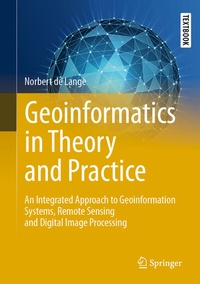
Geoinformatics in Theory and Practice
Description

This textbook is intended to display a broad, methodological introduction to geoinformatics and geoinformation science. It deals with the recording, modeling, processing and analysis as well as presenting and distributing of geodata. As an integrated approach it is dedicated to the multidisciplinary application of methods and concepts of computer science to solve spatial tasks. First the reader receives an introduction to the approach and tasks of geoinformatics, basic concepts and general principles of information processing as well as essentials of computer science. Then this textbook focuses on the following topics: spatial reference systems, digital spatial data, interoperability of spatial data, visualization of spatial information, data organization and database systems, geoinformation systems, remote sensing and digital image processing.
The result is a comprehensive manual for studies and practical applications in geoinformatics. It serves also as a basis to support and deepen methodological courses in geography, geology, geodesy and surveying as well as all environmental sciences. In this first English edition, the author has updated and significantly expanded the fourth German edition. New additions include the development of apps, graphical presentation on the web, geodata-bases and recent methods of classification.
This book is based on the original German 4 th edition Geoinformatik in Theorie und Praxis by Norbert de Lange, published by Springer-Verlag GmbH Germany, part of Springer Nature in 2020 and still presents the only integrated perspective on geoinformatics and geoinformation science. This book was translated with the help of artificial intelligence (machine translation by the service DeepL.com) first and then significantly revised with regard to technical terms and special topics of geoinformatics.
Reviews / Votes
More details
Other editions
Additional editions
Person
Norbert de Lange studied geography and mathematics in Bochum, taught and conducted research at the Institutes of Geography at the Universities of Münster and Osnabrück. In 2005, he was involved in founding the Institute for Geoinformatics and Remote Sensing at the University of Osnabrück, which has since merged with the Institute for Computer Science, where he has been Professor of Environmental Informatics and Municipal Planning since 2016. His main research focuses on applications of geoinformatics in urban and regional planning. He has taught a variety of courses on geoinformation systems, digital cartography and data analysis in earth sciences for more than 40 years.
Content
1 Introduction.- 2 Basic terms and general principles of information processing.- 3 Basics from computer science.- 4 Spatial objects and reference systems.- 5 Digital spatial data: Data mining, geographic reference data and VGI.- 6 Standards and interoperability of spatial data.- 7 Visualization of spatial information.- 8 Data organization and database systems.- 9 Geographic information systems.- 10 Remote sensing and digital image processing.
