

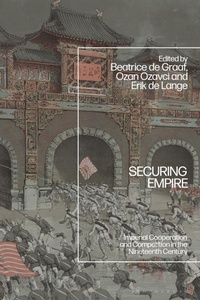
Securing Empire
Imperial Cooperation and Competition in the Nineteenth Century
1st Edition
Published on 17. October 2024
280 pages
978-1-350-37853-7 (ISBN)
Description

This volume explores how the quest for security reshaped the world over the course of the 19th century, altering the structures, hierarchies and dynamics of international relations during a pivotal moment in world history.
Taking a unique approach to imperial and international history, the essays in this volume show how security propelled imperial expansion, supported institutions of cooperation, maintained networks of imperial actors and shaped experiences of imperial rule. Contending that security should be studied as a force in its own right, one that drove processes of colonization, civilization and commerce, Securing Empire shows how cooperation between and across empires hinged on shared notions of threats and common ways of countering them.
In showing that security did not solely inform, support and complicate unilateral imperial endeavours, but also brought different imperial entities together and forged global modes of government, this book shows how integral security was to the 'global transformation' of the 19th century and the new world order that emerged.
Taking a unique approach to imperial and international history, the essays in this volume show how security propelled imperial expansion, supported institutions of cooperation, maintained networks of imperial actors and shaped experiences of imperial rule. Contending that security should be studied as a force in its own right, one that drove processes of colonization, civilization and commerce, Securing Empire shows how cooperation between and across empires hinged on shared notions of threats and common ways of countering them.
In showing that security did not solely inform, support and complicate unilateral imperial endeavours, but also brought different imperial entities together and forged global modes of government, this book shows how integral security was to the 'global transformation' of the 19th century and the new world order that emerged.
More details
Edition
1. Auflage
Language
English
Place of publication
London
United Kingdom
Publishing group
Bloomsbury Publishing PLC
Target group
Professional and scholarly
Illustrations
10 bw illus
ISBN-13
978-1-350-37853-7 (9781350378537)
Copyright in bibliographic data and cover images is held by Nielsen Book Services Limited or by the publishers or by their respective licensors: all rights reserved.
Schweitzer Classification
Other editions
Additional editions
Beatrice de Graaf | Ozan Ozavci | Erik de Lange
Securing Empire
Imperial Cooperation and Competition in the Nineteenth Century
Book
05/2026
Bloomsbury Academic
€44.70
Shipment within 15-20 days
Persons
Beatrice de Graaf is Professor of History at University of Utrecht, Netherlands. A historian in the field of security and terrorism, her research focuses on security-related themes in the 19th century and on modern and contemporary cases of conflict and terrorism. She was awarded with the Stevin Prize in 2018 for her work.
Ozan Ozavi is Assistant Professor of Transimperial History at Utrecht University, Netherlands, and co-convenor of the Lausanne Project and the Security History Network. His current research looks at military presence and imperial cooperation in the nineteenth-century Mediterranean.
Erik de Lange is Assistant Professor of Transimperial History at Utrecht University, Netherlands, and co-convenor of the Lausanne Project and the Security History Network. His publications include Dangerous Gifts: Imperialism, Security, and Civil Wars in the Levant, 1798-1864 (2021), and Intellectual Origins of the Republic: Ahmet Agaoglu and the Genealogy of Liberalism in Turkey (2015).
Ozan Ozavi is Assistant Professor of Transimperial History at Utrecht University, Netherlands, and co-convenor of the Lausanne Project and the Security History Network. His current research looks at military presence and imperial cooperation in the nineteenth-century Mediterranean.
Erik de Lange is Assistant Professor of Transimperial History at Utrecht University, Netherlands, and co-convenor of the Lausanne Project and the Security History Network. His publications include Dangerous Gifts: Imperialism, Security, and Civil Wars in the Levant, 1798-1864 (2021), and Intellectual Origins of the Republic: Ahmet Agaoglu and the Genealogy of Liberalism in Turkey (2015).
Content
Introduction, Beatrice de Graaf, Ozan Ozavci & Erik de Lange (Utrecht University, The Netherlands)
1 . To give to the indigenous population the same security as to the Europeans': The Mixed Courts of Egypt and the financial-legal turn of the Eastern Question, Beatrice de Graaf (Utrecht University, The Netherlands)
2. State Rebuilding and the Modernization of Police Organizations in Korea and Japan, Seo-Hyun Park (Lafayette College, USA)
3. 'Let Them Have What Name They Will': Piracy and Imperial Cooperation from Barbary to the Americas, Erik de Lange (Utrecht University, The Netherlands)
4. Protecting the Sanitary Security of the American Empire in the "Orient": U.S. Health Measures in and Beyond its Pacific Colonies around 1900, Andrea Wiegeshoff (Philipps-University Marburg, Germany)
5. Securing Japan's Civilized Position in the World: Identity Security and Japanese Imperialism in the late-nineteenth Century, Shogo Suzuki (University of Manchester, UK)
6. From the Rhine to the Congo, via the Danube: Transimperial Implantations of a European River Regime, 1815-1885, Constantin Ardeleanu & Joep Schenk (Wissenschaftskolleg zu Berlin, Germany, and Utrecht University, The Netherlands)
7. Civil War and Diplomacy: the 1860 Intervention of the Great Powers in Ottoman Syria, Ozan Ozavci (Utrecht University, The Netherlands)
8. Creating Empire, Resisting Empire: The Boxer Rebellion in China, 1899-1901, David Silbey (Cornell University, USA)
9. Forgetting Two Histories: European Institutional Models, Empty Spaces, and the Failure of the 1885 Congo River Commission, Joanne Yo (Queen Mary University of London, UK)
Conclusion: Transimperial Security Practices, Nineteenth-Century Style, Maartje Abbenhuis (University of Auckland, New Zealand)
Bibliography
Index
1 . To give to the indigenous population the same security as to the Europeans': The Mixed Courts of Egypt and the financial-legal turn of the Eastern Question, Beatrice de Graaf (Utrecht University, The Netherlands)
2. State Rebuilding and the Modernization of Police Organizations in Korea and Japan, Seo-Hyun Park (Lafayette College, USA)
3. 'Let Them Have What Name They Will': Piracy and Imperial Cooperation from Barbary to the Americas, Erik de Lange (Utrecht University, The Netherlands)
4. Protecting the Sanitary Security of the American Empire in the "Orient": U.S. Health Measures in and Beyond its Pacific Colonies around 1900, Andrea Wiegeshoff (Philipps-University Marburg, Germany)
5. Securing Japan's Civilized Position in the World: Identity Security and Japanese Imperialism in the late-nineteenth Century, Shogo Suzuki (University of Manchester, UK)
6. From the Rhine to the Congo, via the Danube: Transimperial Implantations of a European River Regime, 1815-1885, Constantin Ardeleanu & Joep Schenk (Wissenschaftskolleg zu Berlin, Germany, and Utrecht University, The Netherlands)
7. Civil War and Diplomacy: the 1860 Intervention of the Great Powers in Ottoman Syria, Ozan Ozavci (Utrecht University, The Netherlands)
8. Creating Empire, Resisting Empire: The Boxer Rebellion in China, 1899-1901, David Silbey (Cornell University, USA)
9. Forgetting Two Histories: European Institutional Models, Empty Spaces, and the Failure of the 1885 Congo River Commission, Joanne Yo (Queen Mary University of London, UK)
Conclusion: Transimperial Security Practices, Nineteenth-Century Style, Maartje Abbenhuis (University of Auckland, New Zealand)
Bibliography
Index
