

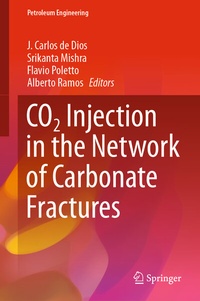
CO2 Injection in the Network of Carbonate Fractures
Description

This book presents guidelines for the design, operation and monitoring of CO2 injection in fractured carbonates, with low permeability in the rock matrix, for geological storage in permanent trapping.
CO2 migration is dominated by fractures in formations where the hydrodynamic and geochemical effects induced by the injection play a key role influencing the reservoir behavior. CO2 injection in these rocks shows specific characteristics that are different to injection in porous media, as the results from several research studies worldwide reveal. All aspects of a project of this type are discussed in this text, from the drilling to the injection, as well as support works like well logging, laboratory and field tests, modeling, and risk assessment. Examples are provided, lesson learned is detailed, and conclusions are drawn.
This work is derived from the experience of international research teams and particularly from that gained during the design, construction and operation of Hontomín Technology Development Plant. Hontomín research pilot is currently the only active onshore injection site in the European Union, operated by Fundación Ciudad de la Energía-CIUDEN F.S.P. and recognized by the European Parliament as a key test facility.
The authors provide guidelines and tools to enable readers to find solutions to their problems. The book covers activities relevant to a wide range of practitioners involved in reservoir exploration, modeling, site operation and monitoring. Fluid injection in fractured media shows specific features that are different than injection in porous media, influencing the reservoir behavior and defining conditions for safe and efficient operation. Therefore, this book is also useful to professionals working on oil & gas, hydrogeology and geothermal projects, and in general for those whose work is related to activities using fluid injection in the ground.
More details
Other editions
Additional editions
Persons
J. Carlos de Dios is currently performing as Director of CO2 Geological Storage in CIUDEN, with full accountability as partner of the project OXYCFB300, one of the most innovative CCS (Carbon Capture Storage) ventures around EU. He is a vocational Engineer and is passionate about disruptive technological solutions and enterprises. He is also Director of the Spanish CO2 Geological Storage project in a deep saline aquifer and has expertise in management of Thermal Generation Plants for CO2 capture, and in general in combustion processes. He has successful experience in international project partnership for 28 years in the energy, mining and environmental sectors.
