

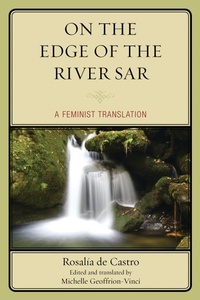
On the Edge of the River Sar
A Feminist Translation
1st Edition
Published on 16. October 2014
178 pages
978-1-61147-680-4 (ISBN)
Description

This book presents the first feminist translation of Rosalía de Castro's seminal poetic anthology En las orillas del Sar [On the Edge of the River Sar] (1884).
Rosalía de Castro (1837-1885) was an artist of vast poetic vision. Her understanding of human nature and her deep sensitivity to the injustices suffered by women and by such marginalized peoples as those of her native region, Galicia, are manifest in verses of universal yet rarely translated significance. An outspoken proponent of both women's rights and her region's cultural and political autonomy, Castro used her poetry as a vehicle through which to decry the crushing hardships both groups endured as Spain vaulted between progressive liberal and conservative reactionary political forces throughout the nineteenth century. Depending upon what faction held sway in the nation at any given time during Castro's truncated literary career, her works were either revered as revolutionary or reviled as heretical for the views they espoused. Long after her death by uterine cancer in 1885, Castro was excluded from the pantheon of Spanish literature by Restoration society for her unorthodox views. Compellingly, the poet's conceptualization of the individual and the national self as informed by gender, ethnicity, class, and language echoes contemporary scholars of cultural studies who seek to broaden present-day definitions of national identity through the incorporation of precisely these same phenomena.
Thanks to the most recent works in Rosalian and Galician studies, we are now able to recuperate and reevaluate Rosalía de Castro's poems in their original languages for the more radical symbolism and themes they foreground related to gender, sexuality, race and class as they inform individual and national identities. However, although Castro's poetic corpus is widely accessible in its original languages, these important features of her verses have yet to be given voice in the small number of English translations of only a sub-set of her works that have been produced in the last century. As a result, our understanding of Castro's potential contributions to contemporary world poetries, gender studies, Galician and more broadly cultural studies is woefully incomplete. An English translation of Castro's works that is specifically feminist in its methodological orientation offers a unique and thought-provoking means by which to fill this void.
Rosalía de Castro (1837-1885) was an artist of vast poetic vision. Her understanding of human nature and her deep sensitivity to the injustices suffered by women and by such marginalized peoples as those of her native region, Galicia, are manifest in verses of universal yet rarely translated significance. An outspoken proponent of both women's rights and her region's cultural and political autonomy, Castro used her poetry as a vehicle through which to decry the crushing hardships both groups endured as Spain vaulted between progressive liberal and conservative reactionary political forces throughout the nineteenth century. Depending upon what faction held sway in the nation at any given time during Castro's truncated literary career, her works were either revered as revolutionary or reviled as heretical for the views they espoused. Long after her death by uterine cancer in 1885, Castro was excluded from the pantheon of Spanish literature by Restoration society for her unorthodox views. Compellingly, the poet's conceptualization of the individual and the national self as informed by gender, ethnicity, class, and language echoes contemporary scholars of cultural studies who seek to broaden present-day definitions of national identity through the incorporation of precisely these same phenomena.
Thanks to the most recent works in Rosalian and Galician studies, we are now able to recuperate and reevaluate Rosalía de Castro's poems in their original languages for the more radical symbolism and themes they foreground related to gender, sexuality, race and class as they inform individual and national identities. However, although Castro's poetic corpus is widely accessible in its original languages, these important features of her verses have yet to be given voice in the small number of English translations of only a sub-set of her works that have been produced in the last century. As a result, our understanding of Castro's potential contributions to contemporary world poetries, gender studies, Galician and more broadly cultural studies is woefully incomplete. An English translation of Castro's works that is specifically feminist in its methodological orientation offers a unique and thought-provoking means by which to fill this void.
More details
Edition
1. Auflage
Language
English
Place of publication
NJ
United States
Publishing group
Associated University Presses
Target group
Professional and scholarly
Illustrations
1 Table
ISBN-13
978-1-61147-680-4 (9781611476804)
Copyright in bibliographic data and cover images is held by Nielsen Book Services Limited or by the publishers or by their respective licensors: all rights reserved.
Schweitzer Classification
Other editions
Additional editions
Book
08/2016
Fairleigh Dickinson University Press
€60.90
Shipment within 3-4 weeks
Book
10/2014
Fairleigh Dickinson University Press
€131.10
Shipment within 3-4 weeks
Persons
Michelle Geoffrion-Vinci is associate professor of Spanish at Lafayette College.
Content
Contents
Acknowledgments
Chapter 1. In Other Words: Rosalía de Castro and Feminist Translation
Chapter 2. Castro's Life and Works
Chapter 3. Edge of the Sar
Chapter 4. Passion
Chapter 5. Fertility/Barrenness
Chapter 6. Motherhood
Chapter 7. Galician Mother/Fatherland
Chapter 8. Agency
Chapter 9. Authorship
Chapter 10. Subjectivity
Chapter 11. Resistance
Bibliography
Appendix
About the Author
Acknowledgments
Chapter 1. In Other Words: Rosalía de Castro and Feminist Translation
Chapter 2. Castro's Life and Works
Chapter 3. Edge of the Sar
Chapter 4. Passion
Chapter 5. Fertility/Barrenness
Chapter 6. Motherhood
Chapter 7. Galician Mother/Fatherland
Chapter 8. Agency
Chapter 9. Authorship
Chapter 10. Subjectivity
Chapter 11. Resistance
Bibliography
Appendix
About the Author
