

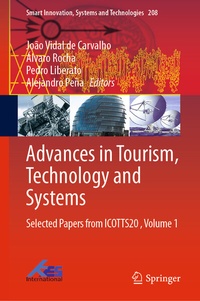
Advances in Tourism, Technology and Systems
Description

More details
Other editions
Additional editions
Persons
João Vidal de Carvalho is Adjunct Professor at the Institute of Accounting and Administration of Porto, Polytechnic of Porto (Portugal). He completed postdoctorate in Technologies and Information Systems from the University of Coimbra (Portugal), PhD in Information Systems and Technology from the University of Santiago de Compostela (Spain), MSc in Information Technology Management from the University of Minho (Portugal), and Bachelor in Computer Science. He is an effective member of the CEOS.PP Research Center-Center for Organizational and Social Studies of the Polytechnic of Oporto-and member of LIACC Artificial Intelligence and Computer Science Laboratory-FEUP. He is a member of the Iberian Systems and Information Technology Association (AISTI) and Conference Chair of the ICOTTS 2019-The 2019 International Conference on Tourism, Technology & Systems. He published some books in computer science/database management. He is a scientific committee member of several conferences in thearea of Information Systems and Technologies.
Álvaro Rocha holds the title of Honorary Professor and holds a D.Sc. in Information Science, Ph.D. in Information Systems and Technologies, M.Sc. in Information Management, and BCS in Computer Science. He is Professor of Information Systems at the University of Lisbon, President of AISTI (the Iberian Association for Information Systems and Technologies), Chair of the IEEE Portugal Section Systems, Man, and Cybernetics Society Chapter, and Editor-in-Chief of both JISEM (Journal of Information Systems Engineering & Management) and RISTI (Iberian Journal of Information Systems and Technologies). Moreover, he has served as Vice-Chair of Experts for the European Commission's Horizon 2020 program and as Expert at the COST-intergovernmental framework for European Cooperation in Science and Technology, at the Government of Italy's Ministry of Education, Universities and Research, at the Government of Latvia's Ministry of Finance, at the Government of Mexico's National Council of Science and Technology, and at the Government of Polish's National Science Centre.
Pedro Liberato is Professor of Tourism, specializing in tourism destinations management, tourism planning, and tourism marketing, at the School of Hospitality and Tourism, Polytechnic of Porto. Currently, he coordinates the Tourism and Leisure Department and the master's degree in Tourism Management in the same school. His main research interests are tourism management, tourism planning, e-tourism, ICT in tourism, and tourism marketing.
Alejandro Peña is part of the academic staff in EIA University in the area of Management, Finance, and Computer Science. He has a Bachelor's degree in Mechanical Engineering, a Master's degree in Systems Engineering, and a Ph.D. in Engineering and is Postdoctoral Researcher focused on Machine Learning. Mr. Peña has developed several researches and publications in advanced topics related to computational intelligence and machine learning, in fields such as financial risk, decision management, precision agriculture, and other areas related to computer science.
