

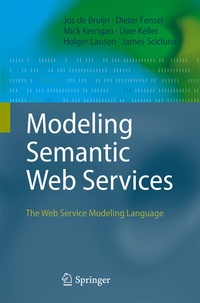
Modeling Semantic Web Services
Description

Semantic Web services promise to automate tasks such as discovery, mediation, selection, composition, and invocation of services, enabling fully flexible automated e-business. Their usage, however, still requires a significant amount of human intervention due to the lack of support for a machine-processable description.
In this book, Jos de Bruijn and his coauthors lay the foundations for understanding the requirements that shape the description of the various aspects related to Semantic Web services, such as the static background knowledge in the form of ontologies, the functional description of the service, and the behavioral description of the service. They introduce the Web Service Modeling Language (WSML), which provides means for describing the functionality and behavior of Web services, as well as the underlying business knowledge, in the form of ontologies, with a conceptual grounding in the Web Service Modeling Ontology.
Academic and industrial researchers as well as professionals will find a comprehensive overview of the concepts and challenges in the area of Semantic Web services, the Web Services Modeling Language and its relation to the Web Services Modeling Ontology, and an in-depth treatment of both enabling technologies and theoretical foundations.
Reviews / Votes
From the reviews:
"This book ... is essential for every scholar or professional who is serious about semantic Web services" from the ACM Reviews by Mariana Damova, Mozaika, Sofia, Bulgaria
"This book introduces the new Web service modeling language (WSML), a semantic Web-based formal language for automating Web services-related tasks. The target audience of the book is listed as professionals, academics, and industry researchers. . it is more suited for researchers who are interested in obtaining in-depth knowledge of WSML. . In conclusion, this is a well-organized and well-written book. I highly recommend it to researchers interested in learning about WSML." (Rajani S. Sadasivam, ACM Computing Reviews, May, 2009)
More details
Other editions
Additional editions
Persons
Jos de Bruijn received his Master of Science degree in Technical Informatics from the Delft, University of Technology, The Netherlands, in 2003. Since 2003 he is employed as a researcher at the Digital Enterprise Research Institute (DERI), at the University of Innsbruck, Austria. His research interests include Semantic Web (Services) languages, Logical languages, Logic Programming and Non-Monotonic Reasoning. He is the main architect of the WSML language.
Dieter Fensel is the Scientific Director of the Digital Enterprise Research Institute (DERI) at the National University of Ireland, Galway in 2003, and the Director of the Digital Enterprise Research Institute (DERI) at the Leopold Franzens University of Innsbruck, Austria in 2006. His current research interests are around the usage of semantics in 21st century computer science.
