

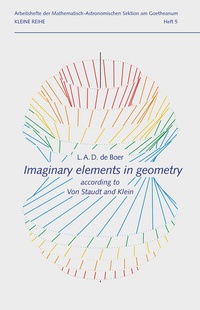
Imaginary elements in geometry
according to Von Staudt and Klein
Published on 2. September 2024
178 pages
978-3-7235-1747-5 (ISBN)
Description

A remarkable fact in mathematics is the accordance between algebra and geometry: since the time of Descartes it is possible to express geometric phenomena in terms of numbers. And after doing calculations with these numbers, we can draw geometric conclusions from them. However, soon it appeared that, for instance, a circle and a line outside that circle have 'imaginary' meeting points: points that have imaginary coordinates but can not be found in the figure. Karl von Staudt found a brilliant way to visualize imaginary geometric points, lines and planes, and Felix Klein simplified and extended his method. In this book imaginary elements appear as Klein-movements in our real space. Apart from its mathematical importance, these movements may be seen as an alternative for the remarkable occurrences of complex numbers in physics, viz. quantum physics.
Lou de Boer (*1947) studied mathematics and music in Amsterdam. From 1971 to 1986 he was a math teacher at a gymnasium in the same city and from 1986 till 1993 he was an ICT-consultant at the Dutch Telecom-company. After that he took mathematics up again, studied, gave lectures and wrote articles and books. In 1977, after having been a convinced materialist/reductionist for seven years, he met anthroposophy. Since then he tries to work in accordance with spiritual science
Lou de Boer (*1947) studied mathematics and music in Amsterdam. From 1971 to 1986 he was a math teacher at a gymnasium in the same city and from 1986 till 1993 he was an ICT-consultant at the Dutch Telecom-company. After that he took mathematics up again, studied, gave lectures and wrote articles and books. In 1977, after having been a convinced materialist/reductionist for seven years, he met anthroposophy. Since then he tries to work in accordance with spiritual science
More details
Other editions
Additional editions
L.A.D. de Boer | Mathematisch-Astronomische Sektion
Imaginary elements in geometry
according to Von Staudt and Klein
Book
05/2024
Verlag am Goetheanum
€34.90
Shipment within 5-7 days
Persons
Lou de Boer (*1947) studied mathematics and music in Amsterdam. From 1971 to 1986 he was a math teacher at a gymnasium in the same city, and from 1986 till 1993 he was an ICT-consultant at the Dutch Telecom-company. After that he took mathematics up again, studied, gave lectures and wrote articles and books. In 1977, after having been a convinced materialist/reductionist for seven years, he met anthroposophy. Since then, he tries to work in accordance with spiritual science.
Content
- Cover
- Impressum
- Preface
- Contents
- I 1-dimensional geometry
- 1 The theory of Von Staudt
- 1.1 The common points of conic and line
- 1.2 Orientation of the line
- 1.3 Imaginary points
- 1.4 Coordinates
- 2 The theory of Klein
- 2.1 Definition
- 2.2 Coordinates
- 2.3 Klein versus Von Staudt
- 3 Groups of automorphisms
- 3.1 Elliptic maps
- 3.2 Drawback
- 3.3 Application to physics
- 4 Constructions
- 4.1 The fundamental construction
- 4.2 The dual construction
- 4.3 The fundamental construction in space
- 4.4 Construction of an imaginary point
- 4.5 Construction of an imaginary line
- 4.6 Construction of an involution
- 4.7 Constructing a Klein-map with a conic
- II 2-dimensional geometry
- 5 The Klein-plane
- 5.1 Imaginary elements
- 5.2 Ordering
- 5.3 The Staudt-plane
- 6 The numerical plane
- 7 The bijection
- 7.1 The coordinate map ?
- 7.2 Consistency
- 7.3 The inverse of ?
- 7.4 The invariance of ?
- 7.5 More objections
- 8 Conic and line
- 8.1 Orientation on a conic
- 8.2 Von Staudt's method
- 8.3 Klein's method
- 8.4 An example
- 8.5 Conversion Klein-Staudt
- 9 Extension to the plane?
- 9.1 The cubic
- 9.2 W-curves
- III 3-dimensional geometry
- 10 The numerical space
- 10.1 Definitions
- 10.2 Plücker-coordinates
- 10.3 Ordering, join, meet
- 10.4 Types of lines
- 10.5 Projective maps
- 10.6 The linear congruence
- 11 The Klein-space
- 11.1 The synthetic space
- 11.2 Low imaginary elements
- 11.3 The high imaginary line
- 11.4 The matrix of a high imaginary line
- 11.5 Sets and numbers
- 11.6 Ordering
- 11.7 Meet and join
- 11.8 Is our Klein-space a projective one?
- 12 The bijection for 3-d
- 12.1 Point and plane coordinates
- 12.2 The coordinates of a line
- 12.3 The inverse of ?
- 13 Invariance of dim and ?
- 13.1 Dimension
- 13.2 Containment
- 14 W-curves in space
- IV Appendix
- 15 Klein's original text
- 16 Projective spaces
- 16.1 Definition of 'projective space'
- 16.2 Subspaces
- 16.3 Isomorphic spaces
- 16.4 Eigenspaces
- 17 Geometry of the line
- 17.1 Orientation
- 17.2 Separation
- 17.3 Cross Ratio
- 17.4 Maps of the real line
- 17.5 Maps of the complex line
- 17.6 Splitting matrices
- 17.7 The standard elliptic map
- 18 The Klein-arrow
- 18.1 Arrow and twist in the plane
- 18.2 Extension to space
- 19 Various
- 19.1 Non-integer powers of a matrix
- 19.2 An image of the linear congruence
- 19.3 Postponed proofs
- 19.4 Three non-concurrent lines in the plane
- 19.5 The projective image of a line
- Bibliography
- List of symbols
- Index
- Rückseite Umschlag
