

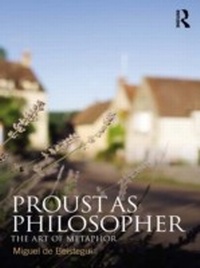
Proust as Philosopher
The Art of Metaphor
1st Edition
Published on 12. November 2012
136 pages
978-1-135-72252-4 (ISBN)
Description

Marcel Proust's In Search of Lost Time has long fascinated philosophers for its complex accounts of time, personal identity and narrative, amongst many other themes. Proust as Philosopher: The Art of Metaphor is the first book to try and connect Proust's implicit ontology of experience with the question of style, and of metaphor in particular.
Miguel de Beistegui begins with an observation: throughout In Search of Lost Time, the two main characters seem prone to chronic dissatisfaction in matters of love, friendship and even art. Reality always falls short of expectation. At the same time, the narrator experiences unexpected bouts of intense elation, the cause and meaning of which remain elusive. Beistegui argues we should understand these experiences as acts of artistic creation, and that this is why Proust himself wrote that true life is the life of art.
He goes on to explore the nature of these joyful and pleasurable experiences and the transformation required of art, and particularly literature, if it is to incorporate them. He concludes that Proust revolutionises the idea of metaphor, extending beyond the confines of language to understand the nature of lived, bodily experience.
Miguel de Beistegui begins with an observation: throughout In Search of Lost Time, the two main characters seem prone to chronic dissatisfaction in matters of love, friendship and even art. Reality always falls short of expectation. At the same time, the narrator experiences unexpected bouts of intense elation, the cause and meaning of which remain elusive. Beistegui argues we should understand these experiences as acts of artistic creation, and that this is why Proust himself wrote that true life is the life of art.
He goes on to explore the nature of these joyful and pleasurable experiences and the transformation required of art, and particularly literature, if it is to incorporate them. He concludes that Proust revolutionises the idea of metaphor, extending beyond the confines of language to understand the nature of lived, bodily experience.
Reviews / Votes
"De Beistegui is bold to write yet one more book on philosophy in Proust. Bold and successful, since his attention to metaphor allows him to discover new insights, sometimes by clarification, other times through expansion into uncharted territory. ... The author, with the aid of his translators, Katz and Simon, creates a work that is artful and a pleasure to read. ... Beistegui gives us much to think about." - Katherine Elkins, Notre Dame Philosophical Reviews"Miguel de Beistegui is the rarest kind of philosophical reader: one who follows Proust where he goes, rather than leading him to foreordained theoretical conclusions, one who learns about life from Proust, rather than translating him into terms already known. This book deserves a place among the very small number of works on Proust that are serious about the depth and richness of Proust's thought. And the beautiful translation of Beistegui's account of Proust's style and vocabulary will enrich any English language reader's sense of Proust's language." - William Flesch, Brandeis University, USA
"Miguel de Beistegui's thought-provoking exploration of memory, imagination, metaphor, and that elusive quest for joy in the recherche masterfully illuminates the genius of Proust's fusion of philosophy and literature into a cathedral of words that transcends both without leaving either behind. Not only a welcome contribution to areas often neglected in Proust scholarship; it is also a challenging engagement with Proust's exploration of the human condition." - Nicolas de Warren, University of Leuven, Belgium "De Beistegui is bold to write yet one more book on philosophy in Proust. Bold and successful, since his attention to metaphor allows him to discover new insights, sometimes by clarification, other times through expansion into uncharted territory. ... The author, with the aid of his translators, Katz and Simon, creates a work that is artful and a pleasure to read. ... Beistegui gives us much to think about." - Katherine Elkins, Notre Dame Philosophical Reviews
"Miguel de Beistegui is the rarest kind of philosophical reader: one who follows Proust where he goes, rather than leading him to foreordained theoretical conclusions, one who learns about life from Proust, rather than translating him into terms already known. This book deserves a place among the very small number of works on Proust that are serious about the depth and richness of Proust's thought. And the beautiful translation of Beistegui's account of Proust's style and vocabulary will enrich any English language reader's sense of Proust's language." - William Flesch, Brandeis University, USA
"Miguel de Beistegui's thought-provoking exploration of memory, imagination, metaphor, and that elusive quest for joy in the recherche masterfully illuminates the genius of Proust's fusion of philosophy and literature into a cathedral of words that transcends both without leaving either behind. Not only a welcome contribution to areas often neglected in Proust scholarship; it is also a challenging engagement with Proust's exploration of the human condition." - Nicolas de Warren, University of Leuven, Belgium
"In short, [this] is a valuable study, incorporating what has been done before while at the same time moving things in a fresh direction. Best of all, it sends the reader back, with renewed wonder, to Proust's giant and magnificent novel." -Adam Gonya, Independent Scholar
More details
Language
English
Place of publication
London
United Kingdom
Publishing group
Taylor & Francis Ltd
Target group
College/higher education
File size
1,10 MB
ISBN-13
978-1-135-72252-4 (9781135722524)
Copyright in bibliographic data and cover images is held by Nielsen Book Services Limited or by the publishers or by their respective licensors: all rights reserved.
Schweitzer Classification
Other editions
Additional editions
Book
08/2012
1st Edition
Routledge
€205.70
Shipment within 15-20 days
Book
08/2012
1st Edition
Routledge
€71.70
Shipment within 15-20 days
Persons
Miguel de Beistegui is Professor of Philosophy at the University of Warwick, UK. His books include Aesthetics After Metaphysics: From Mimesis to Metaphor (Routledge, 2012), Immanence and Philosophy: Deleuze (2010), Truth and Genesis: Philosophy as Differential Ontology (2005) and Heidegger and the Political (Routledge, 1998). He is editor (with Simon Sparks) of Philosophy and Tragedy (Routledge, 2000).
Content
1. Looking for Joy 2. Proust Among the Psychologists 3. Finding Joy (Involuntary Memory) 4. Giving Joy (Metaphor) 5. Dress or Patchwork? Index
