

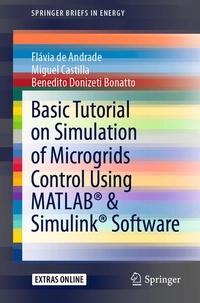
Basic Tutorial on Simulation of Microgrids Control Using MATLAB® & Simulink® Software
Description

This book offers a detailed guide to the design and simulation of basic control methods applied to microgrids in various operating modes, using MATLAB® Simulink® software. It includes discussions on the performance of each configuration, as well as the advantages and limitations of the droop control method.
The content is organised didactically, with a level of mathematical and scientific rigour suitable for undergraduate and graduate programmes, as well as for industry professionals. The use of MATLAB® Simulink® software facilitates the learning process with regard to modelling and simulating power electronic converters at the interface of distributed energy resource (DER) systems. The book also features a wealth of illustrations, schematics, and simulation results.
More details
Other editions
Additional editions
Persons
Flávia de Andrade received his Bachelor's degree from the Technological Federal University of Parana in 2016, and is currently studying for his M.Sc. at Heriot-Watt University. He has professional experience as an energy efficiency engineer at MGD Eficiência Energética and Vitalux Projetos Sustentáveis and has been a research intern at the Polytechnic University of Catalonia. He has completed other academic and professional qualifications, including a Green Building and Sustainable Design Certificate from the University of California.
Professor Miguel Castilla received his Ph.D. from the Technical University of Catalonia in 1998. He subsequently held a number of teaching positions at the same institution and is now a Full Professor at the Department of Electronic Engineering. He has authored or co-authored more than 80 journal articles and over 130 conference papers. He has been a member of numerous committees and journal boards and is currently an Editor of the journal IET Power Electronics and a member of the external advisory board for the Smart Cities Research Center.Benedito Donizeti Bonatto received his M.Sc. from UNICAMP and his Ph.D. from the University of British Columbia (UBC) in 1995 and 2001, respectively. He subsequently worked in engineering and Research and Development roles within the electricity sector. Since 2007, he has been an Associate Professor at UNIFEI - Federal University of Itajuba. He has also been a Visiting Associate Professor at the Department of Electrical and Computer Engineering, UBC, and is currently visiting at Escola Politècnica Superior d'Enginyeria de Vilanova i la Geltrú. He has published more than 100 technical papers in national and international conference proceedings, and has authored one book and one book chapter.
Content
Introduction.- Operation Modes of a Microgrid.- Control Methods of Microgrids.- Case Studies: Modeling and Simulation.- Conclusion.
