

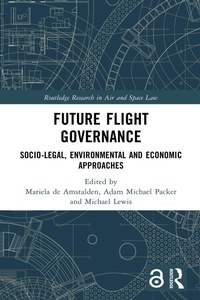
Future Flight Governance
Socio-legal, Environmental and Economic Approaches
1st Edition
Published on 19. November 2025
272 pages
978-1-040-64771-4 (ISBN)
Description

This book seeks to bridge disciplinary and scholarly gaps by bringing together a range of social science studies to capture state-of-the-art advancements in the field of advanced air technology governance, as the vision for the future of aviation systems evolves.
With novel and innovative developments taking place in many different technological fields, the future of aviation is at a pivotal point. Advanced air technologies, including drones, electric vertical take-off and landing vehicles, and electric/hydrogen-fuelled conventional take-off and landing aircraft could transform how we live, move, and transport goods. What we call 'future flight' encompasses a complex range of legal, social, economic, cultural, and environmental issues that cut across a diverse range of sectors, stakeholders, and disciplines. This book discusses the transformative nature of emerging advanced air technologies through an inter- and cross-disciplinary lens, with chapters covering law, economics, geography, and accessibility, alongside other relevant issues that look beyond conventional methodologies and traditional disciplines.
The book will be of interest to academics, practitioners, policy makers, regulators, and those stakeholders working at the intersection of law, policy and governance of emerging technologies, science, the environment, and the economy.
The Open Access version of this book, available at http://www.taylorfrancis.com, has been made available under a Creative Commons Attribution-Non Commercial-No Derivatives (CC BY-NC-ND) 4.0 license.
With novel and innovative developments taking place in many different technological fields, the future of aviation is at a pivotal point. Advanced air technologies, including drones, electric vertical take-off and landing vehicles, and electric/hydrogen-fuelled conventional take-off and landing aircraft could transform how we live, move, and transport goods. What we call 'future flight' encompasses a complex range of legal, social, economic, cultural, and environmental issues that cut across a diverse range of sectors, stakeholders, and disciplines. This book discusses the transformative nature of emerging advanced air technologies through an inter- and cross-disciplinary lens, with chapters covering law, economics, geography, and accessibility, alongside other relevant issues that look beyond conventional methodologies and traditional disciplines.
The book will be of interest to academics, practitioners, policy makers, regulators, and those stakeholders working at the intersection of law, policy and governance of emerging technologies, science, the environment, and the economy.
The Open Access version of this book, available at http://www.taylorfrancis.com, has been made available under a Creative Commons Attribution-Non Commercial-No Derivatives (CC BY-NC-ND) 4.0 license.
More details
Series
Edition
1. Auflage
Language
English
Place of publication
London
United Kingdom
Publishing group
Taylor & Francis Ltd
Target group
College/higher education
Professional and scholarly
Product notice
Reflowable
Illustrations
18 Tables, black and white; 11 Line drawings, black and white; 15 Halftones, black and white; 26 Illustrations, black and white
File size
3,71 MB
ISBN-13
978-1-040-64771-4 (9781040647714)
Copyright in bibliographic data and cover images is held by Nielsen Book Services Limited or by the publishers or by their respective licensors: all rights reserved.
Schweitzer Classification
Other editions
Additional editions
Mariela de Amstalden | Adam Michael Packer | Michael Lewis
Future Flight Governance
Socio-legal, Environmental and Economic Approaches
Book
11/2025
1st Edition
Routledge
€207.90
Shipment within 10-20 days
Persons
Mariela de Amstalden (Dr.iur., LL.M, FHEA, attorney-at-law) is an interdisciplinary and socio-legal scholar. Her academic research focuses on the law of transformative technologies, global economic governance, and intellectual property rights. She is currently on research sabbatical as visiting fellow at the Lauterpacht Centre for International Law, Faculty of Law, University of Cambridge (UK) under a Royal Society APEX Award (APX\R1\231024) for her work on the legalities of future technologies. Formerly, she was an Associate Professor in Law and Technology at the University of Exeter (UK) and Assistant Professor in Intellectual Property and Innovation Law at the University of Birmingham (UK).
Adam Michael Packer is a Postdoctoral Research Fellow in the Institute for STEMM in Culture and Society (ISTEMMiCS) at the University of Birmingham, United Kingdom, and he is part of the ESRC Future Flight Social Science research team. He received his PhD degree from the School of Geography and the Environment at the University of Oxford. His research is broadly interested in the relationship between technology, innovation, and society, with a focus on urban governance and citizenship.
Michael Lewis is a Professor at the University of Bath School of Management. An experienced researcher, teacher, and advisor in operational and supply systems, he is the author of more than 60 journal articles and books, including the widely translated textbook, Operations Strategy, now in its 7th edition. His portfolio of activities has included a long-standing engagement with public policy: health and social care services, local government, major project initiation, public-private partnerships and, most recently, the governance of complex technologies, including unmanned aerial systems (UAS). Recent drone related publications include "A Better Way to Pilot Emerging Technologies" published in MIT Sloan Management Review in 2024.
Adam Michael Packer is a Postdoctoral Research Fellow in the Institute for STEMM in Culture and Society (ISTEMMiCS) at the University of Birmingham, United Kingdom, and he is part of the ESRC Future Flight Social Science research team. He received his PhD degree from the School of Geography and the Environment at the University of Oxford. His research is broadly interested in the relationship between technology, innovation, and society, with a focus on urban governance and citizenship.
Michael Lewis is a Professor at the University of Bath School of Management. An experienced researcher, teacher, and advisor in operational and supply systems, he is the author of more than 60 journal articles and books, including the widely translated textbook, Operations Strategy, now in its 7th edition. His portfolio of activities has included a long-standing engagement with public policy: health and social care services, local government, major project initiation, public-private partnerships and, most recently, the governance of complex technologies, including unmanned aerial systems (UAS). Recent drone related publications include "A Better Way to Pilot Emerging Technologies" published in MIT Sloan Management Review in 2024.
Content
Introduction
Section I: Understandings and Perceptions of Future Flight
1. (Re-)Imagining Future Flight in the UK: Public Responses to Future Flight Media Imagery and their Implications
2. Perceptions of Future Flight Technologies through a Social Psychological Lens: The stereotypes we hold and the impacts they have
3. Advanced Air Mobility Grey Literature: Key Themes and Frames
Section II: Shaping Experiences of Future Flight
4. Accessibility in Current Air Travel: Considerations for Future Flight Technologies
5. From Hindsight to Foresight: Leveraging TRSE Research for Inclusive Future Flight Development
6. Understanding Uncertainties for the Future of Drone Deliveries Through Stakeholder Engagement and Co-Design
7. Trials, Representations and Uncertainties: Involving People with Advanced Air Mobilities.
8. Approaching Future Flight: Urban Life and Design in the Drone Age
Section III: The Governance of Future Flight
9. Advocating a Multilevel Governance Analysis of Advanced Air Mobility
10. The Tentative Governance of Drone Systems: Balancing Hierarchical and Collective Mechanisms?
11. The EU's Direction of Air Travel: Charting the Flight Plan to Realise a 'Droning' Ambition
12. Envisioning Sustainable Future Flight Ecosystems
Section I: Understandings and Perceptions of Future Flight
1. (Re-)Imagining Future Flight in the UK: Public Responses to Future Flight Media Imagery and their Implications
2. Perceptions of Future Flight Technologies through a Social Psychological Lens: The stereotypes we hold and the impacts they have
3. Advanced Air Mobility Grey Literature: Key Themes and Frames
Section II: Shaping Experiences of Future Flight
4. Accessibility in Current Air Travel: Considerations for Future Flight Technologies
5. From Hindsight to Foresight: Leveraging TRSE Research for Inclusive Future Flight Development
6. Understanding Uncertainties for the Future of Drone Deliveries Through Stakeholder Engagement and Co-Design
7. Trials, Representations and Uncertainties: Involving People with Advanced Air Mobilities.
8. Approaching Future Flight: Urban Life and Design in the Drone Age
Section III: The Governance of Future Flight
9. Advocating a Multilevel Governance Analysis of Advanced Air Mobility
10. The Tentative Governance of Drone Systems: Balancing Hierarchical and Collective Mechanisms?
11. The EU's Direction of Air Travel: Charting the Flight Plan to Realise a 'Droning' Ambition
12. Envisioning Sustainable Future Flight Ecosystems
