

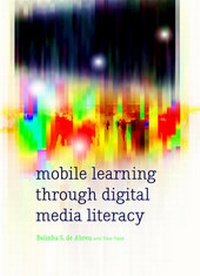
Mobile Learning through Digital Media Literacy
Description

Mobile Learning through Digital Media Literacy proposes media literacy education as a conceptual framework for bridging mobile technologies in teaching and learning. As cell phones have become more advanced and applications more innovative and fitting, candid conversations are taking place as to how technology can be a purposeful tool in the classroom. Mobile technology already attracts students and encourages text-language development; yet its accessibility affords the potential for more extended use, offering enhancement and flexibility for instructional development. In light of a shared vision of collaboration and growth developing globally within educational circles, this book examines mobile learning as a formal literacy, as a productivity environment for creative growth in and out of the classroom, and as an advancement to social learning through online networks. The book surveys media literacy education-both within the classroom and its extended implications-for concerns of civic participation and data privacy, as more educators and policymakers internationally consider the possibilities of connected classrooms and m-learning on a universal scale.
More details
Other editions
Additional editions
Persons
Belinha S. De Abreu is a media literacy educator and educational technology specialist in Connecticut. Dr. de Abreu holds a Ph.D. in curriculum and instruction, with a focus on media literacy, from the University of Connecticut. She is the author and editor of several publications, including Global Media Literacy in a Digital Age; Media Literacy in Action: Theoretical and Pedagogical Perspectives; and Media Literacy, Social Networking, and the Web 2.0 Environment for the K-12 Educator.
Vitor Tomé, Ph.D. in education (2008) and post-Ph.D. in communication studies (2015), is a professional journalist, a teacher trainer (pre-service and in-service), and a researcher on media information literacy and on journalism. Currently he is developing a research project on digital citizenship education involving children (aged three to nine), their teachers, parents, and the community.
