

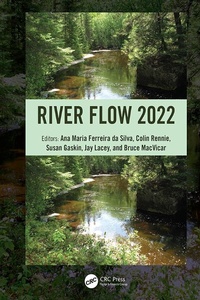
River Flow 2022
1st Edition
Published on 14. August 2024
1088 pages
978-1-040-09919-3 (ISBN)
Description

River Flow 2022 includes the keynote lecture and contributed papers presented at River Flow 2022, the 11th International Conference on Fluvial Hydraulics (8-10 November 2022, Kingston and Ottawa, Canada; held virtually).
River Flow 2022 provides an overview of the latest experimental, theoretical and computational findings on fundamental river flow and transport processes, river morphology and morphodynamics, while covering also issues related to the effects of hydraulic structures on flow regime, river morphology and ecology; sustainable river engineering practices (including stream restoration and re-naturalization); and effects of climate change including extreme flood events. The book presents the state-of-the-art in river research and engineering, and is aimed at academics and practitioners in hydraulics, hydrology and environmental engineering.
River Flow 2022 provides an overview of the latest experimental, theoretical and computational findings on fundamental river flow and transport processes, river morphology and morphodynamics, while covering also issues related to the effects of hydraulic structures on flow regime, river morphology and ecology; sustainable river engineering practices (including stream restoration and re-naturalization); and effects of climate change including extreme flood events. The book presents the state-of-the-art in river research and engineering, and is aimed at academics and practitioners in hydraulics, hydrology and environmental engineering.
More details
Edition
1. Auflage
Language
English
Place of publication
London
United Kingdom
Publishing group
Taylor & Francis Ltd
Target group
College/higher education
Professional and scholarly
File size
909,10 MB
ISBN-13
978-1-040-09919-3 (9781040099193)
Copyright in bibliographic data and cover images is held by Nielsen Book Services Limited or by the publishers or by their respective licensors: all rights reserved.
Schweitzer Classification
Other editions
Additional editions
Ana Maria Ferreira da Silva | Colin Rennie | Susan Gaskin
River Flow 2022
Book
08/2024
1st Edition
CRC Press
€416.65
Article exhausted; check different version
Persons
Ana Maria Ferreira da Silva is Professor and Head of the Department of Civil Engineering of Queen's University, Kingston, Ontario. She holds a B.Sc. in Civil Engineering (1985) from the University of Porto, Portugal, and a M.Sc. (1991) and Ph.D. (1995) from Queen's University. Her main research interests are Environmental Fluid Mechanics, River Mechanics, and Large-Scale River Morphology and Morphodynamics. She has published extensively in these topics, and especially on large-scale bed forms, resistance to flow, and the hydro-morphodynamics of meandering rivers. She is a recipient of the IAHR Arthur Thomas Ippen Award, the CSCE Camille Dagenais Award and the ASCE/EWRI Karl Emil Hilgard Hydraulic Prize. She has served IAHR as secretary, chair and past chair of the Fluvial Hydraulics Committee (2001-2013) and co-opted Council member (2007-2009). She is a Fellow of the Canadian Society for Civil Engineering and presently serves as an Associate Editor for the Canadian Journal of Civil Engineering.
Colin Rennie is a Professor of Civil Engineering at the University of Ottawa, with a research focus on highly resolved measurements and analysis of river morphodynamics and mixing processes. He has expertise in river engineering, sediment transport, ice processes, flood mitigation, hydrometry, hydrokinetic power assessment, environmental hydraulics, and aquatic habitat. He has published over a hundred journal articles, with papers in top journals including Nature. He is a Fellow of the Canadian Society for Civil Engineering, an Associate Editor of the Journal of Hydraulic Engineering (ASCE), a co-opted member of the IAHR Fluvial Hydraulics Committee, and was previously Chair of the IAHR Experimental Methods and Instrumentation Committee.
Susan Gaskin is a Professor of Environmental Hydraulics and Water Resources in the Department of Civil Engineering at McGill University. Her research is in the areas of experimental environmental hydraulics, hydraulics for hydropower, river engineering, water resources and potable water supply. Particular topics of interest are turbulent mixing and entrainment of jets in turbulent environments, fluvial erosion of post-glacial cohesive sediment, river engineering and sediment transport in river habitat improvement works and free surface vortices at hydropower intakes. The research undertaken with over forty Masters thesis and doctoral students has been published in forty-five papers in high-ranked journals including the Journal of Fluid Mechanics and Physics of Fluids. She is Associate Editor of the Canadian Journal of Civil Engineering.
Jay Lacey has been Professor in the Department of Civil and Building Engineering at the Universite de Sherbrooke (UdeS) since 2009. His research focuses on the study of fluvial hydraulic processes through in situ, laboratory, and numerical experiments. He has extensive experience of turbulent flow in open-channels, sediment transport, river restoration, coastal processes and ecohydraulics. Current projects involve bank erosion in the Outdoor Experimental River Facility (OERF) of UdeS, confluence hydrodynamics, lamprey passage, and wave impacts on coastal structures. He is an associate editor for the Canadian Journal of Civil Engineering and has published numerous papers in top ranking water resources journals. He is currently director of the Outdoor and Indoor Hydraulics Laboratories of the Civil Engineering department as well as being the director for the UdeS Water Research Group (GREAUS).
Bruce MacVicar is an Associate Professor of Civil and Environmental Engineering at the University of Waterloo. His research focusses on the dynamics of rivers and the changes that occur in response to land-use and climate change. Particular problems of interest include the measurement of flow turbulence, sediment transport and wood fluxes, the morphodynamics of riffle pools, and applications of river hydraulics to understand urban river degradation, guide river restoration, inform erosion assessment at a watershed scale, and design better stormwater management interventions. He works extensively with municipal governments and water management authorities and has published over 50 papers and book chapters, with recent Editor's Choice awards in top journals such as Water Resources Research and Journal of Hydraulic Engineering.
Colin Rennie is a Professor of Civil Engineering at the University of Ottawa, with a research focus on highly resolved measurements and analysis of river morphodynamics and mixing processes. He has expertise in river engineering, sediment transport, ice processes, flood mitigation, hydrometry, hydrokinetic power assessment, environmental hydraulics, and aquatic habitat. He has published over a hundred journal articles, with papers in top journals including Nature. He is a Fellow of the Canadian Society for Civil Engineering, an Associate Editor of the Journal of Hydraulic Engineering (ASCE), a co-opted member of the IAHR Fluvial Hydraulics Committee, and was previously Chair of the IAHR Experimental Methods and Instrumentation Committee.
Susan Gaskin is a Professor of Environmental Hydraulics and Water Resources in the Department of Civil Engineering at McGill University. Her research is in the areas of experimental environmental hydraulics, hydraulics for hydropower, river engineering, water resources and potable water supply. Particular topics of interest are turbulent mixing and entrainment of jets in turbulent environments, fluvial erosion of post-glacial cohesive sediment, river engineering and sediment transport in river habitat improvement works and free surface vortices at hydropower intakes. The research undertaken with over forty Masters thesis and doctoral students has been published in forty-five papers in high-ranked journals including the Journal of Fluid Mechanics and Physics of Fluids. She is Associate Editor of the Canadian Journal of Civil Engineering.
Jay Lacey has been Professor in the Department of Civil and Building Engineering at the Universite de Sherbrooke (UdeS) since 2009. His research focuses on the study of fluvial hydraulic processes through in situ, laboratory, and numerical experiments. He has extensive experience of turbulent flow in open-channels, sediment transport, river restoration, coastal processes and ecohydraulics. Current projects involve bank erosion in the Outdoor Experimental River Facility (OERF) of UdeS, confluence hydrodynamics, lamprey passage, and wave impacts on coastal structures. He is an associate editor for the Canadian Journal of Civil Engineering and has published numerous papers in top ranking water resources journals. He is currently director of the Outdoor and Indoor Hydraulics Laboratories of the Civil Engineering department as well as being the director for the UdeS Water Research Group (GREAUS).
Bruce MacVicar is an Associate Professor of Civil and Environmental Engineering at the University of Waterloo. His research focusses on the dynamics of rivers and the changes that occur in response to land-use and climate change. Particular problems of interest include the measurement of flow turbulence, sediment transport and wood fluxes, the morphodynamics of riffle pools, and applications of river hydraulics to understand urban river degradation, guide river restoration, inform erosion assessment at a watershed scale, and design better stormwater management interventions. He works extensively with municipal governments and water management authorities and has published over 50 papers and book chapters, with recent Editor's Choice awards in top journals such as Water Resources Research and Journal of Hydraulic Engineering.
Content
THEME A. FUNDAMENTAL FLOW PROCESSES
Theme B. SEDIMENT PROCESSES AND RIVER MORPHODYNAMICS
Theme C: HYDRAULIC STRUCTURES AND THEIR EFFECTS ON BED AND FLOW REGIME
Theme D: ECO-HYDRAULICS, VEGETATION, WOOD, AND RIVER RESTORATION
Theme E: POLLUTANT DYNAMICS AND MIXING PROCESSES
?
Theme F: EXTREME EVENTS AND EFFECTS OF CLIMATE CHANGE
Theme B. SEDIMENT PROCESSES AND RIVER MORPHODYNAMICS
Theme C: HYDRAULIC STRUCTURES AND THEIR EFFECTS ON BED AND FLOW REGIME
Theme D: ECO-HYDRAULICS, VEGETATION, WOOD, AND RIVER RESTORATION
Theme E: POLLUTANT DYNAMICS AND MIXING PROCESSES
?
Theme F: EXTREME EVENTS AND EFFECTS OF CLIMATE CHANGE
