

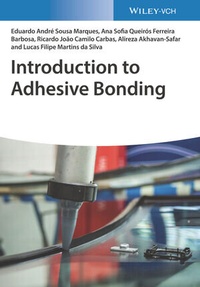
Introduction to Adhesive Bonding
Description

Adhesive bonding - the process of joining two surfaces using glues, epoxies, plastic agents, and other adhesives - is a major technique with wide applications in industries as a diverse as aerospace, footwear manufacturing, and food packaging. Adhesive bonding holds several advantages over conventional joining techniques, such as uniform stress concentrations, protection of the bonded surfaces or joints, and the ability to join a variety of different materials and irregular surfaces.
Introduction to Adhesive Bonding provides an accessible overview of the principles and common applications of adhesive bonding. Using a systematic approach, the authors thoroughly explain each step necessary to achieve a successful adhesive bond, including surface preparation, bonding agent selection, design and construction of bonded joints, health and safety considerations, and quality control. Readers are provided with both the theoretical foundation and practical information required to plan and complete their own adhesive bonding projects. This comprehensive yet reader-friendly volume:
* Highlights the inherent advantages of adhesive bonding in various applications
* Describes the use of adhesive bonding in the development of novel and advanced projects in different industries
* Features numerous real-world examples of adhesive bonding in areas such as the transportation industry, civil engineering, medical applications, and sports equipment
* Discusses how adhesives enable development of new products and constructions of reduced weight and size
* Identifies important limitations and durability concerns of the use of adhesives in specific applications
Introduction to Adhesive Bonding is an ideal textbook for undergraduate or graduate Engineering and Chemistry programs, and a useful reference for researchers and industry professionals working in fields such as Engineering, Surface and Polymer Chemistry, and Materials Science.
More details
Other editions
Additional editions
Persons
Ricardo Carbas is an Assistant Professor at the Department of Mechanical Engineering of the Faculty of Engineering of the University of Porto, He obtained his PhD in adhesive bond technologies in 2013 from the University of Porto (Portugal). He has published 55 ISI papers on adhesive technologies. His papers were cited 881 times and correspond to an h-index of 16 (SCOPUS, 01/2020).
Eduardo Marques is an Assistant Researcher in Institute of Science and Innovation in Mechanical and Industrial, he obtained his PhD in adhesive bond technologies in 2016 from the University of Porto (Portugal). He has published 55 ISI papers on adhesive technologies. His papers were cited 666 times and correspond to an h-index of 15 (SCOPUS, 01/2020).
Ana Queirós Barbosa are currently is an Assistant Researcher in Institute of Science and Innovation in Mechanical and Industrial, she obtained her PhD in Reinforcement adhesives in 2017 and MSc in Material Science from the University of Porto (Portugal). She has published 18 ISI papers and book chapter mainly on adhesive technologies. Her papers were cited 157 times and correspond to an h-index of 7 (SCOPUS, 01/2020).
Alireza Ahkavan-Safar are currently is an Assistant Researcher in Institute of Science and Innovation in Mechanical and Industrial, he obtained his PhD in Adhesive mechanical characterization in 2017 from the Iran University of Science and Technology (Iran). He has published 17 ISI paper mainly on adhesive characterization. His papers were cited 60 times and correspond to an h-index of 4 (SCOPUS, 01/2020).
Content
1.1 - Definition of basic concepts
1.2 - Historical context on adhesive bonding
1.3 - Benefits and limitations of adhesive bonding
1.4 - Examples of current applications of adhesive bonding
1.4.1 - Transportation
1.4.1.1 - Aeronautical industry
1.4.1.2 - Road transport and rail industry
1.4.1.3 - Naval industry
1.4.2 - Civil engineering
1.4.2.1 - Tiling
1.4.2.2 - Floor covering
1.4.2.3 - Anchoring systems
1.4.2.4 - Building facades
1.4.2.5 - Wooden construction
1.4.3 - Labelling and packaging industry
1.4.3.1 - Labelling of consumable products
1.4.3.2 - Packaging
1.4.4 - Medical applications and devices
1.4.5 - Electronic devices
1.4.6 - Sport equipment
1.4.7 - Footwear
Chapter 2 - PRINCIPLES OF ADHESION
2.1 - Forces associated with adhesion
2.2 - Surface roughness
2.3 - Wettability
2.4 - Adhesion and cohesion work
2.5 - Spreading
2.6 - Adhesion theories
2.6.1 - Adsorption theory
2.6.2 - Mechanical theory
2.6.3 - Diffusion theory
2.6.4 - Electrostatic theory
2.7 - Defects and weak spots in adhesive joints
Chapter 3 - SURFACE PREPARATION
3.1 - Objectives of surface preparation
3.2 - Classes of substrate materials
3.2.1 - Metals
3.2.2 - Polymers
3.2.3 - Composites
3.2.4 - Other materials
3.3 - Surface preparation processes
3.3.1 - Passive processes
3.3.2 - Active processes
3.3.3 - Primers and adhesion promoters
3.4 - Conservation of the post-treatment surface
Chapter 4 - MAIN FAMILIES OF ADHESIVES AND ADHESIVE SELECTION
4.1 - Typical composition of a modern adhesive
4.2- Methods for adhesive classification
4.2.1 - Molecular structure
4.2.2 - Physical form
4.2.3 - Mechanical properties
4.2.4 - Hardening and implementation method
4.2.5 - Chemical composition
4.3 - Main structural adhesives
4.3.1 - Epoxy adhesives
4.3.2 - Polyurethane adhesives
4.3.3 - Acrylic adhesives
4.3.4 - Phenolic adhesives
4.3.5 - Aromatic adhesives
4.4 - Main non-structural adhesives
4.4.1 - Elastomeric adhesives
4.4.2 - Polyester adhesives
4.4.3 - Hotmelt adhesives
4.4.4 - Inorganic adhesives
4.5 - How to select an adhesive
4.5.1 - Case study: adhesive selection for the automotive industry
4.6 - How to test and characterize an adhesive
4.6.1 - Mechanical testing
4.7 - Mechanical properties of adhesives
Chapter 5 - MANUFACTURE
5.1 - Adhesive storage
5.1.1 - Storage time
5.1.2 - Humidity
5.1.3 - Temperature
5.1.4 - Light and UV radiation
5.2 - Adhesive metering and mixing
5.2.1 - Adhesive metering
5.2.2 - Adhesive mixing
5.3 - Adhesive forms and application
5.3.1 - Liquid adhesives
5.3.2 - Paste adhesives
5.3.3 - Film adhesives
5.3.4 -Tapes
5.4 - Joint assembly and fixturing
5.4.1 - Moulds and fixtures
5.4.2 - Adhesive thickness control
5.4.3 - Joint assembly
5.5 - Adhesive hardening
5.5.1 - Heat curing processes
5.5.2 - Evaporation based processes
5.6 - Finishing steps
Chapter 6 - QUALITY CONTROL
6.1 - Quality control of the incoming materials
6.1.1 - Control of adhesive quality
6.1.2 - Control of adherend quality
6.2 - Quality control of the manufacturing process
6.3 - Quality control on bonded structures
6.3.1 - Types of defects present in bonded joints
6.3.2 - Destructive tests
6.3.3 - Non-destructive tests
Chapter 7 - ENVIRONMENT, HEALTH AND SAFETY
7.1 - Toxicity of adhesives: are adhesives really toxic?
7.2 - General precautions for handling adhesives
7.2.1 - Pictograms
7.2.2 - Training for handling adhesives
7.3 - Hazardous characteristics of the most common adhesives
7.3.1 -Structural adhesives
7.3.2 - Non-structural adhesives
7.4 - Surface preparation precautions
7.5 - Adhesive application precautions
7.6 - Environmental protection
7.6.1 - Air
7.6.2 - Water
7.6.3 - Soil
Chapter 8 - DESIGN OF BONDED JOINTS
8.1 - Main loading modes on adhesive joints
8.2 - Main adhesive joint geometries
8.3 - Joint strength prediction using analytical methods
8.3.1 - Determination of
1
Benefits, Limitations, and Applications of Adhesive Bonding
Even before reading this book, you probably might already have a general idea of the advantages and capabilities of adhesive bonding, but to deepen your understanding of the subject it is necessary to first precisely define the most important concepts, benefits, and limitations associated to the use of this technique. This will allow you, as a user of this technology, to understand all the subsequent chapters of this book and eventually be able to make informed decisions regarding the usefulness of adhesive bonding and implement it in practice.
Skeist and Miron (adhesive technology scholars) first stated in 1981 that adhesives are the diplomats and the most social members of the polymer world. No other technique of joining materials is so versatile and their transversality lies in the ability to unite different materials, in their capability of remaining permanently in the assembly, in the fact that adhesives are user friendly and their success is measurable by a reduction in production costs while maintaining adequate mechanical properties. Although adhesives have been used for millennia, no other bonding technique meets current demands so successfully.
If we look around, we can easily identify applications of adhesives in numerous items of our daily life, showing how this joining technology is an important, yet somewhat hidden, tool in the way we shape our world. Adhesives are found in cutting-edge applications in the mobility sector, where materials are increasingly more complex, lighter, and the associated designs are increasingly bold. The demands of civil construction have also boosted the application of adhesives, and, in recent decades, we have increasingly seen their application in multi-material structures, something which would be virtually impossible to build using traditional techniques. Nevertheless, we also observe the application of adhesives in less demanding applications, such as small gadgets and household appliances that facilitate our daily life as well as clothes and shoes. And as we will see, adhesive bonding is also prepared to play an important role in a new world, more concerned with sustainability and ecological aspects. Today we already have adhesives that meet strict structural demands but also can be produced from materials of biological origin and with a very small ecological footprint, and the use of these materials is expected to grow significantly in the short term.
1.1 Definition of Basic Concepts
To truly understand the complexity and versatility of an adhesive, we must first clearly define and understand its role. Kinloch, in 1987, defined adhesives as a material which, when applied to surfaces of other materials, can join them together and resist separation, a very rational and synthetic definition of the capabilities of this material. It is, however, necessary to understand that not all adhesives have the same behaviour, and, therefore, it is imperative to differentiate between structural and non-structural adhesives. Adams, one of the greatest impellers of the study of adhesives in the second half of the twentieth century, stated that a structural adhesive is an adhesive that can resist substantial loads and that is responsible for the strength and stiffness of the structure. It is expected that this joint will be stable over the lifetime of the structure, i.e. that its properties will not degrade, that the joint design will be well executed, and that all necessary steps leading to a high-quality bonding joint will be undertaken.
However, if one wishes to be truly knowledgeable in this subject, it is necessary to keep a set of additional basic concepts in mind. So, let us name things as real experts. The adhesive is the substance that initially fills the gap between the materials to be bonded, adheres to them, and solidifies. The materials to be bonded are called substrates and, after bonding, the term generally used is adherend. Between the adhesive and the adherend, the interface is formed. The interface is also designated as the boundary layer and can be defined as the plane of contact between the surface of the two materials (see Figure 1.1).
Adhesives work by exploring the adhesion phenomena. We will study this subject in detail in the following (Chapter 2 - Principles of adhesion), but for now we can define adhesion as the attraction between two substances resulting from intermolecular forces established between them. A joint is the set formed by the adhesive, adherends (or possible intermediate layers as primers), and the interface. A primer is a substance that is used to inhibit corrosion and to improve the level of adhesion with the adhesive and the adherend. In an ideal and well-designed joint, the adherend should always be the weakest part, which means that the presence of the bonded joint does not reduce the strength of the structure.
Figure 1.1 Constituents of an adhesive joint.
1.2 Historical Context on Adhesive Bonding
As mentioned before, although the use of adhesives has expanded significantly since the twentieth century, their use actually dates to prehistorical periods. Adhesives extracted from natural sources were used to craft weapons, tools, and decorative objects. Evidence of application of adhesives was found in several excavations, corresponding to quite distinct civilisations (Babylon, Egypt, and the Aztecs), which indicates that the need to join materials was a common necessity for ancient people.
Around 1500 BCE, the Egyptians discovered that tendons, cartilage, and other animal waste could be reused to produce a suitable adhesive for carpentry work. As a testimony to the early historical production of glue and proof of its immense cultural importance, a mural painting was found at the tomb of the vezir Rekhmara in Thebes, which clearly demonstrates men working with this glue. The painting portrays in detail the different aspects of veneer work, including the use of gelatine glue.
The rise of Roman and Greek empires brought about the increased use of adhesives as it was applied in the construction of buildings that are still standing to this day. The art of adhesive boiling was developed further, and the profession of the adhesive cooker was established in Greece at an early stage (and called as Kellopsos). There are several reports in Greek mythology regarding the importance and symbolism given to the adhesives at that time. One of the best-known stories, and with greater emphasis on the strength and weaknesses of adhesives, is the story of Icarus and his father Daedalus using wings built with glued feathers to escape from the Minotaur's maze. Aristotle emphasised in his studies the adhesion properties that can be found in geckos, a very common animal in the Mediterranean. Geckos, like other reptiles, are animals that have the ability to adhere to vertical surfaces.
During this period of history, and due to the geographical proximity to the sea, the techniques for producing adhesives from fish and other animals had become further refined. The Romans were among the first to use beeswax and tar to caulk planking in ships and boats. They extended the range of adhesives in use at that time to include adhesives produced by boiling fish waste. Some of their knowledge has been applied in products used as late as the twentieth century. One example is the application of adhesives extracted from sturgeons in jewellery, where gems were glued to the metal using these adhesives.
However, following the decline of these civilisations and the onset of the Middle Ages, advances in the development of new adhesives halted. Science in general stagnated and the study of adhesives was no exception to this trend. The lifestyle of the populations did not undergo drastic changes until the fifteenth century. Humanity then witnessed a variety of cultural and social revolutions, which would significantly change the course of the study of adhesives, especially during the Renaissance period and the Age of Discovery. At this stage, a widespread use of adhesives in construction work and in the manufacture of furniture emerged, although most applications were still quite conservative in their nature. This period also brought forth some of the first scientific work carried out in this field. Scientists like Galileo Galilei and Isaac Newton were deeply intrigued by adhesives found in nature and attempted to understand how they worked.
Around 1750, the first patent for an adhesive was issued in Britain. This patented adhesive was produced from a fish source, still drawing from centuries-old knowledge. Further patents were then rapidly issued for adhesives derived from natural rubber, animal bones, fish, starch, milk protein or casein. The accelerated development of all these materials was mainly the result of the Industrial Revolution, which triggered technical breakthroughs that saw factories opting for new materials to formulate their adhesives. Cellulose nitrate became the first wood-derived plastic polymer to be synthesised. It was initially used in the manufacture of small items such as ivory billiard balls. Please note that the adhesives created in this era had very limited mechanical strength and were not especially well suited for structural applications. In addition, they were often limited to the geographical availability of some of these raw materials, limiting their globalisation potential.
The first real advances in the drive toward true structural adhesives took place in the late...
