

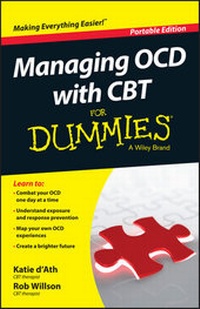
Managing OCD with CBT For Dummies, Portable Edition
Description

Are you suffering from Obsessive Compulsive Disorder (OCD)?You're not alone. Whether you've tried countless treatments or areseeking help for the first time, this expert, accessible guide isyour beacon of hope for breaking the chains of this cripplingdisorder. Managing OCD with CBT For Dummies usesmindfulness-based Cognitive Behavioural Therapy (CBT) to eradicateOCD from your day-to-day life. Through clear and sensitivedirection, you'll find out how to identify and correct negativethought patterns, confront your problems with positive solutionsand recognise the power of cognitive thinking.
Once a term only used by psychologists and counselors, CBT isnow in common use and has become the preferred treatment method fora variety of psychological issues, including anxiety anddepression, self-esteem, eating disorders, addiction, and manyothers. If you're planning on trying it on its own or inconjunction with other types of therapies, you'll be heartened toknow that a staggering 75% of people with OCD are significantlyhelped by CBT--which is why it remains the treatment of choicefor tackling the disorder by the National Institute for Health andClinical Excellence (NICE).
* Demonstrates how CBT encourages new thinking patterns to combatdestructive thought tendencies
* Explains the causes and symptoms of OCD
* Shows you how to use CBT to modify everyday thoughts andbehaviours with the aim of positively influencing youremotions
* Illustrates the importance of facing your fears and offerspositive strategies on exposure therapy
There's no need to let OCD continue to control your life. Thishow-to guide helps you break down the negative patterns that havebeen keeping you hostage--and allows you to build a positivefuture free of the hold of OCD.
More details
Other editions
Additional editions
Persons
Content
Part I: Understanding OCD 5
Chapter 1: All about OCD 7
Chapter 2: Introducing CBT for OCD 15
Part II: Thinking about Thoughts 27
Chapter 3: Thinking about Your Thoughts 29
Chapter 4: Exploring Beliefs and Meanings 37
Chapter 5: Mental Responses 45
Part III: Actively Attacking Your OCD 63
Chapter 6: Exploring Exposure and Response Prevention 65
Chapter 7: Designing Your Own Exposure and Response Prevention Exercises 75
Chapter 8: Beating OCD One Day at a Time 93
Part IV: Move Over OCD - Putting
Yourself in Charge 103
Chapter 9: Reclaiming Your Life from OCD 105
Chapter 10: Building a Brighter Future 111
Part V: The Part of Tens 117
Chapter 11: Ten Tips for Family and Friends of a Person with OCD 119
Chapter 12: Ten Things You Need More of to Help Fight Your OCD 129
Chapter 13: Ten Traps to Avoid in Recovering from OCD 137
Index 141
Chapter 1
All about OCD
In This Chapter
Explaining obsessive-compulsive disorder (OCD)
Exploring whether you may have OCD
Getting an overview of what's keeping your OCD going
Obsessive-compulsive disorder, usually referred to as OCD for short, is a common disorder that affects many people all over the world. For a long time OCD was considered rare, but research shows that between 2 and 3 percent of people will likely suffer from OCD at some point in their lifetimes, so you aren't alone!
In this chapter, we explain what OCD is in more detail and help you ascertain whether the problems you're experiencing are likely to be OCD.
Knowing What OCD Is and Isn't
Obsessive-compulsive disorder (OCD) is characterised by obsessions (see 'Observing Obsessions' later in the chapter) and/or compulsions (see 'Clarifying Compulsions' later in the chapter) - most commonly both. Someone with OCD who doesn't experience both obsessions and compulsions is actually quite rare; however, sometimes people are aware only of their compulsions, such as washing or checking, and no longer notice the obsessions that drive these. Similarly, some people may be aware only of experiencing obsessions and not realise that they're performing internal, mental compulsions. (For more on mental compulsions see, Chapter 5).
OCD ranges in severity from causing distress and negatively impacting your everyday routine to being totally debilitating to the point where you're unable to function normally.
Contrary to popular belief, OCD isn't simply a disorder where people wash their hands too much, check things or keep things orderly. You may have heard people say, 'I'm a bit OCD', usually referring to a tendency for liking things clean or tidy; however, people can have a strong preference for things to be in order and not have OCD. In these cases, people find their preference for cleanliness or orderliness a helpful attribute from which they may often derive satisfaction.
People without OCD commonly have moments of doubt - 'Did I turn my hair-straightener off?' - that lead them to double-check. This tendency is part of being human and doesn't mean you have OCD. If, on the other hand, you repeatedly check the item in an attempt to feel absolutely certain, then you may well have OCD.
OCD is a complex and often debilitating disorder the sufferer doesn't find useful or enjoyable. People suffering from OCD tend to feel high levels of discomfort, often in the form of anxiety, guilt or disgust. People with OCD often have an overinflated sense of responsibility for preventing harm and tend to feel high levels of doubt and uncertainty. A person with OCD tends to know that his behaviours or responses to his obsessions are ridiculous but feels powerless to stop performing them.
Some problems are considered part of the OCD family but aren't strictly the same thing as OCD:
- Body dysmorphic disorder (BDD): A distressing preoccupation with the idea that one is ugly
- Hoarding disorder: A life-interfering compulsion to hoard objects
- Hair-pulling disorder (trichotillomania): A compulsion or impulse to pluck hairs from the body
- Skin-picking disorder: A compulsion or impulse to squeeze spots or pick areas of the skin
- Health anxiety: A distressing preoccupation with the idea that one is ill (usually despite being given medical reassurance) or fear that one will become ill
If you think one of these conditions better describes your problem, we suggest seeking additional advice that is specific to that problem.
Deliberating upon the Diagnosis
The following is a screening questionnaire from the International Council on OCD and can give you an indication as to whether you suffer from the disorder:
- Do you wash or clean a lot?
- Do you check things a lot?
- Is there any thought that keeps bothering you that you want to get rid of but can't?
- Do your activities take a long time to finish?
- Are you concerned with orderliness or symmetry?
If you answered yes to one or more of these questions and it causes significant distress and/or it interferes in your ability to work, study or maintain your social or family life or relationships, then there is a significant chance that you have OCD. For a diagnosis, discuss your symptoms with your doctor.
Considering Causes
The question of how somebody ends up developing OCD has no simple, precise answer. OCD is a combination of several factors: biological, personality, environment and life events. Like so many other kinds of psychological problems, no single type of person develops OCD. We've met people from all walks of life who have OCD, and it certainly has nothing to do with being weak or crazy. However, researchers have identified that some psychological traits tend to be associated with vulnerability to OCD:
- Perfectionism
- Tending to be overly responsible
- Overestimating the importance of thoughts
- Intolerance of uncertainty
For most people, OCD is probably best understood as a misunderstanding of how their minds work, which can lead to some attempts to solve the problem that backfire. Throughout this book, we help you see how you too may have been trying to solve doubts, intrusive thoughts and uncomfortable feelings and that your solutions may very well have become the problem.
Observing Obsessions
Obsessions are defined as unwanted, recurrent, intrusive thoughts, impulses or images that are associated with marked distress. They aren't simply excessive worries about real-life problems and tend to be the opposite of the kinds of thoughts the individual wants to have. A person with OCD tries to avoid triggering, ignore, suppress or neutralise (for example, try to cancel out) his intrusive thoughts.
The following are common examples of obsessions in OCD:
- Doubts about causing/failing to prevent harm related to dirt, chemicals or germs
- Fears of causing harm to elderly/vulnerable people
- Fear of imagining or wishing harm upon someone close to oneself
- Impulses to violently attack, hit, harm or kill a person, small child or animal
- A need to have certain items or possessions symmetrical or just so.
- Blasphemous or 'inappropriate' religious thoughts
- Fear, guilt or disgust at inappropriate sexual thoughts
The most likely thing your certainty-demanding OCD demon will say to any list of obsessions is 'It's not quite the same as mine; what if something more dangerous than OCD is going on with me?'
Clarifying Compulsions
Compulsions are repetitive behaviours or mental acts in response to obsessions, aimed at reducing distress or doubt or preventing harm. Common compulsions (often referred to as rituals) include things like washing, checking, ordering, seeking reassurance, tapping, repeating phrases or actions, saying prayers, replacing bad thoughts or images with good ones and trying to control thoughts. Over time, compulsions become less effective, and people find that they need to work even harder to get a similar result.
- The more you check something, the more responsible you feel.
- The more you check something, the more doubts you have.
- The more you seek reassurance, the less confident you are in your own judgment.
- The more you seek reassurance, the less tolerant you are of uncertainty.
- The more you suppress a thought or image, the more intrusive it becomes. This works in exactly the same way as trying to get an annoying song out of your head; it works backward and makes it more intrusive.
- The more you analyse a thought or threat, the more significant your brain thinks it is and the more attention your brain pays to it. This tendency can mean that thought or threat really dominates your sense of what is happening in the world.
- The more you try to reduce and avoid threats (such as contaminants or knives), the more aware of them you become.
Acknowledging Avoidance
A third key aspect of OCD is avoidance of the triggers for obsessions. Each time the person avoids a situation or activity, the behaviour is reinforced because he has prevented himself from experiencing anxiety and the harm he thinks could have occurred. For example, if you avoid touching an item because of the fear of danger or harm, you prevent yourself from feeling anxious, and your mind is likely to encourage you to avoid touching it again.
The more you avoid something you're afraid of, the more your fear of that person, place, object, thought, image, substance or bodily sensation increases.
Avoidance often seesaws with compulsions; if you can't avoid, you'll often carry out a compulsion. If doing compulsions becomes very troublesome, you'll probably try harder to avoid.
The places, people, items, substances, pictures, news stories and so on that activate your obsessions or that you tend to avoid are commonly referred to as triggers. Spending a few days with a notebook (or your smartphone!) recording your triggers, what obsessions they activate and how you respond to help yourself feel better (which is...
