

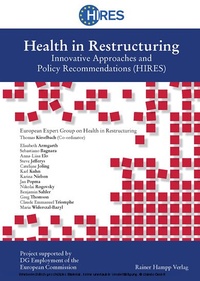
Health in Restructuring
Innovative Approaches and Policy Recommendations
1st Edition
Published on 1. January 2009
229 pages
978-3-86618-340-7 (ISBN)
Description

Enterprise restructuring can no longer be understood as a temporal crisis. Current developments show that for many organizations and even regions or sectors restructuring became a recurrent and continuous process. But often restructuring processes fail to produce the intended effects of secured or increased organizational profitability. On the contrary restructuring puts the physical and psycho-social health of all organizational members at risk. Besides the uncovering of pre-existing health problems, also the chronification of these illnesses had to be documented both for laid-off workers and survivors of the restructuring. But not only increased rates of sick leave and presenteeism of sick employees deteriorate the organizational performance. Some of the irritations that restructuring can cause also directly impede inner-organizational interactions. Therefore, restructuring should be understood as an individual as well as an organizational stressor. To limit the risks of enterprise restructuring effectively, several groups of actors at the individual, enterprise and societal level have to collaborate towards the implementation of healthier change procedures and to create a social convoy in occupational transitions for workers affected by dismissal. The European Expert Group on Health in Restructuring (HIRES) was coordinated by Prof. Dr. Thomas Kieselbach from the University of Bremen and supported by DG Employment of the European Commission. It presents with this report a concise overview of the effects of enterprise restructuring and the social frameworks and change procedures that should be considered for "healthier restructuring". The results of this project are based on the interdisciplinary expertises from 15 European project partners and 12 external experts. With its policy recommendations and the case studies of innovative approaches on a company and regional level the report addresses policy makers, governmental structures like labour inspectorates or federal institutes, unions, managers, occupational health and safety personnel, shareholders and workers alike. The HIRES recommendations are even more important if we consider the current crisis with its unprecedented effects on employment and the health of employees.
More details
Other editions
Additional editions
Thomas Kieselbach | Elisabeth Armgarth | Sebastiano Bagnara
Health in Restructuring
Innovative Approaches and Policy Recommendations
Book
04/2009
1st Edition
Edition Rainer Hampp
€19.80
Article exhausted; check different version
Content
1 - Table of contents [Seite 6]
2 - Executive Summary [Seite 8]
3 - 1. Introduction [Seite 12]
3.1 - 1.1 The rationale and the actual background of the DG Employment project "Health in Restructuring" (HIRES) [Seite 12]
3.2 - 1.2 Social convoy in occupational transitions [Seite 19]
4 - 2. Restructuring and health: Reviewing present research [Seite 22]
4.1 - 2.1 Definition and typology of restructuring [Seite 22]
4.2 - 2.2 Measuring the prevalence and effects of restructuring on health at the EU level [Seite 25]
4.3 - 2.3 The effects on individual health [Seite 30]
4.4 - 2.4 The organisational health effects of restructuring [Seite 42]
5 - 3. European social frameworks and roles of social actors [Seite 49]
5.1 - 3.1 General policies of prevention and promotion [Seite 49]
5.2 - 3.2 Occupational health services: Their role in restructuring [Seite 55]
5.3 - 3.3 The role of social actors [Seite 58]
6 - 4. Tools, instruments, and practices [Seite 72]
6.1 - 4.1 Applying a systems approach to healthy changes in restructuring [Seite 72]
6.2 - 4.2 Labour inspection [Seite 73]
6.3 - 4.3 Regions and territories [Seite 76]
6.4 - 4.4 Public employment services [Seite 78]
6.5 - 4.5 Organisational level change practices [Seite 80]
6.6 - 4.6 Reprioritising health issues in restructuring by unions [Seite 90]
6.7 - 4.7 Individual level activities [Seite 91]
6.8 - 4.8 Core principles of change management [Seite 98]
7 - 5. Lessons from innovative approaches in restructuring and policy recommendations [Seite 100]
7.1 - 5.1 Concrete lessons from the case studies [Seite 101]
7.2 - 5.2. Policy recommendations [Seite 103]
8 - References [Seite 115]
9 - About the authors of the HIRES report [Seite 128]
10 - Annexes [Seite 130]
11 - 6. Empirical background information: National data on restruc-turing and related effects on health [Seite 132]
11.1 - 6.1 Prevalence of restructuring and effects on health in Germany [Seite 132]
11.2 - 6.2 Consequences of restructuring on employability, health and well-being in Denmark [Seite 135]
11.3 - 6.3 Enterprise restructuring and the health of Dutch employees [Seite 138]
11.4 - 6.4 Organisational downsizing and employee health. Lessons learned from [Seite 141]
11.5 - the Finnish 10-Town study [Seite 141]
12 - 7. Case Study Reports [Seite 150]
12.1 - 7.1. The ILO concept of Socially Sensitive Enterprise Restructuring [Seite 150]
12.2 - 7.2 Health policy in BT under continuous restructuring [Seite 155]
12.3 - 7.3 Business restructuring, health and well-being at AstraZeneca: HRM tools for personal and business benefit [Seite 162]
12.4 - 7.4 EDF Energy - Monitoring psychological well-being during change: Change management and resilience enhancement [Seite 168]
12.5 - 7.5 Restructuring Department A460 of the German pension fund: A BGF Case Study Report [Seite 176]
12.6 - 7.6 Restructuring and individual health: Ericsson and Manpower Health Partner/Sweden [Seite 181]
12.7 - 7.7 Human Resources Management protocol on restructuring [Seite 188]
12.8 - 7.8 To protect the health of employees during restructuring: Case studies from the pharmaceutical industry in France (ASP) [Seite 193]
12.9 - 7.9 How to prevent unhealthy effects of job restructuring using the French ANACT stress prevention toolkit? [Seite 197]
12.10 - 7.10 Closing of the Voikkaa paper factory: Supporting the health of employees [Seite 204]
12.11 - 7.11 Participative restructuring toward a cascade-based network [Seite 210]
12.12 - 7.12 Restructuring industry and developing a competitive economy under healthy conditions with special focus on SMEs: Policy and actions in North Rhine-Westphalia (Germany) [Seite 216]
12.13 - 7.13 Group method for promoting career management and preventing symptoms of depression in work organisations (FIOH) [Seite 223]
2 - Executive Summary [Seite 8]
3 - 1. Introduction [Seite 12]
3.1 - 1.1 The rationale and the actual background of the DG Employment project "Health in Restructuring" (HIRES) [Seite 12]
3.2 - 1.2 Social convoy in occupational transitions [Seite 19]
4 - 2. Restructuring and health: Reviewing present research [Seite 22]
4.1 - 2.1 Definition and typology of restructuring [Seite 22]
4.2 - 2.2 Measuring the prevalence and effects of restructuring on health at the EU level [Seite 25]
4.3 - 2.3 The effects on individual health [Seite 30]
4.4 - 2.4 The organisational health effects of restructuring [Seite 42]
5 - 3. European social frameworks and roles of social actors [Seite 49]
5.1 - 3.1 General policies of prevention and promotion [Seite 49]
5.2 - 3.2 Occupational health services: Their role in restructuring [Seite 55]
5.3 - 3.3 The role of social actors [Seite 58]
6 - 4. Tools, instruments, and practices [Seite 72]
6.1 - 4.1 Applying a systems approach to healthy changes in restructuring [Seite 72]
6.2 - 4.2 Labour inspection [Seite 73]
6.3 - 4.3 Regions and territories [Seite 76]
6.4 - 4.4 Public employment services [Seite 78]
6.5 - 4.5 Organisational level change practices [Seite 80]
6.6 - 4.6 Reprioritising health issues in restructuring by unions [Seite 90]
6.7 - 4.7 Individual level activities [Seite 91]
6.8 - 4.8 Core principles of change management [Seite 98]
7 - 5. Lessons from innovative approaches in restructuring and policy recommendations [Seite 100]
7.1 - 5.1 Concrete lessons from the case studies [Seite 101]
7.2 - 5.2. Policy recommendations [Seite 103]
8 - References [Seite 115]
9 - About the authors of the HIRES report [Seite 128]
10 - Annexes [Seite 130]
11 - 6. Empirical background information: National data on restruc-turing and related effects on health [Seite 132]
11.1 - 6.1 Prevalence of restructuring and effects on health in Germany [Seite 132]
11.2 - 6.2 Consequences of restructuring on employability, health and well-being in Denmark [Seite 135]
11.3 - 6.3 Enterprise restructuring and the health of Dutch employees [Seite 138]
11.4 - 6.4 Organisational downsizing and employee health. Lessons learned from [Seite 141]
11.5 - the Finnish 10-Town study [Seite 141]
12 - 7. Case Study Reports [Seite 150]
12.1 - 7.1. The ILO concept of Socially Sensitive Enterprise Restructuring [Seite 150]
12.2 - 7.2 Health policy in BT under continuous restructuring [Seite 155]
12.3 - 7.3 Business restructuring, health and well-being at AstraZeneca: HRM tools for personal and business benefit [Seite 162]
12.4 - 7.4 EDF Energy - Monitoring psychological well-being during change: Change management and resilience enhancement [Seite 168]
12.5 - 7.5 Restructuring Department A460 of the German pension fund: A BGF Case Study Report [Seite 176]
12.6 - 7.6 Restructuring and individual health: Ericsson and Manpower Health Partner/Sweden [Seite 181]
12.7 - 7.7 Human Resources Management protocol on restructuring [Seite 188]
12.8 - 7.8 To protect the health of employees during restructuring: Case studies from the pharmaceutical industry in France (ASP) [Seite 193]
12.9 - 7.9 How to prevent unhealthy effects of job restructuring using the French ANACT stress prevention toolkit? [Seite 197]
12.10 - 7.10 Closing of the Voikkaa paper factory: Supporting the health of employees [Seite 204]
12.11 - 7.11 Participative restructuring toward a cascade-based network [Seite 210]
12.12 - 7.12 Restructuring industry and developing a competitive economy under healthy conditions with special focus on SMEs: Policy and actions in North Rhine-Westphalia (Germany) [Seite 216]
12.13 - 7.13 Group method for promoting career management and preventing symptoms of depression in work organisations (FIOH) [Seite 223]
