

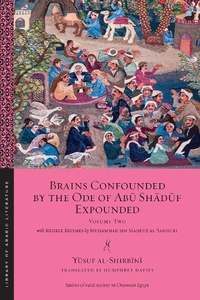
Brains Confounded by the Ode of Abu Shaduf Expounded, with Risible Rhymes
Volume Two
Published on 9. April 2019
277 pages
978-1-4798-1351-3 (ISBN)
Description

Witty, bawdy, and vicious, Yusuf al-Shirbini's Brains Confounded pits the "coarse" rural masses against the "refined" urban population. In Volume One, al-Shirbini describes the three rural "types"-peasant cultivator, village man-of-religion, and rural dervish-offering anecdotes testifying to the ignorance, dirtiness, and criminality of each. In Volume Two, he presents a hilarious parody of the verse-and-commentary genre so beloved by scholars of his day, with a 47-line poem supposedly written by a peasant named Abu Shaduf, who charts the rise and fall of his fortunes. Wielding the scholarly tools of elite literature, al-Shirbini responds to the poem with derision and ridicule, dotting his satire with digressions into love, food, and flatulence.
Volume Two of Brains Confounded is followed by Risible Rhymes, a concise text that includes a comic disquisition on "rural" verse, mocking the pretensions of uneducated poets from Egypt's countryside. Risible Rhymes also examines various kinds of puzzle poems, which were another popular genre of the day, and presents a debate between scholars over a line of verse by the fourth/tenth-century poet al-Mutanabbi. Together, Brains Confounded and Risible Rhymes offer intriguing insight into the intellectual concerns of Ottoman Egypt, showcasing the intense preoccupation with wordplay, grammar, and stylistics and shedding light on the literature of the era.
An English-only edition.
Volume Two of Brains Confounded is followed by Risible Rhymes, a concise text that includes a comic disquisition on "rural" verse, mocking the pretensions of uneducated poets from Egypt's countryside. Risible Rhymes also examines various kinds of puzzle poems, which were another popular genre of the day, and presents a debate between scholars over a line of verse by the fourth/tenth-century poet al-Mutanabbi. Together, Brains Confounded and Risible Rhymes offer intriguing insight into the intellectual concerns of Ottoman Egypt, showcasing the intense preoccupation with wordplay, grammar, and stylistics and shedding light on the literature of the era.
An English-only edition.
Reviews / Votes
Lucid and imaginative...the translation is thankfully reliable and delightfully readable...a remarkable achievement in many ways. - Li Guo (Journal of the American Oriental Society) Paints a sharp portrait of Egyptian villagers. . . . This book has long had its passionate Egyptian adherents: both for its bawdy depictions of village life and for its language, which moves deftly between colloquial and 'high' classical expressions. (Middle East Eye)More details
Series
Language
English
Place of publication
New York
United States
Target group
Professional and scholarly
Product notice
Reflowable
ISBN-13
978-1-4798-1351-3 (9781479813513)
Copyright in bibliographic data and cover images is held by Nielsen Book Services Limited or by the publishers or by their respective licensors: all rights reserved.
Schweitzer Classification
Other editions
Additional editions
Yusuf al-Shirbini | Mu?ammad ibn Ma?fu? al-Sanhuri
Brains Confounded by the Ode of Abu Shaduf Expounded, with Risible Rhymes
Volume Two
Book
04/2019
New York University Press
€17.50
Shipment within 10-20 days
Persons
Yusuf al-Shirbini (Author)
Yusuf al-Shirbini was a well-educated Egyptian from the eleventh/seventeenth century, thought to originate from the town of Shirbin, then a significant rural center in the eastern part of Delta. Little is known about him--including his social standing and profession--beyond Brains Confounded and two other extant texts: The Pearls (Al-La?ali? wa-l-durar) and The Casting Aside of the Clods for the Unstringing of the Pearls (?ar? al-madar li-?all al-la?ali? wa-l-durar).
Muhammad ibn Mahfuz al-Sanhuri (Author)
Mu?ammad ibn Ma?fu? al-Sanhuri is an eleventh/seventeenth-century author who likely hailed from Egypt's Fayyum region, although nothing else is known about him.
Humphrey Davies (Translator)
Humphrey Davies is an award-winning translator of some twenty-five works of modern Arabic literature, among them Alaa Al-Aswany's The Yacoubian Building, five novels by Elias Khoury, including Gate of the Sun, and A?mad Faris al-Shidyaq's Leg over Leg. He has also made a critical edition, translation, and lexicon of the Ottoman-period Brains Confounded by the Ode of Abu Shaduf Expounded by Yusuf al-Shirbini, as well as editions and translations of al-Tunisi's In Darfur and al-Sanhuri's Risible Rhymes from the same era. In addition, he has compiled with Madiha Doss an anthology in Arabic entitled Al-?ammiyyah al-mi?riyyah al-maktubah: mukhtarat min 1400 ila 2009 (Egyptian Colloquial Writing: selections from 1400 to 2009) and co-authored, with Lesley Lababidi, A Field Guide to the Street Names of Central Cairo. He read Arabic at the University of Cambridge, received his Ph.D. from the University of California at Berkeley, and previous to undertaking his first translation in 2003, worked for social development and research organizations in Egypt, Tunisia, Palestine, and Sudan. He is affiliated with the American University in Cairo.
Yusuf al-Shirbini was a well-educated Egyptian from the eleventh/seventeenth century, thought to originate from the town of Shirbin, then a significant rural center in the eastern part of Delta. Little is known about him--including his social standing and profession--beyond Brains Confounded and two other extant texts: The Pearls (Al-La?ali? wa-l-durar) and The Casting Aside of the Clods for the Unstringing of the Pearls (?ar? al-madar li-?all al-la?ali? wa-l-durar).
Muhammad ibn Mahfuz al-Sanhuri (Author)
Mu?ammad ibn Ma?fu? al-Sanhuri is an eleventh/seventeenth-century author who likely hailed from Egypt's Fayyum region, although nothing else is known about him.
Humphrey Davies (Translator)
Humphrey Davies is an award-winning translator of some twenty-five works of modern Arabic literature, among them Alaa Al-Aswany's The Yacoubian Building, five novels by Elias Khoury, including Gate of the Sun, and A?mad Faris al-Shidyaq's Leg over Leg. He has also made a critical edition, translation, and lexicon of the Ottoman-period Brains Confounded by the Ode of Abu Shaduf Expounded by Yusuf al-Shirbini, as well as editions and translations of al-Tunisi's In Darfur and al-Sanhuri's Risible Rhymes from the same era. In addition, he has compiled with Madiha Doss an anthology in Arabic entitled Al-?ammiyyah al-mi?riyyah al-maktubah: mukhtarat min 1400 ila 2009 (Egyptian Colloquial Writing: selections from 1400 to 2009) and co-authored, with Lesley Lababidi, A Field Guide to the Street Names of Central Cairo. He read Arabic at the University of Cambridge, received his Ph.D. from the University of California at Berkeley, and previous to undertaking his first translation in 2003, worked for social development and research organizations in Egypt, Tunisia, Palestine, and Sudan. He is affiliated with the American University in Cairo.
