

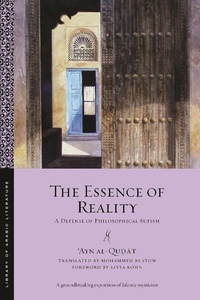
The Essence of Reality
A Defense of Philosophical Sufism
Published on 7. November 2023
277 pages
978-1-4798-2624-7 (ISBN)
Description

A groundbreaking exposition of Islamic mysticism
The Essence of Reality was written over the course of just three days in 514/1120, by a scholar who was just twenty-four. The text, like its author ?Ayn al-Qu?at, is remarkable for many reasons, not least of which that it is in all likelihood the earliest philosophical exposition of mysticism in the Islamic intellectual tradition. This important work would go on to exert significant influence on both classical Islamic philosophy and philosophical mysticism.
Written in a terse yet beautiful style, The Essence of Reality consists of one hundred brief chapters interspersed with Qur?anic verses, prophetic sayings, Sufi maxims, and poetry. In conversation with the work of the philosophers Avicenna and al-Ghazali, the book takes readers on a philosophical journey, with lucid expositions of questions including the problem of the eternity of the world; the nature of God's essence and attributes; the concepts of "before" and "after"; and the soul's relationship to the body. All these discussions are seamlessly tied into ?Ayn al-Qu?at's foundational argument-that mystical knowledge lies beyond the realm of the intellect.
An English-only edition.
The Essence of Reality was written over the course of just three days in 514/1120, by a scholar who was just twenty-four. The text, like its author ?Ayn al-Qu?at, is remarkable for many reasons, not least of which that it is in all likelihood the earliest philosophical exposition of mysticism in the Islamic intellectual tradition. This important work would go on to exert significant influence on both classical Islamic philosophy and philosophical mysticism.
Written in a terse yet beautiful style, The Essence of Reality consists of one hundred brief chapters interspersed with Qur?anic verses, prophetic sayings, Sufi maxims, and poetry. In conversation with the work of the philosophers Avicenna and al-Ghazali, the book takes readers on a philosophical journey, with lucid expositions of questions including the problem of the eternity of the world; the nature of God's essence and attributes; the concepts of "before" and "after"; and the soul's relationship to the body. All these discussions are seamlessly tied into ?Ayn al-Qu?at's foundational argument-that mystical knowledge lies beyond the realm of the intellect.
An English-only edition.
Reviews / Votes
"Rustom's new book is a masterful translation, superb critical edition and comprehensive guide to the thought of one of the most prominent Muslim thinkers." (Islam and Christian-Muslim Relations) "The Essence of Reality is a clear and fluent translation that successfully transfers the literary power of the original text into English." (Nazariyat) "[Rustom's] translation strikes a delicate balance between faithfulness to the Arabic original and readability for a wide audience... A historical classic brought back to life by Rustom's able skills as translator and commentator." (Marginalia (Los Angeles Review of Books))More details
Series
Language
English
Place of publication
New York
United States
Target group
Professional and scholarly
ISBN-13
978-1-4798-2624-7 (9781479826247)
Copyright in bibliographic data and cover images is held by Nielsen Book Services Limited or by the publishers or by their respective licensors: all rights reserved.
Schweitzer Classification
Other editions
Additional editions
Book
11/2023
New York University Press
€15.50
Shipment within 10-20 days
Persons
?Ayn al-Qu?at (Author)
?Ayn al-Qu?at (d. 525/1131) was a philosopher, mystic, and judge who was born in the western Iranian city of Hamadan. He was the student of A?mad al-Ghazali (d. 520/1126), the brother of the famous Abu ?amid al-Ghazali (d. 505/1111). A maverick figure, he was put to death by the Seljuqs at the age of thirty-four, ostensibly on charges of heresy.
Livia Kohn (Foreword by)
Livia Kohn is Professor Emerita of Religion and East Asian Studies at Boston University. She is the author of Sitting in Oblivion: The Heart of Daoist Meditation.
Mohammed Rustom (Translator)
Mohammed Rustom is Professor of Islamic Studies at Carleton University. An internationally recognized scholar whose works have been translated into over ten languages, he specializes in Sufism, Islamic philosophy, and Qur?anic exegesis. He is author of The Triumph of Mercy: Philosophy and Scripture in Mulla ?adra and Inrushes of the Heart: The Sufi Philosophy of ?Ayn al-Qu?at; co-editor of The Study Quran: A New Translation and Commentary; and translator of Abu ?amid al-Ghazali's Condemnation of Pride and Self-Admiration.
?Ayn al-Qu?at (d. 525/1131) was a philosopher, mystic, and judge who was born in the western Iranian city of Hamadan. He was the student of A?mad al-Ghazali (d. 520/1126), the brother of the famous Abu ?amid al-Ghazali (d. 505/1111). A maverick figure, he was put to death by the Seljuqs at the age of thirty-four, ostensibly on charges of heresy.
Livia Kohn (Foreword by)
Livia Kohn is Professor Emerita of Religion and East Asian Studies at Boston University. She is the author of Sitting in Oblivion: The Heart of Daoist Meditation.
Mohammed Rustom (Translator)
Mohammed Rustom is Professor of Islamic Studies at Carleton University. An internationally recognized scholar whose works have been translated into over ten languages, he specializes in Sufism, Islamic philosophy, and Qur?anic exegesis. He is author of The Triumph of Mercy: Philosophy and Scripture in Mulla ?adra and Inrushes of the Heart: The Sufi Philosophy of ?Ayn al-Qu?at; co-editor of The Study Quran: A New Translation and Commentary; and translator of Abu ?amid al-Ghazali's Condemnation of Pride and Self-Admiration.
