

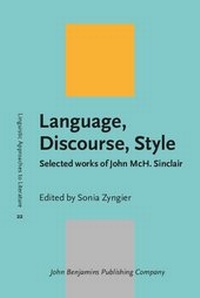
Language, Discourse, Style
Selected works of John McH. Sinclair
1st Edition
Published on 15. December 2016
X, 272 pages
978-90-272-6737-5 (ISBN)
Description

For the first time, the works on stylistics by one of the most brilliant linguists of our times are collected in a single volume. This book highlights the evolution of John Sinclair's theories and insights from studies on language teaching through detailed analyses of text and discourse, into his later works on corpus stylistics. More specifically, Part I focuses on how theory can inform teaching practice. Part II is more directed towards linguistic analyses of specific texts and provides practical bases for stylistics approaches. In Part III Sinclair´s contributions to discourse analysis shed light onto ways of looking and understanding literature. Written in his crisp clear, straightforward style, this book demonstrates Sinclair`s explicit concern for more systematic approaches to the integration of language and literature and shows why his works on stylistics have been both reference and inspiration to students, language and literature teachers and researchers over many decades.
More details
Other editions
Additional editions
Book
09/2016
John Benjamins Publishing Co
€100.70
Shipment within 10-15 days
Person
Content
- Intro
- Language, Discourse, Style
- Editorial page
- Untitled
- Title page
- LCC data
- Table of contents
- Acknowledgements
- Editor's preface
- Introduction
- Part I. Education, language teaching and stylistics
- 1. Linguistics and the teaching of English
- 1.1 Introduction
- 1.2 Direct teaching
- 1.3 The teacher as a linguist
- 1.4 Traditional grammar
- 1.5 The native speaker as learner
- 1.6 Section I: Summary
- 1.7 Linguistic theories
- 1.8 Language development
- 1.9 Comprehensiveness
- 1.10 Internal relations
- 1.11 Language skills
- 1.12 Section II: Summary
- 2. The integration of language and literature in the English curriculum
- 2.1 Introduction
- 2.2 Command of a language
- 2.3 Shortcomings of linguistics in relation to command of a language
- 2.4 Shortcomings of literary criticism in relation to command of a language
- 2.5 The curriculum
- 2.6 An extended example
- 3. Language awareness in six easy lessons
- 3.1 Introduction
- 3.2 Productivity
- 3.3 Creativity
- 3.4 Stability and change
- 3.5 Social variation
- 3.6 How to do things with language
- 3.7 The two-layered code
- 4. Large corpus research and foreign language teaching
- 4.1 The advent of large corpora
- 4.2 New evidence
- 4.3 Implications for teaching the language
- 4.4 Conclusion
- Part II. Linguistic stylistics
- 5. When is a poem like a sunset?
- 5.1 Introduction
- 5.2 Poem as sample of language
- 5.3 The Experiment
- 5.3.1 Tabulation of changes
- 5.3.2 Stylistic categories
- 5.4 Summary
- 6. Taking a poem to pieces
- 6.1 Introduction
- 6.2 Analysis of First Sight
- 6.2.1 Sentence structure
- 6.2.2 Clause structure
- 6.2.3 Line boundaries
- 6.2.4 Groups: Verbal, adverbial and nominal
- 6.3 Conclusion
- 7. A technique of stylistic description
- 7.1 Introduction
- 7.2 Analytical principles
- 7.3 Verse paragraphs
- 7.4 Acceleration
- 7.5 Sentence structure
- 7.6 Stanza 1
- 7.7 Topic
- 7.8 Clause-to-line fit
- 7.9 Clause-to-line fit: Initiation
- 7.10 Stanza types
- 7.11 Clause structure
- 7.12 Verb classification
- 7.13 The definite article
- 7.14 Clause structure concluded
- 7.15 Verbal group structure
- 7.16 Nominal group structure
- 7.17 Adverbial groups
- 7.18 Part versus whole
- 7.19 Conclusion
- 8. Lines about "Lines"
- 8.1 Introduction: Focats
- 8.2 Metrical and meaningful units
- 8.3 "Tight" to "loose" structures
- 8.4 Copying
- 8.5 Arrest
- 8.6 Extension
- 8.7 Rank
- 8.8 Process of analysis
- 8.9 Summary
- 9. The linguistic basis of style
- 9.1 Introduction
- 9.2 Arbitrariness
- 9.2.1 Between sign and referent
- 9.2.2 Between proposition and exponence
- 9.3 Structural superfluity
- 9.4 Derivational hierarchy
- 9.5 Idiom
- 9.6 Reference systems and their referents
- 9.7 Conclusion
- Part III. Style and discourse
- 10. Mirror for a text
- 10.1 Introduction
- 10.2 The model
- 10.3 Verb tense
- 10.4 Attribution
- 10.5 Integration
- 10.6 Time
- 10.7 People
- 10.8 Narrative
- 10.9 Mopping up
- 10.10 Conclusion
- 11. Poetic discourse
- 11.1 Introduction
- 11.2 General commentary
- 11.3 Layout and punctuation
- 11.3.1 Constant features of layout
- 11.3.2 Punctuation
- 11.3.2.1 Mid- and end-lines
- 11.3.2.2 Chunking
- 11.4 Metrics
- 11.4.1 Line length
- 11.4.2 Commentary
- 11.5 Syntax
- 11.5.1 Lists
- 11.5.2 Arrest
- 11.5.3 Continue
- 11.5.4 Transitivity
- 11.5.5 Obscurity
- 11.5.5.1 Stanza 1, line 2
- 11.5.5.2 Stanza 1, line 3
- 11.5.5.3 Stanza 1, line 5
- 11.5.5.4 Stanza 1, lines 10-12
- 11.5.5.5 Stanza 2, lines 16 and 17
- 11.5.5.6 Stanza 2, line 22
- 11.5.5.7 Stanza 3, line 30
- 11.5.5.8 Stanza 3, line 32
- 11.5.5.9 Stanza 3, line 33
- 11.5.6 Commentary
- 11.5.6.1 Parallelism
- 11.5.6.2 Text shape
- 11.6 Grammetrics
- 11.7 Lexis
- 11.7.1 First grouping
- 11.7.2 Second grouping
- 11.7.3 Third grouping
- 11.8 Information structure
- 11.8.1 Pattern 1
- 11.8.2 Pattern 2
- 11.8.3 Pattern 3
- 11.8.4 Pattern 4
- 11.8.5 Pattern 5
- 11.9 Discourse structure
- 11.10 Final comments
- 12. The exploitation of meaning
- 12.1 Introduction
- 12.2 Objectivity
- 12.3 Computing methodology
- 12.4 PALA priorities
- 12.5 Heroic couplets
- 12.6 A commentary on Pope's verses
- 12.7 A local grammar for the Essay on Man
- 12.8 The Couplet
- 12.9 Conclusion
- 12.10 Coda
- 13. Fictional worlds revisited
- 13.1 Introduction
- 13.2 Fact and averral
- 13.3 Correspondence
- 13.4 Discourse
- 13.5 Misleading language
- 13.6 Artefact
- 13.7 Fictional worlds
- 13.8 Fictional narrator
- 13.9 Communicative purpose
- 13.10 Conclusion
- 14. "Passion speechlesse lies"
- 14.1 Introduction
- 14.2 The poem as record of verbal interaction
- 14.3 Identifying and tracking participants
- 14.3.1 Pronouns
- 14.3.2 Imperatives
- 14.3.3 Personification
- 14.3.4 Discussion
- 14.4 Narrative techniques in storytelling
- 14.4.1 Verb Forms
- 14.4.2 Time frame
- 14.4.3 Arrest
- 14.4.4 Discussion
- 14.5 The poem and the context of situation
- 14.5.1 Informality
- 14.5.2 Interaction
- 14.5.3 Poetic Diction
- 14.5.4 Discussion
- 14.6 An Interpretation
- Coda
- 15.1 Introduction
- 15.2 The latent debt to philosophy
- 15.3 The developmental link with literacy and lexicographic instrumentation
- 15.4 'Difficult stylistics': Grammar vs Subtext and the example of 'The Legs' by Robert Graves
- 15.5 Corpus-derived Subtext: A stylistic theory that 'wags the dog' and itself becomes a new linguistic theory
- 15.6 Do Sinclairan corpora provide for stylisticians what Dummett needed in order, fully, to settle his view of the philosophy of language?
- 15.7 Conclusion
- 15.7.1 Trends within Sinclair's stylistics
- 15.7.2 The debt to scholarship and to theory
- References
- Index of Authors, Names and Titles
- Index
