

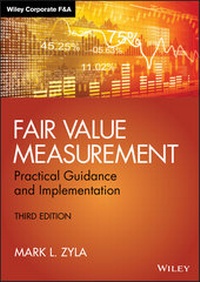
Fair Value Measurement
Description

Fair Value Measurement provides hands-on guidance and the latest best practices for measuring fair value in financial reporting. The Financial Accounting Standards Board (FASB), the U.S. Securities and Exchange Commission (SEC), and the American Institute of CPAs (AICPA) have all updated their guidelines for practitioners, and this book details the changes from a practical perspective. This new third edition includes a discussion on Private Company Council accounting alternatives for business combinations and impairment testing, with a detailed example of the Market Participant Acquisition Premium (MPAP), including European and Asian examples and expanded discussion of IFRS.
Fair value measurement guidelines continue to evolve, and this comprehensive reference provides a valuable, up-to-date resource for preparers, auditors, and valuation specialists.
* Adopt the best practices for implementing the FASB's Topic 820
* Learn the latest reporting requirements for fair value measurements
* Understand accounting alternatives for business combinations
* Examine the details of MPAP in Europe and Asia
Applying fair value measurements to financial statements requires a move away from rules-based standards and toward application of professional judgment. This controversial shift has led to a reliance on valuation specialists, who face their own challenges in applying Topic 820 amidst an economic downturn and recovery, leading to an ever evolving set of best practices. Practitioners must stay up to date, and be aware of the changes as they occur. Fair Value Measurement provides the most recent information and a practical approach to this area of financial reporting.
More details
Other editions
Additional editions
Person
MARK L. ZYLA is a Managing Director of Zyla Valuation Advisors, LLC. an Atlanta, Georgia based valuation and litigation consultancy firm. He is a Certified Public Accountant, Accredited in Business Valuation (CPA/ABV), Certified in Financial Forensics (CFF) by the American Institute of Certified Public Accountants (AICPA), a Chartered Financial Analyst (CFA), and an Accredited Senior Appraiser with the American Society of Appraisers certified in Business Valuation (ASA).
Mark is the Chairman of the Standards Review Board of the International Valuation Standards Council (IVSC) and has served on the AICPA's Forensic and Valuation Services Executive Committee. Mark was inducted into the AICPA Business Valuation Hall of Fame in 2013.
Content
Preface xiii
Acknowledgments xix
Chapter 1: The History and Evolution of Fair Value Accounting 1
Why the Trend Toward Fair Value Accounting? 2
History and Evolution of Fair Value 5
Fair Value Accounting and the Economic Crisis 12
The FASB and IASB Convergence Project 17
The Future of Fair Value Measurement 23
Fair Value Quality Initiative for Valuation Specialists 24
Conclusion 26
Notes 26
Appendix 1A: The Mandatory Performance Framework 31
Performance Requirements 31
Conclusion 33
Notes 46
Chapter 2: Fair Value Measurement Standards and Concepts 47
FASB ASC 820, Fair Value Measurement 48
Disclosures 67
Fair Value Option 70
Standards in the Valuation Profession and Fair Value Measurements 77
Conclusion 79
Notes 80
Appendix 2A: Taxes and Fair Value Measurements 81
Summary of Changes under 2017 TCJA 81
Chapter 3: Business Combinations 85
Mergers and Acquisitions 86
Accounting Standards for Business Combinations-A Brief History 88
ASC 805, Business Combinations 90
Other Business Combination Highlights 95
Subsequent Accounting for Goodwill and Other Intangible Assets 99
Conclusion 100
Notes 101
Chapter 4: The Nature of Goodwill and Intangible Assets 103
History of Intangible Assets 104
Intellectual Property 105
Economic Basis of Intangible Assets 106
Identification of Intangible Assets 106
Useful Life of an Intangible Asset 111
Intangible Assets and Economic Risk 112
Goodwill 112
Economic Balance Sheet 114
Conclusion 116
Notes 117
Chapter 5: Impairment 119
Evolution of Impairment Testing 120
Applicable FASB Guidance for Impairment Testing 122
Accounting for the Impairment of Long-Lived Assets 123
Goodwill Impairment Testing-Public Companies 125
Goodwill Impairment-One-Step Impairment Loss 138
Testing Other Indefinite-Lived Intangible Assets for Impairment 139
Amortization of Goodwill 139
Conclusion 140
Notes 140
Appendix 5A: Example of a Qualitative Impairment Analysis-PlanTrust, Inc. 143
Financial Accounting Standards Board ASC 350, Intangibles-Goodwill and Other 143
PlanTrust, Inc. 144
Notes 159
Chapter 6: The Cost Approach 161
The Cost Approach under FASB ASC 820, Fair Value Measurement 162
Economic Foundation for the Cost Approach 164
Cost versus Price versus Fair Value 164
The Role of Expected Economic Benefits in the Cost Approach 166
Reproduction Cost versus Replacement Cost 167
Components of Cost 168
Obsolescence 169
The Relationships Among Cost, Obsolescence, and Value 170
Physical Deterioration 171
Functional (Technological) Obsolescence 172
Economic (External) Obsolescence 173
Applying the Cost Approach 174
Taxes Under the Cost Approach 178
Limitations of the Cost Approach 179
Conclusion 179
Notes 180
Chapter 7: The Market Approach 183
Applying the Market Approach When Measuring the Fair Value of an Entity or a Reporting Unit of an Entity 184
Conclusion 213
Notes 213
Chapter 8: The Income Approach 215
Introduction 215
Discounted Cash Flow Method 216
Multiperiod Excess Earnings Method 223
FASB Concepts Statement 7 239
Rates of Return Under the Income Approach 244
The Income Increment/Cost Decrement Method 245
Profit Split Method 246
Build-Out, or Greenfield, Method 251
Weighted Average Cost of Capital Calculation 251
Conclusion 258
Notes 259
Chapter 9: Advanced Valuation Methods for Measuring the Fair Value of Intangible Assets 261
Introduction 261
Limitations of Traditional Valuation Methods 261
Real Options 263
Using Option Pricing Methodologies to Value Intangible Assets 266
Black-Scholes Option Pricing Model 269
Binomial or Lattice Models 272
Monte Carlo Simulation 277
Decision Tree Analysis 280
Conclusion 281
Notes 281
Chapter 10: Measuring the Remaining Useful Life of Intangible Assets in Financial Reporting 283
FASB Guidance on Determining the Remaining Useful Life 283
Considerations in Measuring Useful Lives of Intangible Assets 285
Practical Guidance for Estimating and Modeling the Useful Life 289
Conclusion 295
Notes 295
Chapter 11: Fair Value Measurement for Alternative Investments 297
Introduction 297
Investments in Certain Entities That Calculated Net Asset Value per Share 299
AICPA Technical Practice Aid 300
AICPA Guidance for Determining the Fair Value of Investment 301
AICPA Accounting and Valuation Guide, Valuation of Portfolio Company Investments of Venture Capital and Private Equity Funds and Other Investment Companies 305
International Private Equity and Venture Capital Valuation Guidelines 306
Common Valuation Methodologies of Measuring the Fair Value of the Fund's Investment Portfolio 307
Conclusion 308
Notes 308
Chapter 12: Contingent Consideration 311
Contingent Consideration: Earn-outs in Business Combinations 311
Accounting for Contingent Consideration 312
Conclusion 324
Notes 324
Appendix 12A: Measuring the Fair Value of a Nonfinancial Contingent Liability-Example of a Loan Guarantee 327
The Jordan Lee Fund Guarantee of Townsend Farm Development, LLC 328
Notes 334
Chapter 13: Auditing Fair Value Measurement 335
Auditing Standards 336
The Audit Process 338
Evolution of Audit Standards for Fair Value Measurements and Disclosures 342
Auditing Standard 2501, Auditing Accounting Estimates, Including Fair Value Measurements 344
Auditing Standards for Auditor's Use of the Work of Specialists 349
Proposed International Standard on Quality Management 1 354
Practical Guidance for Auditors 354
PCAOB Staff Audit Practice Alert No. 9, Assessing and Responding to Risk in the Current Economic Environment 356
AICPA Nonauthoritative Guidance 358
The Appraisal Foundation 359
Conclusion 359
Notes 360
Appendix 13A: Auditing Fair Value Measurement in a Business Combination 363
Auditor Questions 363
General 363
Income Approach 364
Cost Approach 366
Market Approach-General 367
Appendix 13B: Auditing Fair Value Measurement in a Goodwill Impairment Test 369
General 369
Income Approach 370
WACC 371
The Market Approach 372
Chapter 14: Fair Value Measurement Case Study 373
Learning Objectives 373
Business Background and Facts-Dynamic Analytic Systems, Inc. 374
Notes 406
Appendix 14A: Suggested Case Study Solutions 407
Note 437
Appendix 14B: Model Fair Value Measurements Curriculum 439
Acknowledgments 439
AICPA Staff 440
About Us 440
Preface 440
Model Fair Value Measurement Curriculum 440
Appendices and Examples 448
Note 451
Glossary of International Business Valuation Terms 453
Bibliography 463
About the Author 475
Index 477
Preface
FAIR VALUE MEASUREMENTS AND DISCLOSURES continues to be an area of tremendous interest in financial reporting. Although the Fair Value Measurements framework is fully converged under U.S. GAAP (ASC 820 Fair Value Measurements) and IFRS (IFRS 13 Fair Value Measurements), best practices of the measurements themselves have continued to evolve. Over the past 10 years, organizations such as the AICPA and the Appraisal Foundation have developed varied guidance on best practices on measuring fair value for valuation specialists. In December 2018, the PCAOB finalized AS 2501, Auditing Accounting Estimates, Including Fair Value, and AS 1201, Auditor's Use of a Specialist, to provide additional guidance to auditors in auditing fair value. The valuation profession recently developed a Fair Value Quality Initiative to enhance that profession's involvement in financial reporting, resulting in the new Certified in Entity and Intangible Valuation (CEIV) credential and the Mandatory Performance Framework (MPF).
In December 2018, the International Accounting Standards Board issued a report on their postimplementation review of IFRS 13, Fair Value Measurements. Both the IASB and the FASB regularly conduct reviews of newly implemented accounting standards to assess whether the standards are working as intended. The FASB conducted a postimplementation review in 2014 and concluded that the then-titled FASB Statement 157 "met its objectives."1 The IASB concluded that the information required by IFRS 13 is "useful to users of financial statements."2
Investor-focused organizations such as the CFA Institute have concluded from a series of surveys of their members that "where fair value has been implemented over the past 15-20 years there is greater acceptance as to its appropriateness, relevance and reliability."3 A 2013 CFAI Survey on Fair Value Accounting & Long-Term Investing in Europe summarizes the importance of fair value measurements in financial reporting to investors across the globe.
Simply put all investors buy, sell, and hold their investments based on fair value information. Fair value information is necessary to judge current financial health, is an input to predicting future performance, and helps in the judgment of how effectively management is fulfilling its stewardship function.4
Clearly, fair value measurements enhance the public trust in financial reporting.
The third edition of Fair Value Measurement: Practical Guidance and Implementation, which includes substantial new discussion material and many new comprehensive examples, is organized as follows:
Chapter 1: The History and Evolution of Fair Value Accounting
- Provides a historical look at the development of fair value concepts and accounting standards.
- Includes milestones related to the development of fair value for financial instruments and fair value measurement of nonfinancial assets and liabilities.
- Explains how the economic crisis shaped fair value measurement and how the crisis led to the refinement of several accounting standards.
- Discusses how the proposed convergence of U.S. GAAP with IFRS has shaped fair value measurement concepts, despite the unlikely full convergence of both standards.
- Introduces trends that are likely to continue to affect fair value measurement including different levels of disclosures for public and privately held entities.
- Introduces the Fair Value Quality Initiative and the Mandatory Performance Framework.
- Includes, in an appendix, a checklist of items to consider under the Mandatory Performance Framework.
Chapter 2: Fair Value Measurement Standards and Concepts
- Presents an overview of fair value measurement in U.S. GAAP and with cross references to FASB ASC 820, Fair Value Measurement.
- Examines important fair value framework concepts such as the principal or most advantageous market, market participants, the highest and best use for nonfinancial assets, inputs to fair value measurements, and the fair value hierarchy.
- Discussed the application of FASB ASC 825, Financial Instruments, which provides the fair value option for financial instruments.
- Includes an explanation of standards in the valuation profession, including a discussion of Uniform Standards of Professional Appraisal Practice (USPAP) and International Valuation Standards (IVS).
- Provides, in an appendix, the impact of the Tax Cut and Jobs Act (TCJA) of 2017 on fair value measurements.
Chapter 3: Business Combinations
- Discusses the role merger and acquisition transactions play in our economy, including trends and pitfalls.
- Discusses the development of accounting standards for business combinations.
- Covers the requirements of ASC 805, Business Combinations.
- Discusses private company alternative accounting under ASU 2014-18.
- Provides comprehensive examples.
Chapter 4: The Nature of Goodwill and Intangible Assets
- Provides a brief overview of intangible assets and intellectual property, including the increasingly prominent role these assets contribute to the overall business enterprise value.
- Touches on the criteria for recognizing goodwill and intangible assets in financial reporting and for estimating their useful lives.
- Provides the classification and examples of intangible assets from FASB ASC 805, Business Combination, as well as many other examples.
Chapter 5: Impairment
- Discusses the evolution of testing goodwill for impairment under various accounting standards.
- Includes a description of the alternative accounting for private companies under ASU 2014-02.
- Includes a discussion of the "one-step" impairment test under ASU 2017-04, Simplifying the Test for Goodwill Impairment.
- Covers the qualitative goodwill impairment test as well as the challenges of the prior two-step quantitative impairment test.
- Discusses the applicable guidance for testing goodwill, intangible assets, and long-lived assets for impairment and the order of testing.
- Provides insight into the discussion about whether goodwill impairment testing should be at the equity or enterprise level.
- Includes an appendix with a comprehensive example of a valuation specialist's report prepared for a qualitative goodwill impairment analysis.
Chapter 6: The Cost Approach
- Discusses the cost approach to fair value measurement, including the economic basis for the cost approach, the role of expected economic benefits, and economic obsolescence.
- Distinguishes between reproduction cost and replacement cost.
- Provides examples for applying the cost approach using historical trending, the unit cost method and the unit of cost method.
- Addresses how taxes and other factors may impact the application of the cost approach.
Chapter 7: The Market Approach
- Covers measuring the fair value of an entity using a market approach such as the guideline public company method or the guideline transaction method.
- Provides insight to control premiums and synergies under this method.
- Discusses the development and application of equity and invested capital multiples.
- Covers the application of the market approach to measure the fair value of intangible assets.
- Provides updated examples of use of various techniques under the market approach.
Chapter 8: The Income Approach
- Examines the workhorse of valuation methods, the discounted cash flow method, including single-period and multiperiod variations.
- Provides an in-depth look at the multiperiod excess earnings method, including market participant assumptions in projected financial information and the role of contributory assets and their required returns.
- Provides examples of other income approach methods used in business combinations, such as the profit split method and the "with and without" method.
- Addresses the weighted average cost of capital and its calculation under the build-up method and the capital asset pricing model.
- Provides updated examples of various valuation techniques under the market approach.
Chapter 9: Advanced Valuation Methods for Measuring the Fair Value of Intangible Assets
- Introduces advanced valuation techniques such as the option-pricing methods, Monte Carlo simulation, and decision tree analysis.
- Discusses real options derived from the ownership rights of intangible assets and how to measure their fair value.
Chapter 10: The Remaining Useful Life of Intangible Assets
- Distinguishes between finite-lived assets and indefinite-lived assets.
- Provides factors to consider when measuring the useful lives of intangible assets, including the legal, contractual, and useful lives.
- Provides examples of various approaches to calculating the remaining useful lives of intangible assets.
Chapter 11: Fair Value Measurement of Alternative Investments
- Discusses authoritative guidance for determining the fair value measurement of alternative investments, including recent AICPA Technical Practice...
