

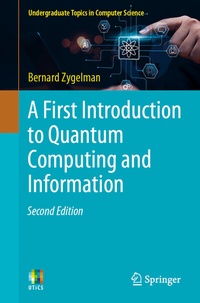
A First Introduction to Quantum Computing and Information
Description

This textbook addresses and introduces new developments in the field of quantum information and computing (QIC) for a primary audience of undergraduate students.
Developments over the past few decades have spurred the need for QIC courseware at major research institutions. To address this, the present 2nd edition of a highly accessible textbook/reference broadens the exposure of QIC science for the undergraduate market. The subject matter is introduced in such a way so that it is accessible to students with only a first-year calculus background. Greater accessibility allows a broader range of academic offerings.
Topics and features:
- Introduces beginning undergraduate students to quantum theory and developments in QIC, without exposure to upper-level physics and mathematics
- Contains a new chapter on Adiabatic Quantum Computing
- Integrates Mathematica-based software examples and projects, which offers a "hands-on" experience and facilitates navigation of difficult abstract concepts
- Offers helpful links to additional exercises, problems, and solution manuals
- Facilitates a more holistic approach to the teaching of difficult concepts, incorporating symbolic manipulation software
- Provides new material on Quantum Error Correction
- Allows a broad-range of course offerings spanning physics, engineering, math and computer science
This unique introductory textbook can serve courses offered in university physics, engineering, math, and definitely computer science departments. Use of Mathematica software allows a fast learning curve for students who have limited experience with scientific programming.
More details
Other editions
Additional editions
Person
Bernard Zygelman is a Professor of Physics at the University of Nevada, Las Vegas (UNLV). His research focuses on quantum dynamics of few-particle systems. He has been a Visiting Scientist at the Harvard-MIT Center for Ultra-Cold Atoms (CUA), the Smithsonian Astrophysical Observatory (SAO), the Institute for Theoretical Physics (ITP) (now the Kavli-Institute) at the University of California, Santa Barbara, and the University of Pittsburgh. In the past dozen years, Dr. Zygelman has developed and taught quantum computing and information courseware at both the graduate and undergraduate level.
Content
1. A Quantum Mechanic's Toolbox.- 2. Apples and Oranges: Matrix Representations.- 3. Circuit Model of Computation.- 4. Quantum Killer Apps: Quantum Fourier Transform and Search Algorithms.- 5. Quantum Mechanics According to Martians: Density Matrix Theory.- 6. No-Cloning Theorem, Quantum Teleportation and Spooky Correlations.- 7. Quantum Hardware I: Ion Trap qubits.- 8. Quantum Hardware II: cQED and cirQED.- 9. Errare Computatrum Est: Quantum Error Correction.
