

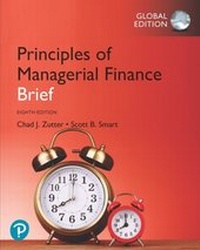
Principles of Managerial Finance, Brief, Global Edition
Global Edition
1st Edition
Published on 28. January 2019
784 pages
978-1-292-26771-5 (ISBN)
Description

Principles of Managerial Finance, Brief, Global Edition
More details
Other editions
Additional editions
Chad Zutter | Scott Smart
Principles of Managerial Finance, Brief Global Edition
Book
01/2019
8th Edition
Pearson Education Limited
€116.55
Shipment within 10-20 days
Content
- Cover
- Title Page
- Copyright Page
- Dedication
- Brief Contents
- Contents
- About the Authors
- Preface
- Acknowledgments
- Global Edition Acknowledgments
- About the Authors
- Preface
- Acknowledgments
- Part 1: Introduction to Managerial Finance
- 1. The Role of Managerial Finance
- 1.1. Finance and the Firm
- What Is Finance?
- What Is a Firm?
- What Is the Goal of the Firm?
- The Role of Business Ethics
- In Practice: Focus on Practice: Must Search Engines Screen Out Fake News?
- Review Questions
- 1.2. Managing the Firm
- The Managerial Finance Function
- Review Questions
- 1.3. Organizational Forms, Taxation, and the Principal-Agent Relationship
- Legal Forms of Business Organization
- Agency Problems and Agency Costs
- Corporate Governance
- Review Questions
- 1.4. Developing Skills for Your Career
- Critical Thinking
- Communication and Collaboration
- Financial Computing Skills
- Summary
- Self-Test Problem
- Warm-Up Exercises
- Problems
- Spreadsheet Exercise
- 2. The Financial Market Environment
- 2.1. Financial Institutions
- Commercial Banks, Investment Banks, and the Shadow Banking System
- Review Questions
- 2.2. Financial Markets
- The Relationship Between Institutions and Markets
- The Money Market
- The Capital Market
- The Role of Capital Markets
- In Practice: Focus on Ethics: Should Insider Trading Be Legal?
- Review Questions
- 2.3. Regulation of Financial Markets and Institutions
- Regulations Governing Financial Institutions
- Regulations Governing Financial Markets
- Review Questions
- 2.4. The Securities Issuing Process
- Issuing Common Stock
- Review Questions
- 2.5. Financial Markets in Crisis
- Financial Institutions and Real Estate Finance
- Spillover Effects and Recovery from the Great Recession
- Review Questions
- Summary
- Self-Test Problem
- Warm-Up Exercises
- Problems
- Spreadsheet Exercise
- Part 2: Financial Tools
- 3. Financial Statements and Ratio Analysis
- 3.1. The Stockholders' Report
- The Letter to Stockholders
- The Four Key Financial Statements
- In Practice: Focus on Ethics: Earnings Shenanigans
- Notes to the Financial Statements
- Consolidating International Financial Statements
- Review Questions
- 3.2. Using Financial Ratios
- Interested Parties
- Types of Ratio Comparisons
- Cautions About Using Ratio Analysis
- Review Questions
- 3.3. Liquidity Ratios
- Current Ratio
- Quick (Acid-Test) Ratio
- Review Questions
- 3.4. Activity Ratios
- Inventory Turnover
- Average Collection Period
- Average Payment Period
- Total Asset Turnover
- Review Question
- 3.5. Debt Ratios
- Debt Ratio
- Debt-to-Equity Ratio
- Times Interest Earned Ratio
- Fixed-Payment Coverage Ratio
- Review Questions
- 3.6. Profitability Ratios
- Common-Size Income Statements
- Gross Profit Margin
- Operating Profit Margin
- Net Profit Margin
- Earnings Per Share (EPS)
- Return on Total Assets (ROA)
- Return on Equity (ROE)
- Review Questions
- 3.7. Market Ratios
- Price/Earnings (P/E) Ratio
- Market/Book (M/B) Ratio
- Review Question
- 3.8. A Complete Ratio Analysis
- Summary of Whole Foods' Financial Condition
- DuPont System of Analysis
- Review Questions
- Summary
- Self-Test Problems
- Warm-Up Exercises
- Problems
- Spreadsheet Exercise
- 4. Long- and Short- Term Financial Planning
- 4.1. The Financial Planning Process
- Long-Term (Strategic) Financial Plans
- Short-Term (Operating) Financial Plans
- Review Questions
- 4.2. Measuring the Firm's Cash Flow
- Depreciation
- Depreciation Methods
- Developing the Statement of Cash Flows
- Free Cash Flow
- In Practice: Focus on Ethics: Is Excess Cash Always a Good Thing?
- Review Questions
- 4.3. Cash Planning: Cash Budgets
- The Sales Forecast
- Preparing the Cash Budget
- Evaluating the Cash Budget
- Coping with Uncertainty in the Cash Budget
- Cash Flow within the Month
- Review Questions
- 4.4. Profit Planning: Pro Forma Statements
- Preceding Year's Financial Statements
- Sales Forecast
- Review Question
- 4.5. Preparing the Pro Forma Income Statement
- Considering Types of Costs and Expenses
- Review Questions
- 4.6. Preparing the Pro Forma Balance Sheet
- Review Questions
- 4.7. Evaluation of Pro Forma Statements
- Review Questions
- Summary
- Self-Test Problems
- Warm-Up Exercises
- Problems
- Spreadsheet Exercise
- 5. Time Value of Money
- 5.1. The Role of Time Value in Finance
- Future Value Versus Present Value
- Computational Tools
- Basic Patterns of Cash Flow
- Review Questions
- 5.2. Single Amounts
- Future Value of a Single Amount
- Present Value of a Single Amount
- Review Questions
- Excel Review Questions
- 5.3. Annuities
- Types of Annuities
- Finding the Future Value of an Ordinary Annuity
- Finding the Present Value of an Ordinary Annuity
- Finding the Future Value of an Annuity Due
- Finding the Present Value of an Annuity Due
- Finding the Present Value of a Perpetuity
- Review Questions
- Excel Review Questions
- 5.4. Mixed Streams
- Future Value of a Mixed Stream
- Present Value of a Mixed Stream
- Review Question
- Excel Review Question
- 5.5. Compounding Interest More Frequently than Annually
- Semiannual Compounding
- Quarterly Compounding
- A General Equation for Compounding
- Using Computational Tools for Compounding
- Continuous Compounding
- Nominal and Effective Annual Rates of Interest
- Review Questions
- In Practice: Focus on Ethics: Was the Deal for Manhattan a Swindle?
- Excel Review Questions
- 5.6. Special Applications of Time Value
- Determining Deposits Needed to Accumulate a Future Sum
- Loan Amortization
- Finding Interest or Growth Rates
- Finding an Unknown Number of Periods
- Review Questions
- Excel Review Questions
- Summary
- Self-Test Problems
- Warm-Up Exercises
- Problems
- Spreadsheet Exercise
- Part 3: Valuation of Securities
- 6. Interest Rates and Bond Valuation
- 6.1. Interest Rates and Required Returns
- Interest Rate Fundamentals
- Term Structure of Interest Rates
- Risk Premiums: Issuer and Issue Characteristics
- Review Questions
- 6.2. Government and Corporate Bonds
- Legal Aspects of Corporate Bonds
- Cost of Bonds to the Issuer
- General Features of a Bond Issue
- Bond Yields
- Bond Prices
- Bond Ratings
- Common Types of Bonds
- International Bond Issues
- In Practice: Focus on Ethics: "Can Bond Ratings Be Trusted?"
- Review Questions
- 6.3. Valuation Fundamentals
- Key Inputs
- Basic Valuation Model
- Review Questions
- 6.4. Bond Valuation
- Bond Fundamentals
- Bond Valuation
- Semiannual Interest Rates and Bond Values
- Changes in Bond Values
- Yield to Maturity (YTM)
- Review Questions
- Excel Review Questions
- Summary
- Self-Test Problems
- Warm-Up Exercises
- Problems
- Spreadsheet Exercise
- 7. Stock Valuation
- 7.1. Differences Between Debt and Equity
- Voice in Management
- Claims on Income and Assets
- Maturity
- Tax Treatment
- Review Question
- 7.2. Common and Preferred Stock
- Common Stock
- Preferred Stock
- Review Questions
- 7.3. Common Stock Valuation
- Market Efficiency and Stock Valuation
- Common Stock Dividend Valuation Model
- In Practice: Focus on Practice: Understanding Human Behavior Helps Us Understand Investor Behavior
- Free Cash Flow Stock Valuation Model
- Other Approaches to Common Stock Valuation
- Review Questions
- 7.4. Decision Making and Common Stock Value
- Changes in Expected Dividends
- Changes in Risk
- Combined Effect
- Review Questions
- Summary
- Self-Test Problems
- Warm-Up Exercises
- Problems
- Spreadsheet Exercise
- Part 4: Risk and the Required Rate of Return
- 8. Risk and Return
- 8.1. Risk and Return Fundamentals
- What Is Risk?
- What Is Return?
- Risk Preferences
- Review Questions
- 8.2. Risk of a Single Asset
- Risk Assessment
- Risk Measurement
- Review Questions
- 8.3. Risk of a Portfolio
- Portfolio Return and Standard Deviation
- Correlation
- Diversification
- Correlation, Diversification, Risk, and Return
- International Diversification
- In Practice: Global Focus: An International Flavor to Risk Reduction
- Review Questions
- 8.4. Risk and Return: The Capital Asset Pricing Model (CAPM)
- Types of Risk
- The Model: CAPM
- Review Questions
- Summary
- Self-Test Problems
- Warm-Up Exercises
- Problems
- Spreadsheet Exercise
- 9. The Cost of Capital
- 9.1. Overview of the Cost of Capital
- In Practice: Focus on Ethics: The Cost of Capital Also Rises
- The Basic Concept
- Sources of Long-Term Capital
- Review Questions
- 9.2. Cost of Long-Term Debt
- Net Proceeds
- Before-Tax Cost of Debt
- After-Tax Cost of Debt
- Review Questions
- Excel Review Question
- 9.3. Cost of Preferred Stock
- Preferred Stock Dividends
- Calculating the Cost of Preferred Stock
- Review Question
- 9.4. Cost of Common Stock
- Finding the Cost of Common Stock Equity
- Cost of Retained Earnings
- Review Questions
- 9.5. Weighted Average Cost of Capital
- Calculating the Weighted Average Cost of Capital (WACC)
- Capital Structure Weights
- Review Questions
- Summary
- Self-Test Problem
- Warm-Up Exercises
- Problems
- Spreadsheet Exercise
- Part 5: Long-Term Investment Decisions
- 10. Capital Budgeting Techniques
- 10.1. Overview of Capital Budgeting
- Motives for Capital Expenditure
- Steps in the Process
- Basic Terminology
- Capital Budgeting Techniques
- Review Question
- 10.2. Payback Period
- Decision Criteria
- Pros and Cons of Payback Analysis
- Review Questions
- 10.3. Net Present Value (NPV)
- Decision Criteria
- NPV and the Profitability Index
- NPV and Economic Value Added
- Review Questions
- Excel Review Question
- 10.4. Internal Rate of Return (IRR)
- Decision Criteria
- Calculating the IRR
- Review Questions
- Excel Review Question
- 10.5. Comparing NPV and IRR Techniques
- Net Present Value Profiles
- Conflicting Rankings
- Which Approach Is Better?
- In Practice: Focus on Ethics: Baby You Can Drive My Car-Just Not a VW Diesel
- Review Questions
- Summary
- Self-Test Problem
- Warm-Up Exercises
- Problems
- Spreadsheet Exercise
- 11. Capital Budgeting Cash Flows and Risk Refinements
- 11.1. Project Cash Flows
- Major Cash Flow Types
- Replacement Versus Expansion Decisions
- Sunk Costs and Opportunity Costs
- In Practice: Focus on Ethics: Fumbling Sunk Costs
- Review Questions
- 11.2. Finding the Initial Investment
- Installed Cost of the New Asset
- After-Tax Proceeds from the Sale of the Old Asset
- Change in Net Working Capital
- Calculating the Initial Investment
- Review Questions
- 11.3. Finding the Operating Cash Flows
- Interpreting the Term Cash Flows
- Interpreting the Term After-Tax
- Interpreting the Term Incremental
- Review Questions
- 11.4. Finding the Terminal Cash Flow
- After-Tax Proceeds from the Sale of New and Old Assets
- Change in Net Working Capital
- Review Question
- 11.5. Risk in Capital Budgeting ( Behavioral Approaches)
- Breakeven Analysis
- Scenario Analysis
- Simulation
- Review Questions
- Excel Review Question
- 11.6. Risk-Adjusted Discount Rates
- Determining Risk-Adjusted Discount Rates (RADRs)
- Applying RADRs
- Portfolio Effects
- RADRs in Practice
- Review Questions
- 11.7. Capital Budgeting Refinements
- Comparing Projects with Unequal Lives
- Recognizing Real Options
- Capital Rationing
- Review Questions
- Excel Review Question
- Summary
- Self-Test Problems
- Warm-Up Exercises
- Problems
- Spreadsheet Exercise
- Part 6: Long-Term Financial Decisions
- 12. Leverage and Capital Structure
- 12.1. Leverage
- Breakeven Analysis
- Operating Leverage
- In Practice: Focus on Practice: Qualcomm's Leverage
- Financial Leverage
- Total Leverage
- Review Questions
- 12.2. The Firm's Capital Structure
- Types of Capital
- External Assessment of Capital Structure
- Capital Structure of Non-U.S. Firms
- Capital Structure Theory
- Optimal Capital Structure
- Review Questions
- 12.3. EBIT-EPS Approach to Capital Structure
- Presenting a Financing Plan Graphically
- Comparing Alternative Capital Structures
- Considering Risk in EBIT-EPS Analysis
- Basic Shortcoming of EBIT-EPS Analysis
- Review Question
- 12.4. Choosing the Optimal Capital Structure
- Linkage
- Estimating Value
- Maximizing Value Versus Maximizing EPS
- Some Other Important Considerations
- Review Questions
- Summary
- Self-Test Problems
- Warm-Up Exercises
- Problems
- Spreadsheet Exercise
- 13. Payout Policy
- 13.1. The Basics of Payout Policy
- Elements of Payout Policy
- Trends in Earnings and Dividends
- Trends in Dividends and Share Repurchases
- Review Questions
- In Practice: Focus on Ethics: Buyback Mountain
- 13.2. The Mechanics of Payout Policy
- Cash Dividend Payment Procedures
- Share Repurchase Procedures
- Tax Treatment of Dividends and Repurchases
- Dividend Reinvestment Plans
- Stock Price Reactions to Corporate Payouts
- Review Questions
- 13.3. Relevance of Payout Policy
- Residual Theory of Dividends
- The Dividend Irrelevance Theory
- Arguments for Dividend Relevance
- Review Questions
- 13.4. Factors Affecting Dividend Policy
- Legal Constraints
- Contractual Constraints
- Growth Prospects
- Owner Considerations
- Market Considerations
- Review Question
- 13.5. Types of Dividend Policies
- Constant-Payout-Ratio Dividend Policy
- Regular Dividend Policy
- Low-Regular-and-Extra Dividend Policy
- Review Question
- 13.6. Other Forms of Dividends
- Stock Dividends
- Stock Splits
- Review Questions
- Summary
- Self-Test Problem
- Warm-Up Exercises
- Problems
- Spreadsheet Exercise
- Part 7: Short-Term Financial Decisions
- 14. Working Capital and Current Assets Management
- 14.1. Net Working Capital Fundamentals
- Working Capital Management
- Net Working Capital
- Tradeoff between Profitability and Risk
- Review Questions
- 14.2. Cash Conversion Cycle
- Calculating the Cash Conversion Cycle
- Funding Requirements of the Cash Conversion Cycle
- Strategies for Managing the Cash Conversion Cycle
- Review Questions
- 14.3. Inventory Management
- Differing Viewpoints about Inventory Level
- Common Techniques for Managing Inventory
- International Inventory Management
- Review Questions
- 14.4. Accounts Receivable Management
- Credit Selection and Standards
- In Practice: Focus on Ethics: If You Can Bilk It, They Will Come
- Credit Terms
- Credit Monitoring
- Review Questions
- 14.5. Management of Receipts and Disbursements
- Float
- Speeding Up Collections
- Slowing Down Payments
- Cash Concentration
- Zero-Balance Accounts
- Investing in Marketable Securities
- Review Questions
- Summary
- Self-Test Problems
- Warm-Up Exercises
- Problems
- Spreadsheet Exercise
- 15. Current Liabilities Management
- 15.1. Spontaneous Liabilities
- Accounts Payable Management
- Accruals
- Review Questions
- 15.2. Unsecured Sources of Short-Term Loans
- Bank Loans
- Commercial Paper
- In Practice: Focus on Practice: The Ebb and Flow of Commercial Paper
- International Loans
- Review Questions
- 15.3. Secured Sources of Short-Term Loans
- Characteristics of Secured Short-Term Loans
- Use of Accounts Receivable as Collateral
- Use of Inventory as Collateral
- Review Questions
- Summary
- Self-Test Problem
- Warm-Up Exercises
- Problems
- Spreadsheet Exercise
- Appendix
- Glossary
- Index
- Back Cover
