

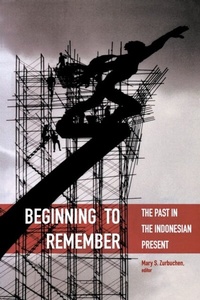
Beginning to Remember
Description

Beginning to Remember charts Indonesia's turbulent decades of cultural repression and renewal amid the rise and fall of Suharto's New Order regime. These cross-disciplinary pieces illuminate Indonesia's current efforts to reexamine and understand its past in order to shape new civic and cultural arrangements.
In 1998, "reformasi" brought a wave of relief and euphoria. But Suharto's removal did not dispel persistent corruption, official secrecy and denial, religious and ethnic violence, and security policies leading to tragedy in East Timor, Aceh, and other regions. But the reformasi did open up new possibilities for seeing the past. What followed was a surge of discourse that challenged officially codified national history in mass media and publishing, in public policy debate, in the arts, and in popular mobilization and politics.
This volume is an exploration of some of the expressions, narratives, and interpretations of the past found in Indonesia today. The authors illustrate ways in which the dissolution of the Indonesian state's monopoly on history is now permitting new national, local, and individual accounts and representations of the past to emerge. The book covers fields from performing arts and literature to anthropology, history, and transitional justice.
The book opens with Goenawan Mohamad's dramatic poem Kali, the first publication of this important work by one of Indonesia's leading intellectuals, which has become the libretto for an international opera production. Another chapter is a personal memoir by one of Java's famous shadow-play masters, Tristuti Rachmadi, for years imprisoned under the New Order. Leading historian Anthony Reid commemorates the national struggle at the regional level, while South African lawyer Paul van Zyl compares efforts in transitional justice in Indonesia, East Timor, and South Africa.
All prices
More details
Other editions
Additional editions
Person
Mary S. Zurbuchen is director for Asia and Russia programs with the Ford Foundation International Fellowships Program. The contributors include Andi F. Bakti, Daniel S. Lev, Hendrik Maier, Kate McGregor, Goenawan Mohamad, Nancy L. Peluso, Tristuti Rachmadi, Anthony Reid, Geoffrey Robinson, Klaus H. Schreiner, Laurie J. Sears, Karen Strassler, Fadjar I. Thufail, Gerry van Klinken, and Paul van Zyl.
Content
List of Illustrations
Notes on Contributors
Foreword
Introduction
Historical Memory in Contemporary Indonesia--Mary S. Zurbuchen
Part One
My Life as a Shadow Master under Suharto--Ki Tristuti Rachmadi
Kali: A Libretto--Goenawan Mohamad
The Persistence of Evil and the Impossibility of Truth in Goenawan Mohamad's Kali--Laurie J. Sears
In Search of Memories: How Malay Tales Try to Shape History--Hendrik M. J. Maier
Part Two
Collective Memories of the Qahhar Movement--Andi F. Bakti
Ninjas in Narratives of Local and National Violence in Post-Suharto Indonesia--Fadjar I. Thufail
Remembering and Forgetting War and Revolution--Anthony Reid
Part Three
Memory, Knowledge and Reform--Daniel S. Lev
Nugroho Notosusanto: The Legacy of a Historian in the Service of an Authoritarian Regime--Katharine E. McGregor
The Battle for History After Suharto--Gerry van Klinken
Part Four
Lubang Buaya: Histories of Trauma and Sites of Memory--Klaus H. Schreiner
Material Witnesses: Photographs and the Making of Reformasi Memory--Karen Strassler
Monument, Document and Mass Grave: The Politics of Representing Violence in Bali--Degung Santikarma
Dealing with the Past: Reflections on South Africa, East Timor and Indonesia--Paul van Zyl
Bibliography
Index
