


Automotive Software Engineering
1st Edition
Published on 30. September 2016
391 pages
978-0-7680-8334-7 (ISBN)
Available for download
Description

Since the early seventies, the development of the automobile has been characterized by a steady increase in the deploymnet of onboard electronics systems and software. This trend continues unabated and is driven by rising end-user demands and increasingly stringent environmental requirements. Today, almost every function onboard the modern vehicle is electronically controlled or monitored. The software-based implementation of vehicle functions provides for unparalleled freedoms of concept and design. However, automobile development calls for the accommodation of contrasting prerequisites such as higher demands on safety and reliability vs. lower cost ceilings, longer product life cycles vs. shorter development times along with growing proliferation of model variants. Automotive Software Engineering has established its position at the center of these seemingly conflicting opposites. This book provides background basics as well as numerous suggestions, rare insights, and cases in point concerning those processes, methods, and tools that contribute to the surefooted mastery of the use of electronic systems and software in the contemporary automobile.
More details
Other editions
Additional editions
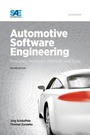
Joerg Schaeuffele | Thomas Zurawka
Automotive Software Engineering
Principles, Processes, Methods, and Tools
Book
11/2019
2nd Edition
SAE International
€93.00
Shipment within 10-20 days
Content
- Intro
- Introduction and Overview
- 1.1 The Driver-Vehicle-Environment System
- 1.1.1 Design and Method of Operation of Vehicle Electronic Systems
- 1.1.2 Electronic Systems of the Vehicle and the Environment
- 1.2 Overview of Vehicle Electronic Systems
- 1.2.1 Electronic Systems of the Powertrain
- 1.2.2 Electronic Systems of the Chassis
- 1.2.3 Body Electronics
- 1.2.4 Multimedia Systems
- 1.2.5 Distributed and Networked Electronic Systems
- 1.2.6 Summary and Outlook
- 1.3 Overview of the Logical System Architecture
- 1.3.1 ECU and Function Networks of the Vehicle
- 1.3.2 Logical System Architecture for Open-Loop/Closed-Loop Control and Monitoring Systems
- 1.4 Processes in Vehicle Development
- 1.4.1 Overview of Vehicle Development
- 1.4.2 Overview of the Development of Electronic Systems
- 1.4.3 Core Process for Electronic Systems and Software Development
- 1.4.4 Support Processes for Electronic Systems and Software Development
- 1.4.5 Production and Service of Electronic Systems and Software
- 1.5 Methods and Tools for the Development of Software for Electronic Systems
- 1.5.1 Model-Based Development
- 1.5.2 Integrated Quality Management
- 1.5.3 Reducing the Development Risk
- 1.5.4 Standardization and Automation
- 1.5.5 Development Steps in the Vehicle
- Essential System Basics
- 2.1 Open-Loop and Closed-Loop Control Systems
- 2.1.1 Modeling
- 2.1.2 Block Diagrams
- 2.2 Discrete Systems
- 2.2.1 Time-Discrete Systems and Signals
- 2.2.2 Value-Discrete Systems and Signals
- 2.2.3 Time- and Value-Discrete Systems and Signals
- 2.2.4 State Machines
- 2.3 Embedded Systems
- 2.3.1 Microcontroller Construction
- 2.3.2 Memory Technologies
- 2.3.3 Microcontroller Programming
- 2.4 Real-Time Systems
- 2.4.1 Defining Tasks
- 2.4.2 Defining Real-Time Requirements
- 2.4.3 Task States
- 2.4.4 Strategies for Processor Scheduling
- 2.4.5 Organization of Real-Time Operating Systems
- 2.4.6 Interaction Among Tasks
- 2.5 Distributed and Networked Systems
- 2.5.1 Logical and Technical System Architecture
- 2.5.2 Defining Logical Communication Links
- 2.5.3 Defining the Technical Network Topology
- 2.5.4 Defining Messages
- 2.5.5 Organization of Communication and Network Management
- 2.5.6 Strategies for Bus Arbitrcation
- 2.6 System Reliability, Safety, Monitoring, and Diagnostics
- 2.6.1 Basic Terms
- 2.6.2 System Reliability and Availability
- 2.6.3 System Safety
- 2.6.4 System Monitoring and Diagnostics
- 2.6.5 Organization of a Monitoring System for Electronic Control Units
- 2.6.6 Organization of a Diagnostic System for Electronic Control Units
- 2.7 Electrics/Electronics and Software Architecture
- Support Processes for Electronic Systems and Software Development
- 3.1 Basic Definitions of System Theory
- 3.2 Process Models and Standards
- 3.3 Configuration Management
- 3.3.1 Product and Life Cycle
- 3.3.2 Variants and Scalability
- 3.3.3 Versions and Configurations
- 3.4 Project Management
- 3.4.1 Project Planning
- 3.4.2 Project Tracking and Risk Management
- 3.5 Subcontractor/Supplier Management
- 3.5.1 System and Component Responsibilities
- 3.5.2 Interfaces for Specification and Integration
- 3.5.3 Defining the Cross-Corporation Development Process
- 3.6 Requirements Management
- 3.6.1 Mining, Recording, and Interpreting User Requirements
- 3.6.2 Tracking User Requirements
- 3.7 Quality Assurance
- 3.7.1 Integration and Testing Procedures
- 3.7.2 Software Quality Assurance Methods
- Core Process for Electronic Systems and Software Engineering
- 4.1 Requirements and Prerequisites
- 4.1.1 Shared System and Component Responsibilities
- 4.1.2 Coordination of Systems Engineering and Software Engineering
- 4.1.3 Model-Based Software Development
- 4.2 Basic Definitions and Notations
- 4.2.1 Processes, Process Steps, and Artifacts
- 4.2.2 Methods and Tools
- 4.3 Specification of Logical System Architecture
- 4.4 Specification of Technical System Architecture
- 4.4.1 Analysis and Specification of Open-Loop/Closed-Loop Control Systems
- 4.4.2 Analysis and Specification of Real-Time Systems
- 4.4.3 Analysis and Specification of Distributed and Networked Systems
- 4.4.4 Analysis and Specification of Reliable and Safe Systems
- 4.5 Specification of Software Architecture
- 4.5.1 Specification of Software Components and Associated Interfaces
- 4.5.2 Specification of Software Layers
- 4.5.3 Specification of Operating States
- 4.6 Specification of Software Components
- 4.6.1 Specification of Data Model
- 4.6.2 Specification of Behavioral Model
- 4.6.3 Specification of Real-Time Model
- 4.7 Design and Implementation of Software Components
- 4.7.1 Consideration of Requested Nonfunctional Product Properties
- 4.7.2 Design and Implementation of Data Model
- 4.7.3 Design and Implementation of Behavioral Model
- 4.7.4 Design and Implementation of Real-Time Model
- 4.8 Software Component Testing
- 4.9 Integration of Software Components
- 4.9.1 Generating Program Version and Data Version
- 4.9.2 Generating Description Files
- 4.9.3 Generating Documentation
- 4.10 Software Integration Testing
- 4.11 Integration of System Components
- 4.11.1 Integration of Software and Hardware
- 4.11.2 Integration of ECUs, Setpoint Generators, Sensors, and Actuators
- 4.12 System Integration Test
- 4.13 Calibration
- 4.14 System and Acceptance Test
- Methods and Tools for Development
- 5.1 Offboard Interface Between Electronic Control Units and Tools
- 5.2 Analysis of Logical System Architecture and Specification of Technical System Architecture
- 5.2.1 Analysis and Specification of Open-Loop and Closed-Loop Control Systems
- 5.2.2 Analysis and Specification of Real-Time Systems
- 5.2.3 Analysis and Specification of Distributed and Networked Systems
- 5.2.4 Analysis and Specification of Reliable and Safe Systems
- 5.3 Specification and Validation of Software Functions
- 5.3.1 Specification of Software Architecture and Software Components
- 5.3.2 Specification of Data Model
- 5.3.3 Specification of Behavioral Model Using Block Diagrams
- 5.3.4 Specification of Behavioral Model Using Decision Tables
- 5.3.5 Specification of Behavioral Model Using State Machines
- 5.3.6 Specification of Behavioral Model Using High-Level Languages
- 5.3.7 Specification of Real-Time Model
- 5.3.8 Validating the Specification Through Simulation and Rapid Prototyping
- 5.4 Design and Implementation of Software Functions
- 5.4.1 Consideration of Requested Nonfunctional Product Properties
- 5.4.2 Design and Implementation of Algorithms for Fixed-Point and Floating-Point Arithmetic
- 5.4.3 Design and Implementation of Software Architecture
- 5.4.4 Design and Implementation of Data Model
- 5.4.5 Design and Implementation of Behavioral Model
- 5.5 Integration and Testing of Software Functions
- 5.5.1 Software-in-the-Loop Simulations
- 5.5.2 Laboratory Vehicles and Test Benches
- 5.5.3 Experimental, Prototype, and Production Vehicles
- 5.5.4 Design and Automation of Experiments
- 5.6 Calibration of Software Functions
- 5.6.1 Offline and Online Calibration Procedures
- 5.6.2 Software Update Through Flash Programming
- 5.6.3 Synchronous Measuring of Microcontroller and Instrumentation Signals
- 5.6.4 Downloading and Evaluating Onboard Diagnostic Data
- 5.6.5 Offline Calibration of Parameters
- 5.6.6 Online Calibration of Parameters
- 5.6.7 Classification of Offboard Interfaces for Online Calibration
- 5.6.8 CAL-RAM Management
- 5.6.9 Parameter and Data Version Management
- 5.6.10 Design and Automation of Experiments
- Methods and Tools for Production and Service
- 6.1 Offboard Diagnostics
- 6.2 Parameterization of Software Functions
- 6.3 Software Update Through Flash Programming
- 6.3.1 Erasing and Programming Flash Memory
- 6.3.2 Flash Programming Through the Offboard Diagnostic Interface
- 6.3.3 Security Requirements
- 6.3.4 Availability Requirements
- 6.3.5 Boot Block Shifting and Flash Programming
- 6.4 Startup and Testing of Electronic Systems
- Summary and Outlook
- References
- Illustration Credits
- List of Acronyms
- Index
- About the Authors
- _GoBack
- _GoBack
- _GoBack
- _GoBack
- _GoBack
- _GoBack
- _GoBack
- _GoBack

