

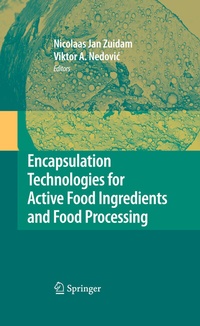
Encapsulation Technologies for Active Food Ingredients and Food Processing
Description

Consumers prefer food products that are tasty, healthy, and convenient. Encapsulation is an important way to meet these demands by delivering food ingredients at the right time and right place. For example, encapsulates may allow flavor retention, mask bad tasting or bad smelling components, stabilize food ingredients, and increase their bioavailability. Encapsulation may also be used to immobilize cells or enzymes in the production of food materials or products, such as fermentation or metabolite production.
This book provides a detailed overview of the encapsulation technologies available for use in food products, food processing, and food production. The book aims to inform those who work in academia or R&D about both the delivery of food compounds via encapsulation and food processing using immobilized cells or enzymes. The structure of the book is according to the use of encapsulates for a specific application. Emphasis is placed on strategy, since encapsulation technologies may change. Most chapters include application possibilities of the encapsulation technologies in specific food products or processes.
The first part of the book reviews general technologies, food-grade materials, and characterization methods for encapsulates.
The second part discusses encapsulates of active ingredients (e.g., aroma, fish oil, minerals, vitamins, peptides, proteins, probiotics) for specific food applications.
The last part describes immobilization technologies of cells and enzymes for use within food fermentation processes (e.g., beer, wine, dairy, meat), and food production (e.g., sugar conversion, production of organic acids or amino acids, hydrolysis of triglycerides).
Edited by two leading experts in the field, Encapsulation Technologies for Food Active Ingredients and Food Processing will be a valuable reference source for those working in the academia or food industry. The editors work in both industry oracademia, and they have brought together in this book contributions from both fields.
More details
Other editions
Additional editions
Persons
Dr. Nicolaas Jan (Klaas-Jan) Zuidam is leading the skillbase group 'Controlled Delivery of Food Actives' and is a member of the management team of the Flavour Generation & Delivery department within Unilever Research and Development in Vlaardingen, The Netherlands. Since 1990, he has been working on encapsulation, respectively, in the area of pharmaceutics, gene therapy, laundry and foods. He is an author of more than 35 peer-reviewed articles and book chapters, and holds 2 patents.
Dr. Viktor A. Nedovic is an associate professor at the Department of Food Technology and Biochemistry, Faculty of Agriculture, University of Belgrade, Belgrade, Republic of Serbia. Since 1989, he has been working on immobilisation, co-immobilisation, encapsulation and bioreactor system design in the fields of food production and fermentation processes. He is an author of more than 70 peer-reviewed articles and book chapters. He has served as co-editor of two important books on cell immobilisation: Fundamentals of Cell Immobilisation Biotechnology (Kluwer Academic Publishers, 2004) and Applications of Cell Immobilisation Biotechnology (Springer, 2005).
