

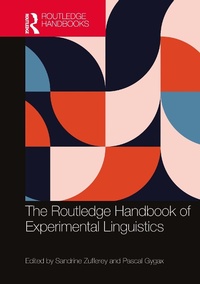
The Routledge Handbook of Experimental Linguistics
1st Edition
Published on 4. September 2023
522 pages
978-1-000-91939-4 (ISBN)
Description

The Routledge Handbook of Experimental Linguistics provides an up-to-date and accessible overview of various ways in which experiments are used across all domains of linguistics and surveys the range of state-of-the-art methods that can be applied to analyse the language of populations with a wide range of linguistic profiles.
Each chapter provides a step-by-step introduction to theoretical and methodological challenges and critically presents a wide range of studies in various domains of experimental linguistics.
This handbook:
Provides a unified perspective on the data, methods and findings stemming from all experimental research in linguistics
Covers many different subfields of linguistics, including argumentation theory, discourse studies and typology
Provides an introduction to classical as well as new methods to conduct experiments such as eye tracking and brain imaging
Features a range of internationally renowned academics
Shows how experimental research can be used to study populations with various linguistic profiles, including young children, people with linguistic impairments, older adults, language learners and bilingual speakers
Providing readers with a wealth of theoretical and practical information in order to guide them in designing methodologically sound linguistic experiments, this handbook is essential reading for scholars and students researching in all areas of linguistics.
Each chapter provides a step-by-step introduction to theoretical and methodological challenges and critically presents a wide range of studies in various domains of experimental linguistics.
This handbook:
Provides a unified perspective on the data, methods and findings stemming from all experimental research in linguistics
Covers many different subfields of linguistics, including argumentation theory, discourse studies and typology
Provides an introduction to classical as well as new methods to conduct experiments such as eye tracking and brain imaging
Features a range of internationally renowned academics
Shows how experimental research can be used to study populations with various linguistic profiles, including young children, people with linguistic impairments, older adults, language learners and bilingual speakers
Providing readers with a wealth of theoretical and practical information in order to guide them in designing methodologically sound linguistic experiments, this handbook is essential reading for scholars and students researching in all areas of linguistics.
Reviews / Votes
Offering impressive breadth and depth of coverage, and surveying classic and cutting-edge approaches and techniques, The Routledge Handbook of Experimental Linguistics uniquely positions itself as an indispensable resource for the novice and expert linguistics researcher alike. Essential reading for any methods course, too. Highly recommended.Professor Panos Athanasopoulos, Lancaster University, UK
The use of experimental methods is no longer something peripheral but lies at the core of language studies. Yet we lack coherent overviews of the large body of methods and knowledge from experiments on language. This book fills a gap and it is essential for the new generation of linguists.
Professor Valentina Bambini, University School for Advanced Studies IUSS Pavia, Italy
More details
Series
Edition
1. Auflage
Language
English
Place of publication
London
United Kingdom
Publishing group
Taylor & Francis Ltd
Target group
College/higher education
Product notice
Reflowable
Illustrations
13 Tables, black and white; 8 Line drawings, black and white; 12 Halftones, black and white; 20 Illustrations, black and white
ISBN-13
978-1-000-91939-4 (9781000919394)
Copyright in bibliographic data and cover images is held by Nielsen Book Services Limited or by the publishers or by their respective licensors: all rights reserved.
Schweitzer Classification
Other editions
Additional editions
Sandrine Zufferey | Pascal Gygax
The Routledge Handbook of Experimental Linguistics
Book
09/2023
1st Edition
Routledge
€335.00
Shipment within 10-20 days
Persons
Sandrine Zufferey is a Professor of French linguistics at the University of Bern, Switzerland.
Pascal Gygax is a Senior Lecturer at the University of Fribourg, Switzerland.
Pascal Gygax is a Senior Lecturer at the University of Fribourg, Switzerland.
Content
Acknowledgements
List of Contributors
Introduction
Sandrine Zufferey and Pascal Gygax
PART 1: FOCUS ON LINGUISTIC DOMAINS
Historical Perspectives on the Use of Experimental Methods in Linguistics
Alan Garnham
Experimental Phonetics and Phonology
Ivana Didirkova and Anne Catherine Simon
Experimental Morphology
Vera Heyer
Experimental Syntax
Yamila Sevilla and Maria Elina Sanchez
Experimental Semantics
Stephanie Solt
Experimental Pragmatics
Tomoko Matsui
Experimental Sociolinguistics
Erez Levon
Experimental Studies in Discourse
Ted Sanders, Jet Hoek, and Merel Scholman
Experimental Studies in Argumentation
Peter Collins and Ulrike Hahn
Experimental Studies in Contrastive Linguistics and Typology
Caroline Andrews, Elisabeth Norcliffe, and Sebastian Sauppe
Experimental Methods to Study Distributed Comprehension of Action Language
Carole Madden and William Dupont
PART II: FOCUS ON EXPERIMENTAL METHODS
Eliciting Spontaneous Linguistic Productions
Jennifer Arnold
Analysing Speech Perception
Sandra Schwab and Nathalie Giroud
Contrasting Online and Offline Measures: Examples from Experimental Research on Linguistic Relativity
Sayaka Sato and Norbert Vanek
Cognitive Processes Involved in Text Comprehension: Walking the Fine Line between Passive and Strategic Validating Processes in Reading
Anne Cook and Edward O'Brien
Analysing Reading with Eye-tracking
Anna Siyanova-Chanturia and Irina Elgort
Analysing Spoken Language Comprehension with Eye-Tracking
Yipu Wei and Michael Tanenhaus
Mobile Eye-tracking for Multimodal Interaction Analysis
Geert Brone and Bert Oben
Analysing Language using Brain Imaging
Trisha Thomas, Francesca Pesciarelli, Clara Martin, and Sendy Caffarra
New Trends in Statistical Analysis for Experimental Linguistics
Shravan Vasishth
Assessing Adult Linguistic Competence
Lydia White
Dealing with Participant Variability in Experimental Linguistics
Ute Gabriel and Pascal Gygax
Testing in the Lab and Testing through the Web
Jonathan Kim
PART III: FOCUS ON SPECIFIC POPULATIONS
Experimental Methods to Study Child Language
Titia Benders, Nan Xu Rattanasone, Rosalind Thornton, Iris Mulders, and Loes Koring
Experimental Methods to Study Atypical Language Development
Phaedra Royle, Emilie Courteau, and Marie Pourquie
Experimental Methods to Study Disorders of Language Production in Adults
Andrea Marini
Experimental methods for studying second language learners
Alan Juffs and Shaohua Fang
Experimental Methods to study Bilinguals
Ramesh Kumar Mishra and Seema Prasad
Experimental Methods to Study Cultural Differences in Linguistics
Evangelia Adamou
Experimental Methods to Study Late-life Language Learning
Merel Keijzer, Jelle Brouwer, Floor van den Berg, and Mara van der Ploeg
Index
List of Contributors
Introduction
Sandrine Zufferey and Pascal Gygax
PART 1: FOCUS ON LINGUISTIC DOMAINS
Historical Perspectives on the Use of Experimental Methods in Linguistics
Alan Garnham
Experimental Phonetics and Phonology
Ivana Didirkova and Anne Catherine Simon
Experimental Morphology
Vera Heyer
Experimental Syntax
Yamila Sevilla and Maria Elina Sanchez
Experimental Semantics
Stephanie Solt
Experimental Pragmatics
Tomoko Matsui
Experimental Sociolinguistics
Erez Levon
Experimental Studies in Discourse
Ted Sanders, Jet Hoek, and Merel Scholman
Experimental Studies in Argumentation
Peter Collins and Ulrike Hahn
Experimental Studies in Contrastive Linguistics and Typology
Caroline Andrews, Elisabeth Norcliffe, and Sebastian Sauppe
Experimental Methods to Study Distributed Comprehension of Action Language
Carole Madden and William Dupont
PART II: FOCUS ON EXPERIMENTAL METHODS
Eliciting Spontaneous Linguistic Productions
Jennifer Arnold
Analysing Speech Perception
Sandra Schwab and Nathalie Giroud
Contrasting Online and Offline Measures: Examples from Experimental Research on Linguistic Relativity
Sayaka Sato and Norbert Vanek
Cognitive Processes Involved in Text Comprehension: Walking the Fine Line between Passive and Strategic Validating Processes in Reading
Anne Cook and Edward O'Brien
Analysing Reading with Eye-tracking
Anna Siyanova-Chanturia and Irina Elgort
Analysing Spoken Language Comprehension with Eye-Tracking
Yipu Wei and Michael Tanenhaus
Mobile Eye-tracking for Multimodal Interaction Analysis
Geert Brone and Bert Oben
Analysing Language using Brain Imaging
Trisha Thomas, Francesca Pesciarelli, Clara Martin, and Sendy Caffarra
New Trends in Statistical Analysis for Experimental Linguistics
Shravan Vasishth
Assessing Adult Linguistic Competence
Lydia White
Dealing with Participant Variability in Experimental Linguistics
Ute Gabriel and Pascal Gygax
Testing in the Lab and Testing through the Web
Jonathan Kim
PART III: FOCUS ON SPECIFIC POPULATIONS
Experimental Methods to Study Child Language
Titia Benders, Nan Xu Rattanasone, Rosalind Thornton, Iris Mulders, and Loes Koring
Experimental Methods to Study Atypical Language Development
Phaedra Royle, Emilie Courteau, and Marie Pourquie
Experimental Methods to Study Disorders of Language Production in Adults
Andrea Marini
Experimental methods for studying second language learners
Alan Juffs and Shaohua Fang
Experimental Methods to study Bilinguals
Ramesh Kumar Mishra and Seema Prasad
Experimental Methods to Study Cultural Differences in Linguistics
Evangelia Adamou
Experimental Methods to Study Late-life Language Learning
Merel Keijzer, Jelle Brouwer, Floor van den Berg, and Mara van der Ploeg
Index
