

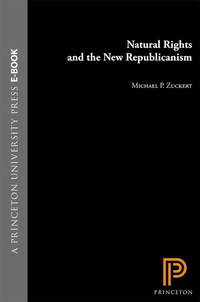
Natural Rights and the New Republicanism
1st Edition
Published on 27. June 2011
410 pages
978-1-4008-2152-5 (ISBN)
Description

In Natural Rights and the New Republicanism, Michael Zuckert proposes a new view of the political philosophy that lay behind the founding of the United States. In a book that will interest political scientists, historians, and philosophers, Zuckert looks at the Whig or opposition tradition as it developed in England. He argues that there were, in fact, three opposition traditions: Protestant, Grotian, and Lockean. Before the English Civil War the opposition was inspired by the effort to find the "one true Protestant politics--an effort that was seen to be a failure by the end of the Interregnum period. The Restoration saw the emergence of the Whigs, who sought a way to ground politics free from the sectarian theological-scriptural conflicts of the previous period.
The Whigs were particularly influenced by the Dutch natural law philosopher Hugo Grotius. However, as Zuckert shows, by the mid-eighteenth century John Locke had replaced Grotius as the philosopher of the Whigs. Zuckert's analysis concludes with a penetrating examination of John Trenchard and Thomas Gordon, the English "Cato," who, he argues, brought together Lockean political philosophy and pre-existing Whig political science into a new and powerful synthesis. Although it has been misleadingly presented as a separate "classical republican" tradition in recent scholarly discussions, it is this "new republicanism" that served as the philosophical point of departure for the founders of the American republic.
The Whigs were particularly influenced by the Dutch natural law philosopher Hugo Grotius. However, as Zuckert shows, by the mid-eighteenth century John Locke had replaced Grotius as the philosopher of the Whigs. Zuckert's analysis concludes with a penetrating examination of John Trenchard and Thomas Gordon, the English "Cato," who, he argues, brought together Lockean political philosophy and pre-existing Whig political science into a new and powerful synthesis. Although it has been misleadingly presented as a separate "classical republican" tradition in recent scholarly discussions, it is this "new republicanism" that served as the philosophical point of departure for the founders of the American republic.
More details
Other editions
Additional editions
Michael Zuckert
Natural Rights and the New Republicanism
Book
03/1998
Princeton University Press
€58.40
Shipment within 10-20 days
Michael Zuckert
Natural Rights and the New Republicanism
Book
09/1994
Princeton University Press
€59.42
Article exhausted; check different version
Person
Michael P. Zuckert is Congdon Professor of Political Science at Carleton College. He is the author of The National Rights Republic: Studies on the Foundations of the American Political Tradition.
Content
Preface
Acknowledgments
Introduction
Prologue 3
Pt. 1 Protestants 27
Ch. 1 Aristotelian Royalism and Reformation Absolutism: Divine Right Theory 29
Ch. 2 Aristotelian Constitutionalism and Reformation Contractarianism: From Ancient Constitution to Original Contract 49
Ch. 3 Contract and Christian Liberty: John Milton 77
Pt. 2 Whigs 95
Ch. 4 Whig Contractarianisms and Rights 97
Ch. 5 The Master of Whig Political Philosophy 119
Ch. 6 A Neo-Harringtonian Moment? Whig Political Science and the Old Republicanism 150
Pt. 3 Natural Rights and the New Republicanism 185
Ch. 7 Locke and the Reformation of Natural Law: Questions Concerning the Law of Nature 187
Ch. 8 Locke and the Reformation of Natural Law: Two Treatises of Government 216
Ch. 9 Locke and the Reformation of Natural Law: Of Property 247
Ch. 10 Locke and the Transformation of Whig Political Philosophy 289
Notes 321
Bibliography 377
Index 391
Acknowledgments
Introduction
Prologue 3
Pt. 1 Protestants 27
Ch. 1 Aristotelian Royalism and Reformation Absolutism: Divine Right Theory 29
Ch. 2 Aristotelian Constitutionalism and Reformation Contractarianism: From Ancient Constitution to Original Contract 49
Ch. 3 Contract and Christian Liberty: John Milton 77
Pt. 2 Whigs 95
Ch. 4 Whig Contractarianisms and Rights 97
Ch. 5 The Master of Whig Political Philosophy 119
Ch. 6 A Neo-Harringtonian Moment? Whig Political Science and the Old Republicanism 150
Pt. 3 Natural Rights and the New Republicanism 185
Ch. 7 Locke and the Reformation of Natural Law: Questions Concerning the Law of Nature 187
Ch. 8 Locke and the Reformation of Natural Law: Two Treatises of Government 216
Ch. 9 Locke and the Reformation of Natural Law: Of Property 247
Ch. 10 Locke and the Transformation of Whig Political Philosophy 289
Notes 321
Bibliography 377
Index 391
