

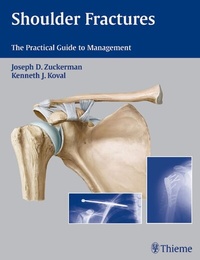
Shoulder Fractures
Description

Thieme congratulates Joseph D. Zuckerman on being chosen by New York magazine for its prestigious Best Doctors 2015 list.
From high impact energy injuries to fragility fractures in the elderly, the wide variability in shoulder fractures have made them simultaneously the most common and challenging of shoulder injuries.
Based on the authors' extensive clinical and teaching experience, here is your complete guide to the management of fractures of the proximal humerus, clavicle, and scapula. You will find focused discussions of anatomy, diagnosis, fracture classifications, imaging, surgical and non-surgical treatments, complications, and outcomes -- a one-volume compendium of modern shoulder care! The book provides in-depth recommendations for evaluation and management of one, two, three, and four-part fractures and fracture-dislocations, as well as complications that may arise. More than 500 illustrations and radiographs enhance every concept and technique in the book.
With a strong emphasis on treatment options and outcome assessment, this book is a must for all orthopedic surgeons, shoulder specialists, orthopedic traumatologists, and residents and fellows who restore function to the injured shoulder.
More details
Other editions
Additional editions

Content
Chapter 1 Principles of Treatment and Outcomes Assessment
Chapter 2 Anatomy of the Shoulder
Chapter 3 Proximal Humeral Fractures: Clinical Evaluation and Classification
Chapter 4 One-Part Fractures
Chapter 5 Two-Part Fractures and Fracture-Dislocations
Chapter 6 Three-Part Fractures and Fracture-Dislocations
Chapter 7 Four-Part Fractures and Fracture-Dislocations
Chapter 8 Humeral Head Impression Fractures and Head-Splitting Fractures
Chapter 9 Complications of Proximal Humeral Fractures
Chapter 10 Clavicle Fractures
Chapter 11 Scapula Fractures
