

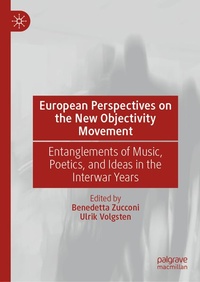
European Perspectives on the New Objectivity Movement
Description

This edited volume offers a new perspective on the new objectivity movement in music during the interwar period, challenging the view of it as a solely German or Berlin-based movement. Unlike architecture or visual arts, musicology has rarely applied the term beyond Germany. Yet, new objectivity in music-spanning composition, performance, and listening-had significant European expressions. Key features included a rejection of expressionism, interest in mechanical reproduction (radio, gramophone), and objective performance styles. Through historiographical analysis and diverse case studies from several European countries, the book presents the movement as a broader, locally rooted phenomenon reflecting a shared Zeitgeist. It explores how these ideas emerged independently across national contexts, offering new insights into the cultural and political dynamics of the period. By examining aesthetic, institutional, political, and performative dimensions, the book invites a rethinking of new objectivity as a transnational and multifaceted phenomenon, and proposes its relevance as a tool for historiographical inquiry in music studies.
More details
Other editions
Additional editions
Persons
Benedetta Zucconi is Assistant Professor in Musicology at the University of Cagliari. Her research interests focus on the history of sound technology and music media, the cultural history of music, music theatre and the European historical avant-garde in music.
Ulrik Volgsten is Professor of musicology at Örebro University, Sweden. He has held positions at the University of Gothenburg and Stockholm University. His research is concerned with the conceptual history of Western music (composer, work, listener), philosophy of music, with a special focus on musical communication in different media and the role of vitality affects.
Content
Part 1-Theoretical and Historical Mappings.Chapter 1-Defamed but seized: contradictory approaches of Nazi music politics to Neue.- Chapter 2-A plurality of (metaphorical) languages: Neue Sachlichkeit under the prism of multilingualism.- Part 2:Decentering Neue Sachlichkeit.- Chapter 3-New Objectivity in interwar Catalonia: reception and influence.- Chapter4-Neue Sachlichkeit and the beginnings of modern Slovak music.- Chapter5-: Neue Sachlichkeit in Sweden? On the search for a modernist aesthetics.- Chapter6-The complexity of banality: Neo-classicism and Popular Music in Pauline Hall's Suite for Wind Quintet.- Part 3:Institutional Foundations of Neue Sachlichkeit in Europe.- Chapter 7-The most objective music: the ascendancy of Neue Sachlichkeit as norm in Swedish church music.- Chapter 8-A Lost Imagination? New Objectivity and the Swedish Section of the International Society for Contemporary Music (ISSM) 1923-1939.- Chapter9-Between Expressionism and Neue Sachlichkeit? Transformations of the Händel opera revival in the light of artistic networks.- Part 4-Sachliche" Practices Through New Media and Technology.- Chapter 10-New attitudes of professional music listeners in Hungary in the 1920s and 1930s.Chapter 11-Kajsa Rootzén and the record review: Solitary listening to die Sache selbst.Chapter 12-The performer and the machine: unexpected parallels between Neue Sachlichkeit and Italian Neo-Idealism in the interwar years.- Chapter 13-Between Sachlichkeit and sentimentality: the medial qualities of early Danish music radio programming.
