

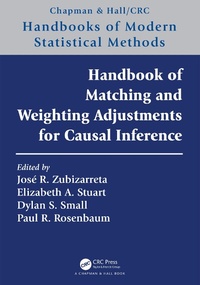
Handbook of Matching and Weighting Adjustments for Causal Inference
1st Edition
Published on 11. April 2023
634 pages
978-1-000-85081-9 (ISBN)
Description

An observational study infers the effects caused by a treatment, policy, program, intervention, or exposure in a context in which randomized experimentation is unethical or impractical. One task in an observational study is to adjust for visible pretreatment differences between the treated and control groups. Multivariate matching and weighting are two modern forms of adjustment. This handbook provides a comprehensive survey of the most recent methods of adjustment by matching, weighting, machine learning and their combinations. Three additional chapters introduce the steps from association to causation that follow after adjustments are complete.
When used alone, matching and weighting do not use outcome information, so they are part of the design of an observational study. When used in conjunction with models for the outcome, matching and weighting may enhance the robustness of model-based adjustments. The book is for researchers in medicine, economics, public health, psychology, epidemiology, public program evaluation, and statistics who examine evidence of the effects on human beings of treatments, policies or exposures.
When used alone, matching and weighting do not use outcome information, so they are part of the design of an observational study. When used in conjunction with models for the outcome, matching and weighting may enhance the robustness of model-based adjustments. The book is for researchers in medicine, economics, public health, psychology, epidemiology, public program evaluation, and statistics who examine evidence of the effects on human beings of treatments, policies or exposures.
Reviews / Votes
"Edited and written by many prominent researchers in the field, the book covers both classical and modern topics. Each chapter is self-contained, making it a great reference book. The book is organized in a way that related topics are clustered together, enabling readers to easily navigate and read chapter by chapter. Overall, I enjoyed reading this book very much. [...] The book contains numerous real-data examples that aid readers in understanding the concepts and methods. Additionally, many chapters discuss the computational implementation of the corresponding methods. I am confident that researchers and practitioners will find this book to be an excellent resource for adjustment methods."-Raymond K.W. Wong in Journal of the American Statistical Association, December 2023
"The book benefits from a comprehensive collection of recent causal inference methods, offering a wide range of perspectives on weighting and matching techniques. While all the methods share the common goal of unbiased causal effect estimation in observational studies, each chapter clearly demonstrates its focus (eg, balancing covariates or using survival outcomes). In particular, each chapter includes data application examples at the end or incorporates application studies throughout. [...] I am grateful that this book contributes to expanding the accessibility of modern causal inference tools, bringing them together in a cohesive manner for researchers and educators who wish to learn, teach, and apply these methods to obtain unbiased causal evidence from -potentially messy and unkind-observational studies."
-Youjin Lee in Biometrics, September 2024
More details
Series
Edition
1. Auflage
Language
English
Place of publication
London
United Kingdom
Publishing group
Taylor & Francis Ltd
Target group
College/higher education
Professional and scholarly
Illustrations
63 Tables, black and white; 41 Line drawings, color; 32 Line drawings, black and white; 1 Halftones, color; 42 Illustrations, color; 32 Illustrations, black and white
ISBN-13
978-1-000-85081-9 (9781000850819)
Copyright in bibliographic data and cover images is held by Nielsen Book Services Limited or by the publishers or by their respective licensors: all rights reserved.
Schweitzer Classification
Other editions
Additional editions
Jose R. Zubizarreta | Elizabeth A. Stuart | Dylan S. Small
Handbook of Matching and Weighting Adjustments for Causal Inference
Book
04/2023
1st Edition
Chapman & Hall/CRC
€330.00
Shipment within 15-20 days
Persons
Jose Zubizarreta, PhD, is an associate professor in the Department of Health Care Policy at Harvard Medical School and in the Department Biostatistics at Harvard University. He is a Fellow of the American Statistical Association, and is a recipient of the Kenneth Rothman Award, the William Cochran Award, and the Tom Ten Have Memorial Award.
Elizabeth A. Stuart, Ph.D. is Bloomberg Professor of American Health in the Department of Mental Health, the Department of Biostatistics and the Department of Health Policy and Management at Johns Hopkins Bloomberg School of Public Health. She is a Fellow of the American Statistical Association, and she received the mid-career award from the Health Policy Statistics Section of the ASA, the Gertrude Cox Award for applied statistics, Harvard University's Myrto Lefkopoulou Award for excellence in Biostatistics, and the Society for Epidemiologic Research Marshall Joffe Epidemiologic Methods award.
Dylan Small, PhD is the Universal Furniture Professor in the Department of Statistics and Data Science of the Wharton School of the University of Pennsylvania. He is a Fellow of the American Statistical Association and an Institute of Mathematical Statistics Medallion Lecturer.
Paul R. Rosenbaum is emeritus professor of Statistics and Data Science at the Wharton School of the University of Pennsylvania. From the Committee of Presidents of Statistical Societies, he received the R. A. Fisher Award and the George W. Snedecor Award. He is the author of several books, including Design of Observational Studies and Replication and Evidence Factors in Observational Studies.
Elizabeth A. Stuart, Ph.D. is Bloomberg Professor of American Health in the Department of Mental Health, the Department of Biostatistics and the Department of Health Policy and Management at Johns Hopkins Bloomberg School of Public Health. She is a Fellow of the American Statistical Association, and she received the mid-career award from the Health Policy Statistics Section of the ASA, the Gertrude Cox Award for applied statistics, Harvard University's Myrto Lefkopoulou Award for excellence in Biostatistics, and the Society for Epidemiologic Research Marshall Joffe Epidemiologic Methods award.
Dylan Small, PhD is the Universal Furniture Professor in the Department of Statistics and Data Science of the Wharton School of the University of Pennsylvania. He is a Fellow of the American Statistical Association and an Institute of Mathematical Statistics Medallion Lecturer.
Paul R. Rosenbaum is emeritus professor of Statistics and Data Science at the Wharton School of the University of Pennsylvania. From the Committee of Presidents of Statistical Societies, he received the R. A. Fisher Award and the George W. Snedecor Award. He is the author of several books, including Design of Observational Studies and Replication and Evidence Factors in Observational Studies.
Content
Part 1: Conceptual issues 1. Overview of methods for adjustment and applications in the social and behavioral sciences: The role of study design 2. Propensity score 3. Generalization and Transportability Part 2: Matching 4. Optimization techniques in multivariate matching 5. Optimal Full matching 6. Fine balance and its variations in modern optimal matching 7. Matching with instrumental variables 8. Covariate Adjustment in Regression Discontinuity Designs 9. Risk Set Matching 10. Matching with Multilevel Data 11. Effect Modification in Observational Studies 12. Optimal Nonbipartite Matching 13. Matching Methods for Large Observational Studies Part 3: Weighting 14. Overlap Weighting 15. Covariate Balancing Propensity Score 16. Balancing Weights for Causal Inference 17. Assessing Principal Causal Effects Using Principal Score Methods 18. Incremental Causal Effects: An Introduction and Review 19. Weighting Estimators for Causal Mediation Part 4: Machine Learning Adjustments 20. Machine Learning for Causal Inference 21. Treatment Heterogeneity with Survival Outcomes 22. Why Machine Learning Cannot Ignore Maximum Likelihood Estimation 23. Bayesian Propensity Score methods and Related Approaches for Confounding Adjustment Part 5: Beyond Adjustments 24. How to Be a Good Critic of an Observational Study 25. Sensitivity Analysis 26. Evidence Factors
