

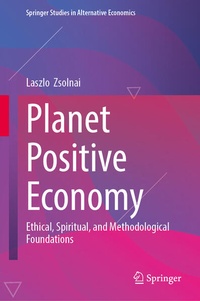
Planet Positive Economy
Description

This volume discusses the grand challenges of the Anthropocene era and explores how the economy can be transformed to serve the wellbeing of humans and nature in an integrated way. It develops a broad, spiritually informed view of the economy and argues for the need to shift the underlying materialistic value orientation of current economic and business functioning. The author argues that without adopting a non-materialistic value orientation, it is not possible for humanity to survive and flourish in the Anthropocene. Economic actors should abandon the single goal of financial wealth creation; instead, they should focus on wellbeing creation, which serves the flourishing of human and non-human beings in the present and the future. The book presents dozens of practical business models and working policies from different industries and countries to move in the direction of a wellbeing economy. Additionally, it discusses the required holistic methodology, which goes beyond the prevailing reductionist science of today. Finally, the book offers a spiritually based ethics that may motivate individuals, organizations, and larger social entities to transform themselves into "planet-positive" change agents.
More details
Other editions
Additional editions
Person
Laszlo Zsolnai is Professor and Director of the Business Ethics Center at Corvinus Institute for Advanced Studies, Corvinus University of Budapest. He is Associate Member of the Las Casas Institute, Blackfriars Hall, University of Oxford, and President of the European SPES Institute in Leuven. In 2025 he was elected as Full Member of The Club of Rome. His latest publications include Value Creation for a Sustainable World (Palgrave, 2023) and Spirituality and Business in the Anthropocene (Palgrave, 2025).
Content
Chapter 1: Introduction: What is Planet Positivity?.- Part 1- The Spiritual Perspective on the Economy: The Spiritual Perspective on the Economy: Chapter 2: Spiritually Informed Economics.- Chapter 3: The Economics of Pope Francis.- Chapter 4: Buddhist Economics.-Chapter 5: Lessons from Hindu Spirituality.- Chapter 6: Indigenous Worldviews.- Part 2- Business in the Anthropocene: Chapter 7: Models for Creating Wellbeing.- Chapter 8: Living with Non-Materialistic Values.- Chapter 9: Intrinsic versus Extrinsic Motivation in Business.-Chapter 10: Wellbeing Oriented Organizations.- Chapter 11: Wellbeing Policies for Countries and Cities.- Part 3- Models for Wellbeing Creation: Chapter 12: Holistic Methodology.- Part 4- Holistic Methodology: Chapter 13: Identifying and Solving the Right Problem.- Chapter 14: The Methodology of Systems Change.- Part 5- Ethics in Dark Times: Chapter 15: Ethics in Dark Times.- Chapter 16: Ethics and Spirituality Care, and Its Relevance to Today's Economy.- Chapter 17: How to Renew Business Ethics Education?.
