

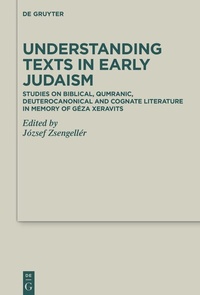
Understanding Texts in Early Judaism
Description

This volume remembers Géza Xeravits, a well known scholar of deuterocanonical and Qumran literature.
The volume is divided into four sections according to his scholarly work and interest. Contributions in the first part deal with Old Testament and related issues (Thomas Hiecke, Stefan Beyerle, and Matthew Goff). The second section is about the Dead Sea Scrolls (John J, Collins, John Kampen, Peter Porzig, Eibert Tigchelaar, Balázs Tamási and Réka Esztári). The largest part is the forth on deuterocanonica (Beate Ego, Lucas Brum Teixeira, Fancis Macatangay, Tobias Nicklas, Maria Brutti, Calduch-Benages Nuria, Pancratius Beentjes, Benjamin Wright, Otto Mulder, Angelo Passaro, Friedrich Reiterer, Severino Bussino, Jeremy Corley and JiSeong Kwong). The third section deals with cognate literature (József Zsengellér and Karin Schöpflin). The last section about the Ancient Synagogue has the paper of Anders Kloostergaard Petersen.
Some hot topics are discussed, for example the Two spirits in Qumran, the cathegorization of the Dead Sea Scrolls, the authorship and antropology of Ben Sira, and the angelology of Vitae Prophetarum.
More details
Other editions
Additional editions
Person
Content
- Intro
- Preface: In memoriam Géza G. Xeravits (1971-2019)
- Contents
- Part 1: Old Testament and Early Judaism
- "From the Heavens, From the Earth"
- Different Texts and Different Interpretations of "Exile"
- Effaced and Naturalized Modes of Jewish Reading: The Judah and Tamar Story (Genesis 38), the Book of Jubilees, and Robert Alter
- Part 2: Qumran
- The Two Spirits and the Origin of Evil
- Reading Instruction as a Sectarian Composition
- Thoughts on the Way towards "Prolegomena" to an Introduction to the Writings of the Dead Sea Scrolls
- Levi, Levites and Worship in Qumran
- Children Confined in the House of Darkness
- Part 3: Deuterocanonica
- "Narrate omnia mirabilia eius" (Tob 12:20 Vg)
- The Rhetorical Function of Burying the Dead in the Book of Tobit
- Das Wortfeld "Sterben" im 2. Makkabäerbuch
- The Topic of Intercession in Second Temple Judaism
- What's in a Name?
- Des Menschen Wohltat und Gottes Wohlwollen
- "Better"-Proverbs in the Book of Ben Sira
- "When the Lord created his works from the beginning" (Sir 16:26a)
- "Pillars of Gold on Plinths of Silver. . ." (Sir 26:18)
- Ben Sira 36:18-37:15: the Art of Choosing
- The Enigma of the Judges in Ben Sira 46: 11-12
- Bethesda in Sirach 50 revised
- Is Wisdom in Baruch 3:9-4:4 Combined with Torah?
- Part 4: Cognate Literature
- Good and Bad Angels in the Vitae Prophetarum
- "All Is Vanity, Saith the Preacher"
- Part 5: Antique Synagogue
- An Evolutionary Perspective on Temple, Synagogue, and Ekklesia with Special Focus on Paul
- Bibliography of Géza G. Xeravits
- List of Contributors
- Index of Modern Authors
- Index of Sources
- Index of Subjects
