

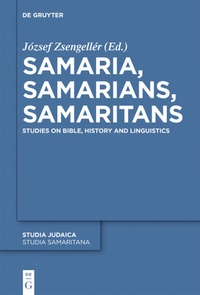
Samaria, Samarians, Samaritans
Description

Papers in this volume were presented at the seventh international conference of the Société d'Études Samaritaines held at the Reformed Theological Academy of Pápa, Hungary in July 17-25, 2008. The discussed Samaritan topics permeate different areas of biblical studies: The question of the Samaritan Pentateuch has a serious impact on the textual criticism of the Hebrew Bible. The pre-Samaritan text-type among the Dead Sea Scrolls, as well as the dating and isolation of Samaritan features of the Samaritan Pentateuch provide fresh and important data for gaining a better understanding of the composition of the Torah/Pentateuch. New reconstructions of the early history of the Samaritans have a great effect on the history of the Jewish people in the Persian and Hellenistic period. As a distinct group in the centuries around the turn of the Common Era in Palestine, Samaritans played an important role in the social and religious formation of early Judaism and early Christianity. Living for centuries under Islamic rule, Samaritans provide a good example of linguistic, cultural and religious developments experienced by ethnic and religious group in Islamic contexts.
More details
Other editions
Additional editions
Person
Content
2 - List of Contributors [Seite 9]
3 - I. Memorial [Seite 13]
3.1 - Equisse Biographique du Pére Dom Guy Dominique Sixdenier [Seite 15]
4 - II. Bible [Seite 21]
4.1 - Genesis 4 and the Pentateuch's Reiterative Discourse: Some Samaritan Themes [Seite 23]
4.2 - The Samaritan Version of Deuteronomy and the Origin of Deuteronomy [Seite 37]
4.3 - Did Jacob Become Judah?: The Configuration of Israel's Restoration in Deutero-Isaiah [Seite 53]
5 - III. History [Seite 83]
5.1 - Administration of Samaria in the Hellenistic period [Seite 85]
5.2 - The Building of the Samaritan Temple and the Samaritan Governors - Again [Seite 103]
5.3 - Josephus on the Samaritans - his Tendenz and Purpose [Seite 123]
5.4 - Israelites, Samaritans, Temples, Jews [Seite 135]
5.5 - Samaritans. History and Tradition in Relationship to Jews, Christians and Muslims: Problems in Writing a Monograph [Seite 187]
6 - IV. Linguistics [Seite 199]
6.1 - "Hebrew Language" and "Holy Language" Between Judea and Samaria [Seite 201]
6.2 - An Unknown Samaritan Poem of the Type FATIH.A [Seite 217]
6.3 - Different Pronunciations of the Same Word in the Torah Reading of the Israelite Samaritans in Comparison Its Significant Attributes [Seite 231]
7 - V. Artifacts and Texts [Seite 237]
7.1 - The Samaritans in Caesarea Maritima [Seite 239]
7.2 - An Elusive Samaritan Manuscript in Utrecht [Seite 251]
8 - VI. Arabica [Seite 257]
8.1 - Reflections in a Samaritan Belief in an After-life. Text-proofs for 'The Appointed Day' in Sam. Ms. BL Or10370 [Seite 259]
8.2 - Abu l-.asan as.-S.uri and his Inclinations to Mu'tazilite Theology [Seite 275]
8.3 - A Samaritan Legend in the Alhambra Stories? [Seite 301]
8.4 - The Samaritan High Priest 'Imram ben Salama and his Poem against Mubarak al Mufarragi, Who Became a Convert to Islam in 1841 [Seite 307]
9 - Indexes [Seite 325]
