

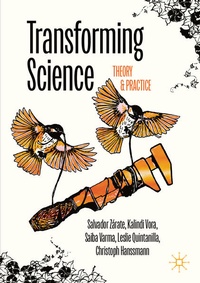
Transforming Science
Description

Transforming Science: Theory and Practice is an accessible handbook aimed at scientists, researchers, and students interested in research for transformative social change. Readers learn to design and implement a research project that forwards scientific and social justice ends. Through conceptual tools, examples, and exercises that illustrate community-based research gone wrong and right, the book covers how scientific processes have been misused, how to develop non-hierarchical and long-term relations and practices, and how researchers can repair relations with communities and environments. Transforming Science is a guide for practicing the science we are for: science for and with the people.
Written by the Science, Transformation, Accountability, and Resistance (STAR) Collective
More details
Other editions
Additional editions
Persons
Christoph Hanssmann is Assistant Professor of Gender, Sexuality and Women's Studies at the University of California, Davis. He has published articles in Social Science & Medicine, Transgender Studies Quarterly, and Sexuality Research and Social Policy, and authored a chapter in Transfeminist Perspectives in and beyond Transgender and Gender Studies (Temple Univ. Press 2012). His first book, Care without Pathology: How Trans- Health Activists are Changing Medicine is forthcoming from the University of Minnesota Press.
Leslie Quintanilla is Assistant Professor of Women and Gender Studies at San Francisco State University. She earned her Ph.D. in ethnic studies, with a graduate certificate in critical gender studies, from University of California, San Diego, in 2019. Her book manuscript is titled, "Towards a Transnational 'No Ban, No Wall' Movement: Contemporary San Diego-Tijuana Border Activisms," and she has published articles in journals including American Quarterly .
Saiba Varma (s2varma@ucsd.edu) is an Associate Professor of Anthropology at the University of California San Diego. She is affiliated with the Science Studies and Global Health programs as well. She is author of The Occupied Clinic: Militarism and Care in Kashmir (Duke University Press, 2020), winner of the Edie Turner Prize for Ethnographic Writing. She has written for public outlets including The Nation, Al Jazeera, Truthout, Salon, and Warscapes.
Kalindi Vora is Professor of Women's Gender and Sexuality Studies and Ethnicity Race & Migration at Yale University. She is author of Reimagining Reproduction: Surrogacy, Labour and Human Reproduction ( Routledge 2023), Surrogate Humanity: Race, Robots and the Politics of Technological Futures (with Neda Atanasoski, Duke UP 2019), and Life Support: Biocapital and the New History of Outsourced Labor (Univ. of Minnesota Press, 2015, Winner of the Rachel Carson Book Prize for Social and Political Impact), and with the Precarity Lab, the multigraph Technoprecarious (Goldsmiths University Press, 2021).
Salvador Zárate is Assistant Professor of Anthropology at University of California, Irvine. Winner of the 2018 Ralph Henry Gabriel Prize for best dissertation by the American Studies Association, his reviews, essay, and creative works have appeared in Anthropology and Humanism , Cultural Anthropology , University of Chicago's Next Chapter from the Race & Capitalism Project, and in Aztlán: A Journal of Chicana and Chicano Studies .
Content
Chapter 1. The Invitation, or How to Use this Handbook Self-Reflection Prompt: Understanding where I am A word of advice.- Chapter 2. Science with a capital-S.- Chapter 3. Slowing Down, Building Relations.- Chapter 4. Co-labbing with Care .- Chapter 5. Backpocket Methodology: Seven Radical Scientific Inquiries.
