

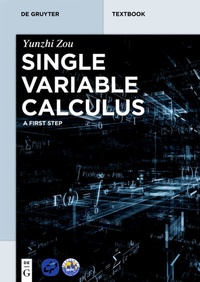
Single Variable Calculus
Description

The book is a comprehensive yet compressed entry-level introduction on single variable calculus, focusing on the concepts and applications of limits, continuity, derivative, defi nite integral, series, sequences and approximations. Chapters are arranged to outline the essence of each topic and to address learning diffi culties, making it suitable for students and lecturers in mathematics, physics and engineering.
Contents
Prerequisites for calculus
Limits and continuity
The derivative
Applications of the derivative
The definite integral
Techniques for integration and improper integrals
Applications of the definite integral
Infinite series, sequences, and approximations
Reviews / Votes
"This is an efficiently compressed entry-level calculus introduction. [...] This is a concisely delivered introduction for engineering students and those on other applied tracks that could support two semesters of study."
Tom Schulte in: MAA (18.09.2018),
https://www.maa.org/press/maa-reviews/single-variable-calculus-a-first-step
More details
Other editions
Additional editions
Persons
Content
1.1 Overview of Calculus
1.2 Sets and Numbers
1.3 Functions
1.4 Exercises
Chapter 2 Limits and Continuity
2.1 Rates of Change and Derivatives
2.2 Limits of a Function
2.3 Limits of Sequences
2.4 Squeeze Theorem and Cauchy's Theorem
2.5 Infinitesimal Functions and Asymptotic Functions
2.6 Continuous and Discontinuous Functions
2.7 Some Proofs in Chapter 2
2.8 Exercises
Chapter 3 The Derivative
3.1 Derivative of a Function at a Point
3.2 Derivative as a Function
3.3 Derivative Laws
3.4 Derivative of an Inverse Function
3.5 Differentiating a Composite Function - The Chain Rule
3.6 Derivatives of Higher Orders
3.7 Implicit Differentiation
3.8 Functions Defined by Parametric and Polar Equations
3.9 Related Rates of Change
3.10 The Tangent Line Approximation and the Differential
3.11 Derivative Rules-Summar
3.12 Exercises
Chapter 4 Applications of the Derivative
4.1 Extreme Values and The Candidate Theorem
4.2 The Mean Value Theorem
4.3 Monotonic Functions and The First Derivative Test
4.4 Extended Mean Value Theorem and the L'opital's Rules
4.5 Taylor's Theorem
4.6 Concave Functions and The Second Derivative Test
4.7 Extreme Values of Functions Revisited
4.8 Curve Sketching
4.9 Solving Equations Numerically
4.10 Curvatures and the Differential of the Arc Length
Chapter 5 The Definite Integral
5.1 Definite Integrals and Properties
5.2 The Fundamental Theorem of Calculus
5.3 Numerical lntegration
5.4 Exercises
Chapter 6 Techniques for Integration and Improper Integrals
6.1 Indefinite Integrals
6.2 Substitution in Definite Integrals
6.3 Integration by Parts in Definite Integrals
6.4 lmproper Integrals
6.5 Exercises
Chapter 7 Applications of the Definite Integral
7.1 Areas Volumes and Arc Lengths
7.2 Applications in Other Disciplines
7.3 Exercises
Chapter 8 Infinite Series, Sequences, and Approximations
8.1 Infinite Sequences
8.2 Infinite Series
8.3 Tests for Convergence
8.4 Power Series and Taylor Series
8.5 Fourier Series
8.6 Exercises
