

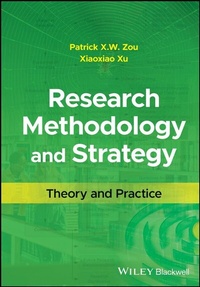
Research Methodology and Strategy
Description

Provides comprehensive coverage of the entire research process, methodologies, strategies and their applications, ideal for final-year undergraduate, Masters and PhD students, academics, researchers and professionals.
Research Methodology and Strategy: Theory and Practice is designed to help readers understand the research process and equip them with the skills required to successfully execute their projects. In-depth chapters describe the general research processes, different research paradigms and their applications and criticism, and more. Written by authors with decades of research experience, this authoritative textbook addresses the skills needed by all active researchers, including mixed method research design and development, data- and technology-driven research methodologies, writing and publishing research outcomes, strengthening research-practice nexus and strategies for improving research impact and citations.
* Provides a solid understanding of interdisciplinary research and analytical methods
* Offers clear guidance on the application of data-driven and technology-enabled research methods
* Covers qualitative, quantitative and mixed methods research methodologies
* Discusses different case study research methods and practices
* Describes methods drawn from business, management, economics, and social sciences research
* Provides strategies for thesis and journal article writing and publishing
* Provides theoretical frameworks and examples for research-practice nexus and improving research impacts
Research Methodology and Strategy: Theory and Practice is an invaluable textbook for senior undergraduate, masters, and PhD research students, academic and scientific researchers, and industry professionals who perform research in the course of their work.
More details
Other editions
Additional editions
Persons
Patrick X.W. Zou is Chang'an Scholar Distinguished Professor at Chang'an University, Xi'an, China. He obtained his PhD from the University of New South Wales (UNSW), Australia, and taught and conducted research at several Universities in Australia for more than 20 years. He has also held visiting appointments at several universities. His research, teaching and consultancy is focused on research methodologies, safety management, risk management and energy saving of critical infrastructure engineering. He has won more than 10 awards for excellence in research, teaching and service.
Xiaoxiao Xu is an Associate Professor in the School of Civil Engineering at Nanjing Forestry University, Nanjing, China. His research interests include complex system modeling and simulation, building energy, and risk management.
Content
Foreword by Andrew Dainty vii
Foreword by Chimay J. Anumba ix
Foreword by Lieyun Ding xi
Foreword by Dongping Fang xiii
Acknowledgements xv
1 Fundamentals of Research 1
2 Qualitative Research 19
3 Quantitative Research 37
4 Mixed Methods Research 85
5 Case Study Research 97
6 Technology-Enabled Experimental Research 117
7 Data-Driven Research 129
8 The Fifth Research Paradigm: Hybrid Natural-Social Sciences Methods Research 151
9 Journal Article Writing and Publishing 161
10 Thesis Writing 187
11 Research-Practice Nexus and Knowledge Coproduction 199
12 Managing the Researching-Writing-Publishing Journey 211
13 Improving Impact and Citation of Research Outcomes 225
14 Concluding Remarks and the Ways Forward 235
Index 237
1
Fundamentals of Research
1.1 Introduction
The advancement of human society is dependent on creating and applying new theory and new knowledge. This is achieved through research, which in turn requires the application of methodology and strategy.
Research is defined as the detailed study of a subject, especially in order to discover information or reach an understanding (Cambridge Dictionary), or an endeavour to discover new or collate old facts by the scientific study of a subject or by a course of critical investigation (The Oxford Encyclopaedic English Dictionary). It is a systematic process of collecting, analysing, and interpreting data to increase understanding of a phenomenon. Specifically, it is the systematic, controlled, empirical, and critical investigation of hypothetical propositions about presumed relations among natural or social phenomena. Research is a combination of experience and reasoning and is regarded as an approach to the discovery of truth, where experience leads to knowledge and understanding through day-to-day living and reasoning is a method of coming to a conclusion by the use of logical argument.
The main objectives of engaging in research are to develop new theory or support existing theory, and to create new knowledge. Theory is a statement about a phenomenon or a set of statements describing the interrelationships of the elements within a phenomenon, while knowledge is the understanding of or information about a subject that researchers get by experience or study.
Quality research can bring a range of social, cultural, and economic benefits locally and globally, leading to social development and productivity and economic improvement. At an individual personal level, successfully undertaking research could be a major development and achievement. It is an opportunity to master different research methods and methodologies, develop decision-making and problem-solving capabilities, and develop personal attitude, skills, and knowledge (ASK), which leads to a more professional approach and career opportunities.
This chapter introduces the characteristics and cornerstones of research, philosophical assumptions, general research process, different research paradigms and methods, theory development methods, research ethics, and an overview of the book's contents and its unique features.
1.2 Characteristics of Research and the General Research Process
Research should have the following characteristics, as stated by Leedy and Ormrod (2013):
- Originates with a research question or a problem; in other words, it is guided by a specific research problem, question, or hypothesis.
- Divides the principal problem into more manageable subproblems.
- Requires clear articulation of a research goal (i.e., the aim of the research).
- Rests on certain critical theories.
- Requires a specific plan to proceed.
- Requires collection, analysis, and interpretation of data in an attempt to resolve the problem that initiated the research.
- Is cyclical; there is no obvious end point because research encourages follow-up studies.
The term 'research' implies several elements: (i) the methodology, which includes the basic and critical theories, hypothesis, principles, and the logic of the research being undertaken; (ii) the research process and operational procedure; and (iii) detailed operational technique and tools for collecting and analysing data. The general research processes and steps are visualized in Figure 1.1. This diagram outlines a cyclical process of research, informed by literature and theories. With the problem being addressed through research, there is room for new research thinking to arise.
Figure 1.1 General research process.
1.3 Cornerstones of Research
For research to be convincing and understandable to readers, it must follow certain research rules. In general, successful research has clearly defined and discussed elements.
-
Concept
A research concept is a set of meanings or characteristics associated with specific events, objects, conditions, situations, and behaviours in general, such as building energy consumption, organizational behaviour, corporate culture, and stakeholders. The success of research arguably depends first and foremost on the clarity of the concept and how others understand the concepts used. In some cases, the researcher may come up with a new concept, but this requires the researcher to define the concept clearly so that the reader understands the concept, and to maintain the strength and validity of the study.
-
Theory
The Cambridge Dictionary defines theory is a formal statement of the rules on which a subject of study is based or of ideas that are suggested to explain a fact or event or, more generally, an opinion or explanation; this definition applies directly to research theory.
-
Model
A research model is a formal representation of a practical problem or an object or law after abstraction. The difference between a model and a theory is that the role of a theory is to explain, whereas the role of a model is to demonstrate. A model is an important means of testing a theory.
-
Construct
A research construct is an idea invented specifically for the purpose of a particular research or theory construction.
-
Variable
In research, the variable is a specific value used to measure concepts or constructs.
-
Proposition
A research proposition is a statement of concepts (variables) and relations between concepts (variables), used at the beginning of research design.
-
Hypothesis
Hypothesis is a statement that attempts to explain phenomena or facts but has not yet been proven. Chapter 3, Section 3.1.1 expands upon this.
Apart from the above-mentioned cornerstones and elements, there are also other cornerstones of research, as shown in Figure 1.2. These elements and cornerstones are located in one of the three different phases of a research: conceptualization, operationalization, and measurement. Figure 1.2 also shows relevant components and methods which may be required to implement the research.
Figure 1.2 Relationships among cornerstones of research.
1.4 Philosophical Understanding of Research Methodology
It is important for researchers to clearly explain the philosophical assumptions that provide a foundation for the chosen research topic or problem before selecting a research methodology (Creswell and Clark 2017; Zou et al. 2014). Researchers' worldview (also known as paradigm) is the core of philosophical assumption. Thus, researchers need to be aware of the implicit worldviews they bring to their research (Creswell and Clark 2017). Worldviews directly affect assumptions the researcher makes about reality and the way to obtain knowledge (Creswell and Clark 2017).
There are four main types of worldviews applicable in research: positivism, postpositivism, constructivism, and pragmatism. Positivism believes that knowledge is based on natural phenomena, which is unbiased and cannot be affected by researchers' subjective view (Macionis and Gerber 1999). Positivism is associated with quantitative methods. As an amendment to positivism, postpositivism states that the subjective view of the researcher can influence what is observed (Seaman 1995). To pursue objectivity, postpositivists use checks to recognize the possible effects of biases and eliminate them. Similar to positivism, postpositivism is also associated with quantitative methods. Contrary to positivism and postpositivism, constructivism is a worldview that is made up of the understanding and meaning of phenomena formed through the person being researched and their subjective view. It is believed that researchers and persons being researched are dependent on each other. Creswell and Clark (2017) pointed out that, in constructivism, researchers start with views of the persons being researched and build 'up' to patterns, theories, and generalizations. Constructivism is associated with qualitative methods. Due to the opposition of the worldview, there is a protracted debate between positivism (and postpositivism) and constructivism, which in turn has evolved into a conflict between qualitative and quantitative research methodologies. Under this background, pragmatism was born. Pragmatism is problem-oriented, believing that any method that can solve the research problem is a good method. With the support of pragmatism, mixed methods approaches have been developing rapidly in recent years.
To help readers gain an in-depth understanding of worldviews, five main philosophical considerations in research are discussed (Creswell and Clark 2017; Tashakkori and Teddlie 1998) below.
- Ontology studies the nature of reality; researchers with different philosophical assumptions could have different views on the nature of reality. For example, positivism believes singular reality while constructivism believes multiple realities.
- Epistemology explores the nature of knowledge, justification, and the relationship between cognition and reality.
- Axiology examines whether researchers include biased perspective or not.
- Logical inference focuses on the way to acquire knowledge, including induction and deduction.
- Rhetoric concentrates on the language of research. For...
