

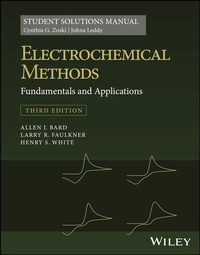
Electrochemical Methods: Fundamentals and Applications, 3e Student Solutions Manual
Description

Provides students with solutions to problems in the 3rd edition of the classic textbook Electrochemical Methods: Fundamentals and Applications
Electrochemical Methods is a popular textbook on electrochemistry that takes the reader from the most basic chemical and physical principles, through fundamentals of thermodynamics, kinetics, and mass transfer, all the way to a thorough treatment of all important experimental methods. Holistically, it offers comprehensive coverage of all important topics in the field. To aid in reader comprehension, exercises are included at the end of each chapter which extend concepts introduced in the text or show how experimental data are reduced to fundamental results. This book provides worked solutions for many of the end-of-chapter exercises and is a key resource for any student who makes use of the original textbook.
More details
Other editions
Additional editions
Persons
Cynthia G. Zoski, Research Professor of Chemistry and Associate Director of the Center for Electrochemistry, The University of Texas at Austin, USA, is co-author of the solutions manual for the 2nd and 3rd editions of Electrochemical Methods. Her current research focuses on electrochemistry at the micro- and nanoscale in order to understand practical chemical, physical, materials, and biologically-related problems.
Johna Leddy, Associate Professor, The University of Iowa, USA is co-author of the solutions manual for the 2nd edition of Electrochemical Methods. Her electrochemical research interests range from fundamentals through measurements to build of electrochemical energy systems. Of special focus are classical modeling methods, modified electrodes, and magnetic effects on electron transfer.
Content
Preface vii
1. Overview of Electrode Processes 1
2. Potentials and Thermodynamics of Cells 13
3. Basic Kinetics of Electrode Reactions 23
4. Mass Transfer by Migration and Diffusion 33
5. Steady-state Voltammetry at Ultramicroelectrodes 37
6. Transient Methods Based on Potential Steps 41
7. Linear Sweep and Cyclic Voltammetry 61
8. Polarography, Pulse Voltammetry, and Square-wave Voltammetry 73
9. Controlled-current Techniques 77
10. Methods Involving Forced Convection - Hydrodynamic Methods 83
11. Electrochemical Impedance Spectroscopy and Ac Voltammetry 89
12. Bulk Electrolysis 101
13. Electrode Reactions with Coupled Homogeneous Chemical Reactions 117
14. Double-layer Structure and Adsorption 125
15. Inner-sphere Electrode Reactions and Electrocatalysis 137
16. Electrochemical Instrumentation 143
17. Electroactive Layers and Modified Electrodes 151
18. Scanning Electrochemical Microscopy 157
19. Single-particle Electrochemistry 161
20. Photoelectrochemistry and Electrogenerated Chemiluminescence 171
A. Mathematical Methods 175
B. Basic Concepts of Simulations 189
