

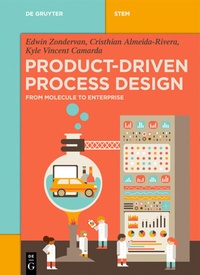
Product-Driven Process Design
Description

Product-driven process design - from molecule to enterprise provides process engineers and process engineering students with access to a modern and stimulating methodology to process and product design.
Throughout the book the links between product design and process design become evident while the reader is guided step-by-step through the different stages of the intertwining product and process design activities. Both molecular and enterprise-wide considerations in design are introduced and addressed in detail. Several examples and case studies in emerging areas such as bio- and food-systems, pharmaceuticals and energy are discussed and presented. This book is an excellent guide and companion for undergraduate, graduate students as well as professional practitioners.
More details
Other editions
Additional editions
Persons
Professor Edwin Zondervan obtained his Ph.D. in Chemical Engineering in 2007 from Twente University and University of Groningen (Netherlands). Afterwards he was visiting researcher at the Technical University in Lyngby (Denmark) and at the Imperial College in London (UK). Between 2007 and 2015 he was working as assistant professor at the Eindhoven University of Technology in the Netherlands. Currently, he holds a professorship at the University of Bremen (Germany) for Process Systems Engineering. Besides research (he published over 100 articles, chapters and patents) Edwin Zondervan has been very active in the educational gremials where he trained many generations of students in process design, process control and numerical methods. For the latter one Edwin published a textbook that was released in 2014: "A numerical primer for the chemical engineer".
Dr. Cristhian Almeida-Rivera obtained his Ph.D. in Chemical Engineering in 2005 from Delft University of (Netherlands). Afterwards he was working as Research Manager and Global Supply Chain Manager for 7 years at Unilever in the Netherlands. Currently, he is working as Team leader for chemical process technology at the Organisation for the Prohibition of Chemical Weapons (OPCW) in the The Hague area (Netherlands). Cristhian Almeida-Rivera published over 35 articles and chapters.
Professor Kyle Vincent Camarda obtained his Ph.D. in Chemical Engineering in 1997 from University of Illinois at Urbana-Champaign (USA). Currently, he is active as Associate Professor at the University of Kansas (USA). He published over 55 chapters and articles on Chemical Process and Product Design as well Process Systems Engineering.
Content
- Intro
- Foreword
- Contents
- Part I: Process Design
- 1. Introduction
- 2. Performance products in a challenging environment
- 3. A structured approach for product-driven process design of consumer products
- 4. Formulation of design problems and identification of consumer wants
- 5. Product function and generation of ideas
- 6. Network of tasks, mechanisms and operational window
- 7. Equipment selection and design
- 8. Multi-product and multi-product-equipment integration
- 9. Molecular product design
- Part II: Process Design Principles
- 10. Process synthesis
- 11. Process simulation
- 12. Reactor design
- 13. Batch process design
- 14. Separation train design
- 15. Plant-wide control
- 16. Heat integration
- 17. Process economics and safety
- 18. Design for sustainability
- 19. Optimization
- 20. Enterprise-wide optimization
- A Appendix
- Index
