

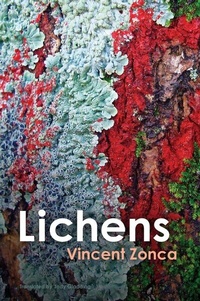
Lichens
Description

The result of several years of investigation carried out on several different continents, this remarkable book offers an original, radical, and, like its subject matter, symbiotic reflection on this common but mostly invisible form of life, blending cultures and disciplines, drawing on biology, ecology, philosophy, literature, poetry, even graphic art. What if lichens were at the heart of some of the most pressing and topical questions of our day? Does the fact that they can live everywhere, even in very harsh environments, that they persist when almost all other traces of life have disappeared, mean that, despite their fragility, lichens are a force of resistance?
After reading this book you will never see lichens, or the world, in the same way again.
More details
Other editions
Additional editions
Persons
Content
Acknowledgments xiii
Preface by Emanuele Coccia xiv
Part 1
First Contacts 1
Origins 1
Winters 2
Weeds 3
A Scientific Challenge: Remaining or Rising in the Ranks 12
Customs and Beliefs 22
Lichen Erotics 34
Part 2
To Describe, Name, Represent 45
A Challenge to Representation 45
Music = Mushroom 72
The Far East, Mosses, and Wabi-Sabi 77
Part 3
Ecopoetics: Life Force and Resistance 91
Ruderal 91
Rousseauist Walks 92
Sentinel Species 108
"Lichens of sunlight and mucus of azure" 112
"Sbarbarian" Glowworm 116
Ecological Forewarnings 124
Fragility, Resistance 132
Contemporary "Poethics" 134
"Insurrection of the Humble" 156
Micro-habitats 166
Part 4
Toward a Symbiotic Way of Thought 173
The Politics of Lichen: at the Origins of Symbiosis 175
Chimeras, Vampires, and Other Common Monsters 192
A "Third Place" 197
Cohabitation 210
Envoi: Sporules 215
Notes 220
Index of Names 255
Index of Lichens 260
Part 2
TO DESCRIBE, NAME, REPRESENT
"As their structures and colors are so different from those of most terrestrial plants, I often see them as windows onto another way of viewing the world."
Oscar Furbacken1
A Challenge to Representation
Colors and Forms
At present, about twenty thousand species of lichens have been inventoried, which corresponds to twenty percent of the known fungi species.
One could say that it constitutes, in whole or in part, the most disparate of substances: starch and flour; wool and murex; gold, sulfur and sealing wax; sponge, cork, and anthracite, parchment and gutta-percha.
Camillo Sbarbaro2
A challenge to classification, but also a challenge to representation. Frizzy, curly, frayed, leafy, or bearded; tuberous or warty, leprous or elephant-skinned, lace or cup; granular crust, almost invisible patch on bark or stone, creepers falling from branches, small projections or mini-escutcheons, coral, tentacles, antennae, tubes or scales, powder or ash: lichen is polymorphous, it a laboratory of forms. What jumps out even more as soon as you look through a magnifying glass: the crevices and valleys of the thallus, the turrets of the apothecia and sharp teeth of the rhizines hidden under the thallus. It is in itself a landscape, an invitation for metaphor and verbal creativity, but also an invitation to touch.
The names (the Latin ones especially) and descriptions by botanists, often poetic and magnificent, are the mark and scar of this; they clearly demonstrate the challenge presented to language. To identify lichens, scientists have shown remarkable sensitivity and poetic inventiveness by approaching them through metaphors and, quite readily, through personification in terms of the human body (skin, hair). Thus there exists a "decayed molar" lichen (Pertusaria pertusa, whose apothecia resemble bad teeth or tiny skulls), and well or badly "combed" species (Cladonia arbuscula or Cladonia portentosa). Scientific works are packed with particularly elaborate images:
LICHEN of Greece (exotic botanical), species of lichen used for red dyes. [.] It grows in grayish bunches, two or three inches long, divided into small sprigs almost as fine as hair, and grouped into two or three small horns, released at birth rounded and stiff, but subsequently almost as thick as a line, bent into a sickle, and sometimes terminating in two points. These small horns are lined lengthwise with a row of cups whiter than the rest, a half-line in diameter, held up by small warts, similar to the cups of sea polyps; the whole plant is solid, white, and salty tasting.3
Lichen carpineus [Lecanora carpinea] . [.] Laden with rough patches similar to those on a hand toughened by work.
Lichen miniatus [Lecanora miniata]. Foliose, hunchbacked, punctuated, tawny underneath. On the Alps. It forms leaves singly or in threes, hard, ashen, raised and concave, in the form of a saucer or irregular seashell, punctuated above, a bit yellowish or reddish underneath.
Lichen jubatus [Usnea jubata]. Filamentous, hanging; axils compressed. In forests and on rocks in Europe. Blackish beard hanging from trees, like the tail of a horse, which has earned it the name of jubatus which expresses this characteristic.4
Persoon Opegrapha. Off-white, slightly smooth, uneven crust; deep-set conceptacles, initially oblong, with furrowed disc, then rough, flexuous, creased, deformed, nearly contiguous, with irregular, half-open disc. Acharius describes two varieties of it: one of them, aporea, with a leprous, pulverulent crust, and twisting conceptacles opening irregularly.5
Scientists have identified four main appearances, according to the form of the thallus. Generally, these are: the gelatinous lichens, with the filaments of the fungus branching into the gelatinous mass of the algae, which is the only case where the algae gives the lichen its exterior form; the powdery or leprous lichens, which appear in the form of a powder and have no superior surface; the crustose lichens, in which the green cells of the algae are confined within the compact tissue of the fungus, the lichen spreading out into a crust inseparable from the substrate which serves as inferior surface; the foliose lichens, which form strips with wavy edges, like tiny lettuce leaves, that detach slightly from the substrate even while adhering strongly to it; and the fruticose lichens, which resemble a miniature shrub or bush - fruticulus - that is only attached by its base to the substrate, and thus easily detachable. In all these cases, only one of the two partners is immediately visible to the naked eye; the other is invisible, hidden within the tissue.
Lichen is not just a flat, horizontal form; it has a third dimension. Its reproductive organs - sexual, the apothecium (in the form of small cups originating from the spores), or asexual, the icidium (excrescence whose name means "coral" in Greek) - constitute a whole repertoire of erect forms rising, in proportion to their size, toward the sky. Thus the Cladonia have a complex thallus (see Ill. 16): a primary crustose thallus on which grows a kind of foot, point, horn, or tentacle (the podetium) surmounted by an apotheceum, sometimes of a different color.
This organism gives its name to a color: lichen green, a green tending toward pale and gray, which is no doubt one of its most common and certainly one of its most remarkable colors. At the end of the nineteenth century, this color appeared on color charts and was part of the nomenclature fashionable at the time, along with "moss green," "frog green," "lizard green," "juniper green," "Alpen glacier green," "angelic green," "peacock green, "acanthus green," "fucus green," and even "caterpillar green." According to old botanical manuals, lichen was "rarely a beautiful green," but in the 2010s, this "lichen green" became a color of choice for interior decoration, ubiquitous on the walls of our apartments, in stores and restaurants. Here are its color codes:
Figure 7a (crustose; foliose; fruticose)
Figure 7b Fruticose (Usnea florida) and Complex (Cladonia)]
RGB 17, 150, 113
HSL 163, 80, 33
HSB 163, 89, 59
CMYK 89, 0, 25, 41
There is an intense polychromy to lichen. Contrary to what we may think, there is not only this greenish or grayish green color, coming from the algae and their chloroplasts, this dull tone so popular today. Lichen also has its flashy or "pop" side. Such shades explode on the palette, intensified by moisture; like tattoo art engraved outside, there are so many individual flourishes, cut jewels, decorating the fingers of trees and the skin of rocks. There are also grays, blues, purples (because of cyanobacteria), "orange and sulfur colors" wrote novelist Joris-Karl Huysmans, to evoke, of course, the shades of the famous Xanthoria parietina found in our cities (see Ill. 6), candle or egg yellow as indicated by the name Candelariella vitellina (from the Latin candela, "candle," evoking the color of the wax formerly used), due to the substance it secretes as protection from the sun. Lichen is a complex play of colors, as mycologist Richard Bernaer (born in 1948) describes in his poetic botanical blog:
The Caloplaca: beautiful plates, beautiful wide, flat surfaces, are often pure marvels of warm tones over warm tones, like our Caloplaca aurantia [.], a mosaic of saturated brown-orange lecanorine apothecia, a yellow thalline rim, over the vitelline yellow-orange of the thallus.6
I'm thinking as well of the magnificent blood reds of the Herpothallon rubrocintum that have accompanied me throughout my time in Brazil, the "Christmas lichen": bright red patches, as though left by bullets - or stars, or dusk - that seem to flow from these wounds as they grow vertically on tree trunks in the luxuriance of the tropics (see Ill. 2). And when the weather turns wet, the colors intensify and come to life, saturating the landscape.
Lichen creates striking compositions according to the colors of the bark and stones it grows on, or the moss it very often lives with. On trees, it can make us think of leprous and aging skin or, alternatively, bring the bark to life with vibrant colors. Videographer Claire Second (born in 1989), who has made a documentary on lichens in Ardèche (L'Algue et le Champignon, 2016), described to me her excitement over their explosive colors on the deep black of basal rocks. Barry Lopez observed the same thing in the Far North:
At first it seems that, except for a brief two weeks in autumn, the Arctic is without color. Its land colors are the color of deserts, the ochers and siennas of stratified soils, the gray-greens of sparse plant life on bare soil. On closer inspection, however, the monotonic rock of the polar desert is seen to harbor the myriad greens, reds, yellow, and oranges of lichens. [.] Occasionally there is brilliant coloring - as with wildflowers in summer, or a hillside of...
