

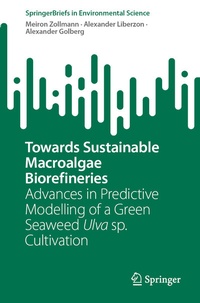
Towards Sustainable Macroalgae Biorefineries
Description

Marine biorefineries of macroalgal (seaweed) feedstock are sustainable sources of food, materials, and energy, and can alleviate the growing pressure on land and freshwater resources. Development of an environmentally friendly seaweed biorefinery at an industrial scale requires a better understanding of the seaweeds' life cycle and improving the inefficiency of on- and offshore cultivation technologies and downstream processing. This study addresses the challenges of developing a reliable, efficient, and continuous macroalgae feedstock supply through an enhanced understanding of the cultivation dynamics of the green macroalgae Ulva .
We identified and focused on six knowledge gaps in the macroalgae cultivation process: (i) insufficient knowledge regarding the combined effect of nutrient concentrations and relative water-thallus velocity on growth rates of Ulva sp.; (ii) lack of exergy analysis of macroalgae cultivation systems; (iii) poor information regarding the potential growth rates of macroalgae in the Eastern Mediterranean Sea (EMS) deep seawater (DSW) nutrient concentrations; (iv) a lack of high-resolution (time scale of hours-to-days) macroalgae growth and nutrient models describing the dynamics of ambient N concentrations, internal N content, and growth rate; (v) poor knowledge about nutrient and growth dynamics of Ulva sp. when cultivated in naturally varying environmental conditions offshore the EMS; and (vi) a lack of multi-scale nutrient removal and macroalgae growth dynamics model relating to temporal and spatial variations.
We attempt to fill these gaps by measuring growth rates and chemical compositions of Ulva sp. macroalgae in cultivation experiments in different systems and under different conditions and by developing models that progress from an energy balance model, through a basic growth model, to a more advanced physiological model, all based on experimental results. Altogether, we create a methodology and a framework for future precision seaweed farming.
More details
Other editions
Additional editions
Content
1.Global need for alternative biomass sources.- 2.Macroalgae.- 3.Offshore cultivation.- 4.Artificial upwelling.- 5.Bioenergy-oriented macroalgae cultivation.- 6.Precision agriculture.- 7.Multi-scale models for sustainable marine development.- 8.Analytical and experimental methodology.- 9.Ulva sp. growth rates and chemical composition in different cultivation systems.- 10.Exergy model and analysis of outdoor macroalgae photobioreactors system.
